By Rodger Morrow, Editor & Publisher, Beaver County Business
Listen to a podcast discussion about this article.
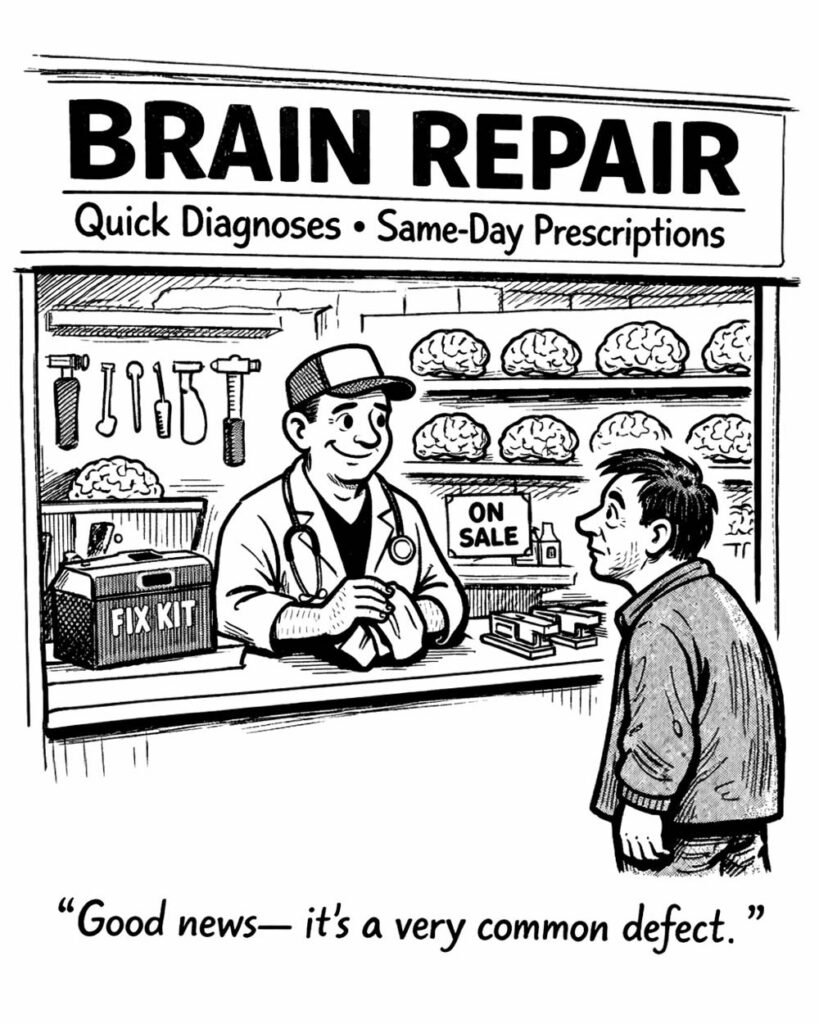
If you are feeling depressed in Beaver County, the modern health-care system has a plan for you. It involves a clipboard, a checklist, a brisk nod of professional concern, and a prescription written before the ink on your name has fully dried. You will be told you have a disorder. Possibly several. You will be reassured this is very common. And you will leave with the quiet suspicion that you have just been upgraded from “having a bad year” to “owning a permanently defective brain.”
This is where I suggest you pause—politely, respectfully, and with your wallet still in your pocket—and watch a video by Dr. Josef Witt-Doerring, a board-certified psychiatrist who has done something unusual in American medicine: he has decided to explain, in plain English, why the system he works in often makes people worse.
Dr. Josef’s central heresy is this: most doctors no longer ask why someone is unhappy. They ask how many boxes they can check in under fifteen minutes. Sad? Tired? Anxious? Trouble sleeping? Congratulations—you qualify. No blood work required. No imaging. No curiosity. Just a diagnosis that carries the subtle implication that your brain is broken and will remain so unless properly medicated.
This “broken brain” narrative is comforting in the way a parking ticket is comforting. It gives everything a name, assigns blame to chemistry, and absolves everyone—patient, doctor, employer, culture—from further investigation. According to Dr. Josef, it is also often nonsense.
The reason this persists has less to do with science than with billing codes. Insurance companies do not reward long conversations, careful histories, or detective work. They reward speed. Fifteen minutes pays better than ninety. A prescription pays better than a discussion about diet, sleep, relationships, or the quiet despair that comes from spending forty years in a job you hate while eating things that were not technically food when you were a child.
And then there is the pharmaceutical industry, which hovers over the whole enterprise like a kindly uncle who insists on paying for dinner and then chooses the restaurant. Much of the research, many of the guidelines, and more than a few academic careers are built on the assumption that medication is the answer because medication is the product.
Dr. Josef is especially clear about the danger of using drugs to paper over symptoms. When you mute the alarm without addressing the fire—poor diet, toxic environments, unresolved trauma, broken routines—the underlying problem continues to smolder. Over time, tolerance develops. Dosages rise. Additional medications are added. Side effects appear, are misread as new illnesses, and suddenly you are no longer a person with a problem but a walking pharmacology experiment.
His alternative is neither mystical nor radical. It is merely unfashionable.
Start with root causes. Look at what you eat. Look hard. Industrial seed oils, refined carbohydrates, and ultra-processed food are not emotional support; they are biochemical chaos. Consider functional medicine—expensive, yes, and inconvenient, but thorough. Examine your work, your relationships, your history. If your marriage is miserable, see a therapist who deals with marriages. If your job is soul-crushing, talk to someone who understands work. Medication, Dr. Josef argues, should come last, not first—and when used, used cautiously and briefly.
None of this will surprise anyone who remembers a time when doctors still took histories, food came from places, and despair was understood as a signal rather than a diagnosis.
I am not offering medical advice. I am offering a recommendation. If you—or someone you love—are struggling, this video is worth your time. It will not flatter the system. It will not promise miracles. What it will do is restore a sense that you are not broken machinery, but a human being whose life might actually be examined before it is medicated.
In Beaver County, we pride ourselves on fixing things properly the first time. Watch the video. Ask better questions. And do not be in a rush to accept a story about yourself that was written for speed, profit, and convenience rather than truth.