Listen to a podcast discussion about this article.
There was a time in Beaver County when the phrase “tin mill restart” would have produced not a press release, but a traffic jam.
Men would have come down the hill from Aliquippa in their work boots, the lunch pails would have reappeared as if summoned by some industrial séance, and somebody’s uncle—who had been “laid off temporarily” since 1985—would have declared himself permanently unretired.
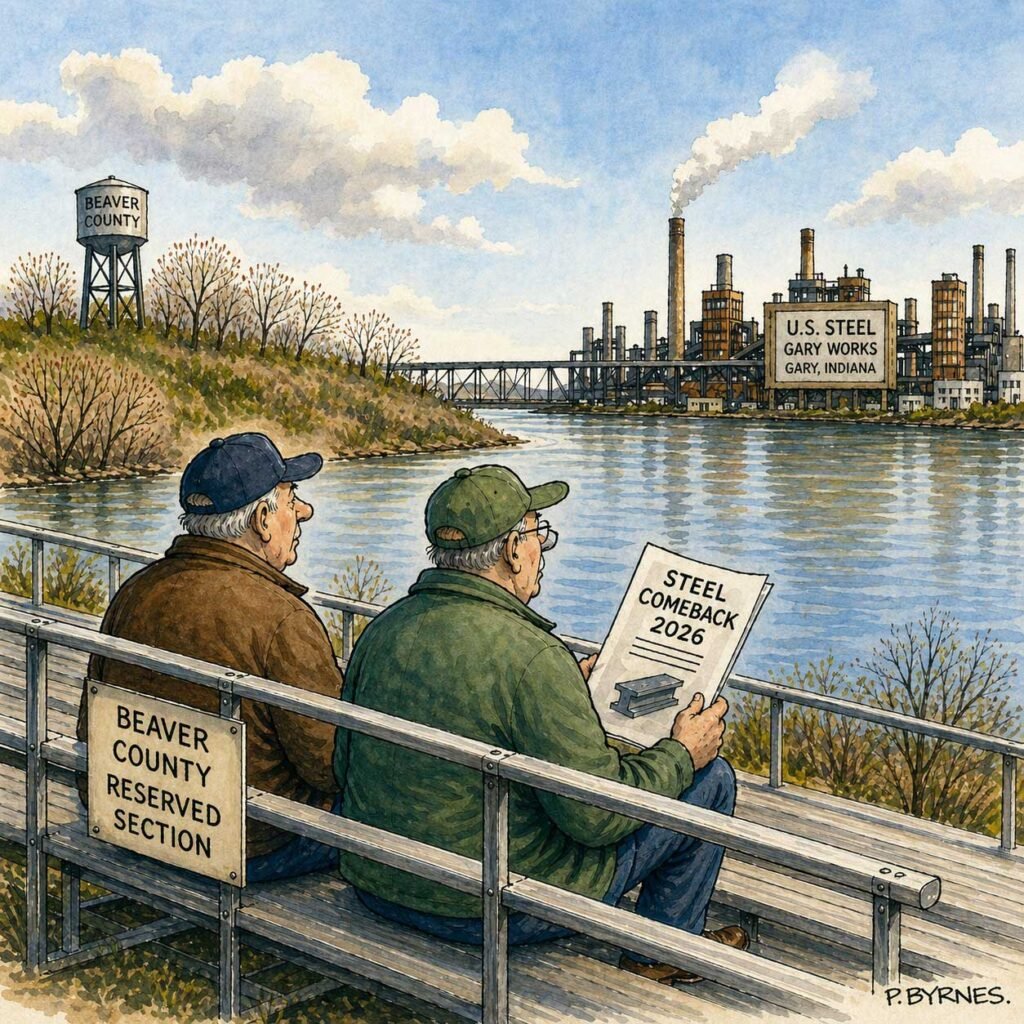
Instead, on April 16, 2026, when United States Steel Corporation announced it would restart its tin mill at Gary Works in Indiana, Beaver County responded in the modern fashion: by reading about it online and wondering, with admirable restraint, what exactly any of it had to do with us.
The short answer is: not much.
The longer answer, being more suitable to a county that once rolled steel as a matter of civic identity, requires a little unpacking—and perhaps a touch of nostalgia best handled with gloves.
U.S. Steel’s announcement, which has been received with understandable enthusiasm in northwest Indiana, calls for the restart of a tin-plating facility idled in 2022. The plan is to bring it back online in early 2027, at a cost of roughly $15 to $20 million, supporting about 225 jobs.
The products are the sort of things that rarely inspire poetry but quietly hold the modern world together: tin-plated steel for food and beverage cans, aerosol containers, oil filters, electronics, and various bits of industrial life that make civilization feel less like a temporary arrangement.
The company, now operating under the ownership of Nippon Steel since 2025 (with a U.S. government “golden share” ensuring national security oversight), has framed the move as part of a broader strategy: strengthen domestic supply chains, reduce reliance on imports, and remind the world that America can still make things that clang.
CEO David B. Burritt emphasized “mined, melted, and made in America,” which is the sort of phrase that plays well in congressional hearings and even better in places where people remember when it wasn’t a slogan but a daily routine.
All of which is encouraging—if you happen to live in Gary, Indiana.
Beaver County, for its part, occupies an awkward position in this story: emotionally invested, historically qualified, and geographically irrelevant.
We know tin mills here. We had one.
The last tin mill in Beaver County—at the old Jones & Laughlin/LTV complex in Aliquippa—kept going long after the blast furnaces went cold, a stubborn holdout that continued into the year 2000. When it finally shut down, taking roughly 400 jobs with it, it wasn’t just the end of a facility. It was the closing chapter of a local industry that had already been fading into memory for a generation.
Since then, the county has done what former steel towns do: it diversified, adapted, improvised, and occasionally reminisced.
But it did not, notably, reopen a tin mill.
To be fair, the Gary restart is not a one-off. It’s part of a much larger push.
Under the Nippon partnership, U.S. Steel has outlined roughly $14 billion in U.S. investments, with about $11 billion expected by 2028. There are upgrades planned at Mon Valley Works—facilities like Clairton, Edgar Thomson, and Irvin—that remain the beating heart of the company’s Pennsylvania operations.
This is, by any reasonable measure, a resurgence. Or at least the early stages of one.
It is also a resurgence with a map.
And that map, if you look closely, tends to circle places where steel never entirely left.
Beaver County is not one of those places.
Now, it is possible—economists are fond of this sort of possibility—that a stronger U.S. Steel could produce “ripple effects.”
The Clairton Coke Works, for instance, has historically supplied coke to Gary’s blast furnaces. If Gary ramps up production, perhaps Clairton produces a little more. If Clairton produces a little more, perhaps someone in the Pittsburgh metropolitan area sees a marginal benefit. And if that someone happens to live in Beaver County, then, by a chain of reasoning so delicate it ought to be handled with tweezers, we might feel something.
This is what passes, in modern economic development, for proximity to good news.
There are also the broader numbers to consider. U.S. Steel’s Pennsylvania footprint—billions in economic activity, thousands of jobs, hundreds of suppliers—creates a regional ecosystem in which Beaver County participates, if not prominently, then at least peripherally.
It’s not nothing.
It’s just not a reopening.
Along the Ohio River, where steel once defined the horizon, the story has taken a different turn.
Beaver County’s recent industrial revival has come not from molten metal but from molecules and machinery: Shell Polymers in Monaca, Tenaris in Koppel, and a rotating cast of advanced manufacturing projects that tend to involve fewer sparks and more software.
Even the site of the old Aliquippa works has been eyed for redevelopment, including newer steel-related ventures like 72 Steel—promising, ambitious, and still very much in the future tense.
In other words, Beaver County has not abandoned industry. It has simply changed its accent.
There is a temptation, whenever steel makes a comeback anywhere in America, to assume it might wander back home out of nostalgia.
Industries, like people, rarely return for sentimental reasons.
They go where the infrastructure is ready, the economics make sense, and the future looks more profitable than the past. Right now, for tin-plated steel, that place happens to be Indiana.
Could that change? Possibly. Economic conditions shift. Technologies evolve. Projects emerge.
But for the moment, the resurgence of American steel—real, measurable, and worth noting—remains something Beaver County can admire more easily than it can claim.
Which leaves us in a position that would have been unimaginable a few decades ago: watching the steel industry from the outside, like spectators at a game we once played.
There is no shame in that, exactly. The county has built a new economic identity from the remains of the old one, and done so with a certain resilience that deserves recognition.
Still, when a company announces the restart of a tin mill—any tin mill—there is an understandable impulse to glance toward the river and listen for a sound that no longer comes.
The mills, as it turns out, do not echo.
They relocate.
And for now, at least, they seem perfectly content to do so somewhere else.