By Rodger Morrow, Editor & Publisher, Beaver County Business
Listen to a podcast discussion about this article.
There are few spectacles more touching—or more Pittsburgh—than a roomful of newspapermen discovering, all at once, that they have managed to pick a fight with everyone. This week, the staff of the Pittsburgh Post-Gazette announced that they would very much like to make peace. With the Block family. With management. With reality. Possibly even with one another. They would also like, if at all possible, to keep their jobs past May 3, the date on which the paper’s owners have penciled in the obituary.
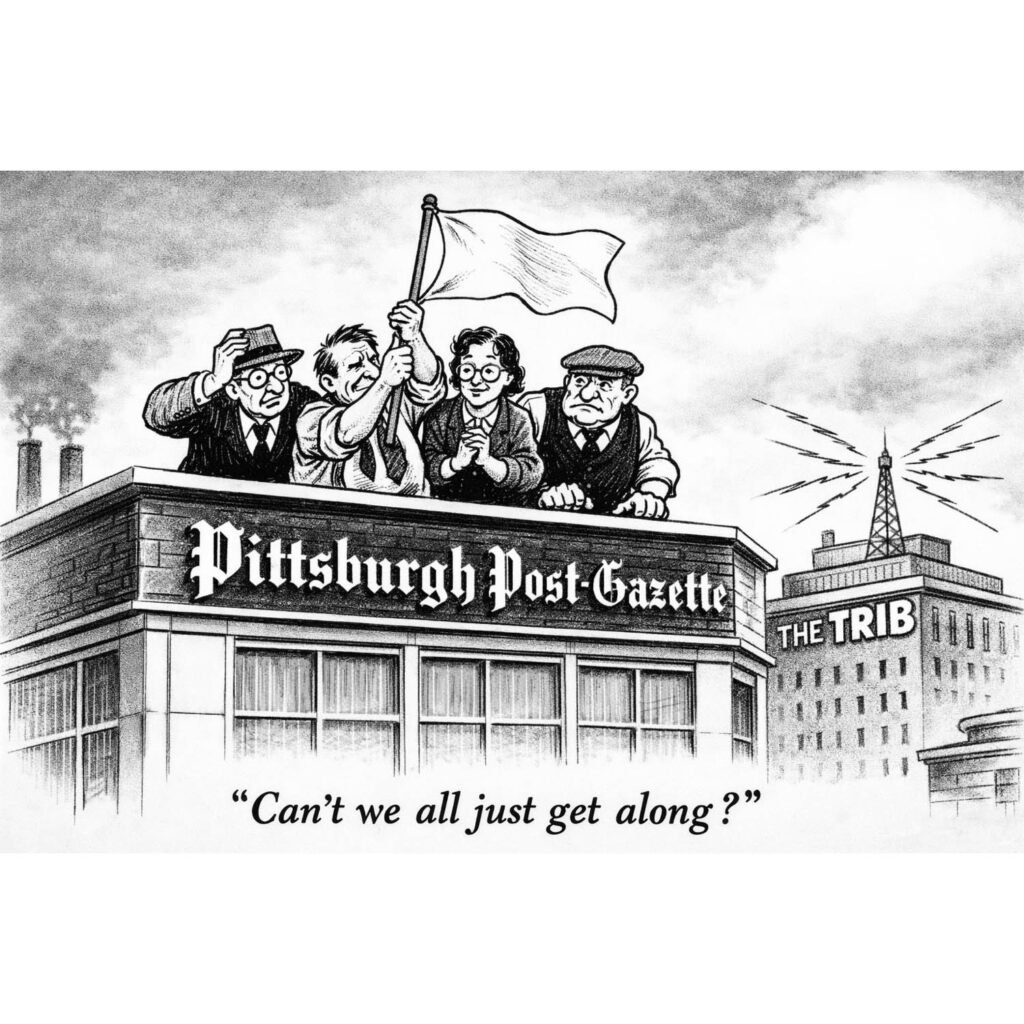
This is not, it should be said, the first time the staff has tried reconciliation. For three years they conducted a strike that was meant to bend management to their will. Instead, it bent time itself. By the end of it, a quarter of the bargaining unit had wandered back into the newsroom, blinking in the fluorescent light like survivors of a long polar expedition, while the rest either resigned from the union, crossed the picket line in protest, or arrived later as new hires who missed the war entirely and are now being asked to explain how it ended.
And now comes the really awkward part: the workers have concluded that their union—specifically the Newspaper Guild of Pittsburgh—has not exactly been reading the room.
In a statement that has the careful phrasing of a family intervention, “the majority of the bargaining unit” announced it wants new leadership. The union, they say, has misrepresented their views “for many years.” This is union-speak for we tried it your way, it didn’t work, and now the building is on fire.
The Guild, for its part, insists it has been working “hand-in-hand” with everyone, regardless of which side of the picket line they once occupied. This is the sort of phrase people use when they are trying to remind you that they are, in fact, still holding your hand.
Meanwhile, the clock keeps ticking.
On January 7, Block Communications announced that the 240-year-old Post-Gazette would cease publication on May 3. That date now hangs over every negotiation like a chalk outline.
The staff’s latest plea to the Block family is not especially radical: please give us time. Time to find a buyer. Time to restructure. Time to save your legacy. Time, in short, to do journalism’s favorite thing—another draft.
Enter the civic saviors.
Kevin Acklin, a shareholder at Stevens & Lee, has written to Allan Block expressing interest in converting the paper into a nonprofit, following a model that has become popular among endangered metropolitan dailies. He reports conversations with investors and business leaders who believe the Post-Gazette is a “civic asset,” which is the phrase you use when something no longer makes money but still looks good in a boardroom.
The letter speaks of negotiated transactions, restructurings, acquisitions, and “decades to come.” It is earnest, reasonable, and hopeful—three qualities that have been in short supply throughout this saga.
The employees, for their part, now promise a new tone. No more “character assassination.” No more public humiliation. A shared mission. Productive engagement. This is admirable, and also deeply ironic, since journalism has spent the last century perfecting the art of character assassination in the public interest.
Still, the sentiment is sincere. They want to save the institution. They want to serve the city. They want to preserve the Block family legacy—an offer that may land differently depending on how one feels about that legacy at the moment.
Lost in all of this is an uncomfortable possibility: that even if everyone makes peace, the war may already be over.
Because while the Post-Gazette has been locked in a three-year labor dispute followed by a five-month death watch, its cross-town rival has been quietly doing the one thing newspapers must do to survive—changing. Meanwhile The Pittsburgh Tribune-Review—which just announced a new Allegheny-County-wide print edition—has avoided strikes, avoided melodrama, and avoided the need for public letters begging for time.
History suggests that when everyone in a negotiation believes they are fighting for the soul of journalism, the eventual winner is usually the outfit that kept its head down and shipped product.
So here we are: a newsroom unhappy with management, unhappy with ownership, unhappy with its union, and racing a deadline set by the calendar rather than the courts. If a miracle occurs—if a nonprofit savior appears, if negotiations soften, if the May 3 date dissolves—the Post-Gazette may yet limp into a new chapter.
If not, Pittsburgh will still have journalism. Just not the kind that holds press conferences to announce it has decided, at last, to stop shouting at everyone in the room.