By Rodger Morrow, Editor & Publisher, Beaver County Business
Listen to a podcast discussion about this article.
For the last few years, we’ve been told—by people who speak in TED Talks and dress like venture capitalists—that the future belongs to artificial intelligence. And so the public, being obedient and easily dazzled, has rushed off to buy AI stocks the way earlier generations bought Beanie Babies, tulips, and pets.com.
But while the crowd argues about algorithms, the smart money is quietly rummaging around in the basement, looking for the breaker panel.
Because AI doesn’t run on code. It runs on electricity. And electricity runs on copper.
This is the part of the future no one puts on a slide deck.
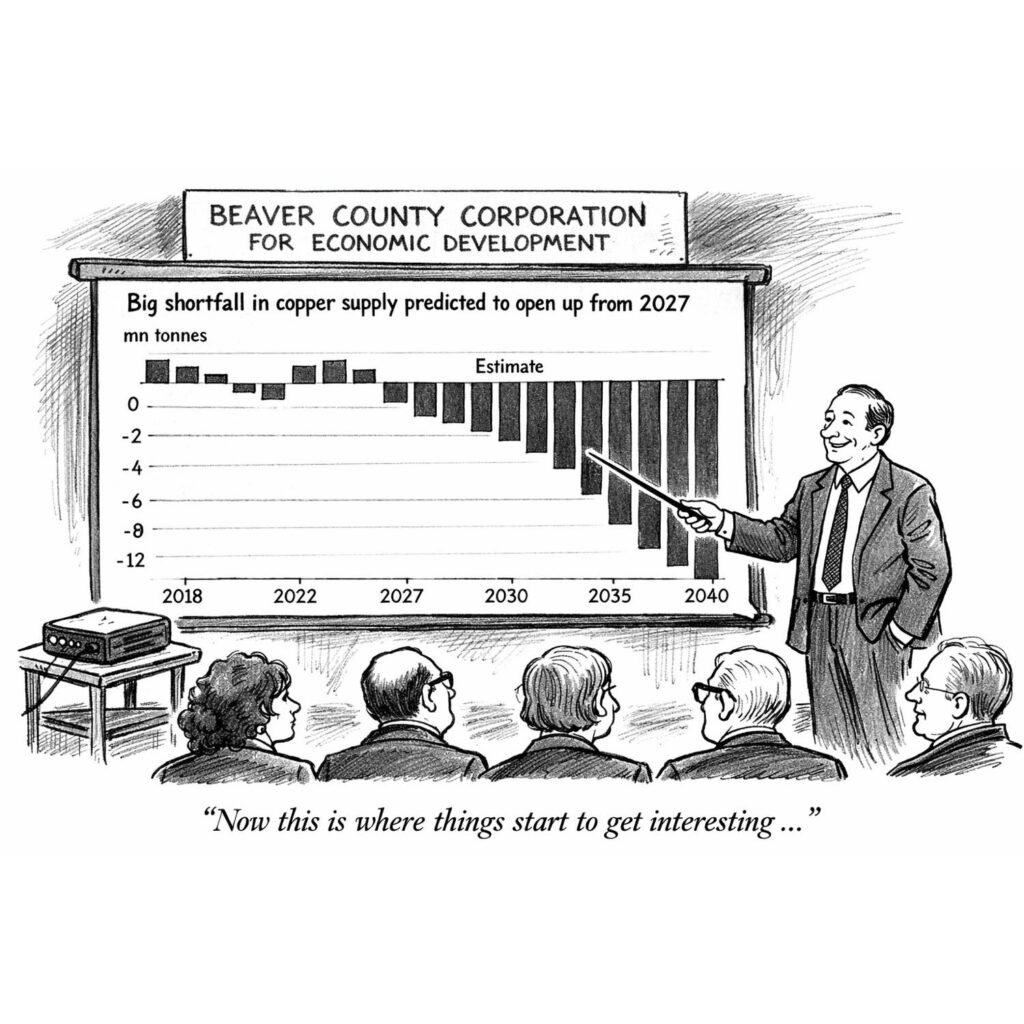
Between now and 2050, global demand for copper is expected to exceed everything humanity consumed from 1900 to 2021—one hundred and twenty-eight years’ worth of wiring, motors, transformers, and transmission lines, compressed into less than three decades. Production is expected to peak around 2030. After that, we’re supposed to do more with less, which is the sort of thinking that usually ends with candles.
Copper, inconveniently, does not respond to slogans.
Every AI data center—whether it belongs to Meta, Amazon, or the next startup promising to “redefine intelligence”—is a copper hog. So are electric vehicles, which use three to four times more copper than gas-powered cars. So are wind turbines, smart grids, and all the infrastructure required to electrify everything we were previously told was fine running on fossil fuels.
We are attempting the largest electrical build-out in human history using a material we have not bothered to secure.
Which brings us, improbably, to Beaver County.
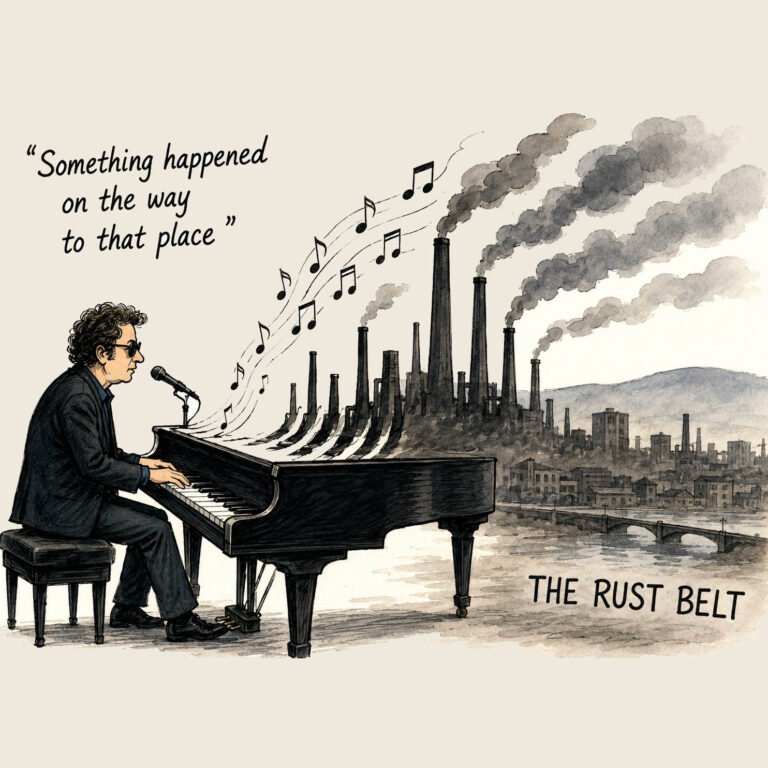
For decades, this county has been cast as a supporting character in the American industrial drama—steel once, petrochemicals more recently, and now energy. The Beaver Valley Nuclear Generating Station sits on the Ohio River quietly doing what nuclear plants do best: producing large amounts of reliable electricity without emitting carbon or requiring a favorable breeze. Its long-term power deals with data-hungry companies are not a coincidence. Data centers crave baseload power the way teenagers crave Wi-Fi.
But electricity doesn’t travel by vibes. It travels through copper.
That’s where things get interesting.
Beaver County is also home to manufacturers who live at the less glamorous—but more essential—end of the energy value chain. Eaton Corporation, a major employer in the region, builds the electrical equipment that keeps modern power systems from behaving like a 1970s blackout. Switchgear, breakers, power management systems—none of it works without copper, and none of it can be easily replaced with optimism.
The same is true for transformer and grid-equipment manufacturing more broadly. Rising copper prices squeeze margins, delay projects, and complicate expansions. When copper gets expensive, everything downstream feels it: utilities, manufacturers, contractors, and ultimately ratepayers.
And yet—here’s the Beaver County twist—those same copper pressures also underscore why this place matters.
As the global economy electrifies and AI demand explodes, regions that already generate power and manufacture the hardware that moves it become strategically valuable. Not trendy. Valuable. There’s a difference. Trends disappear; infrastructure endures.
This is the uncomfortable reality beneath the glossy future narrative: innovation is flashy, but infrastructure is decisive. You can’t scale AI without grids. You can’t build grids without copper. And you can’t pretend any of this happens instantly, because opening a new copper mine takes 10 to 20 years—longer than most political attention spans and nearly all venture-capital patience.
So while the rest of the country debates which app will change the world, Beaver County is sitting astride the less glamorous question: how the world actually gets powered.
That doesn’t mean the county is immune to risk. Rising copper prices raise costs for maintenance, expansion, and manufacturing inputs. They complicate already tight capital decisions. They add friction to projects that were supposed to be “easy.”
But they also clarify something important.
The future isn’t just built by dreamers. It’s built by electricians, engineers, nuclear operators, and manufacturers who understand that electrons need somewhere to go. Beaver County, somewhat against its own expectations, already lives in that world.
Copper may not make headlines the way AI does. But without it, the future everyone is selling simply doesn’t turn on.
And for once, that puts Beaver County not behind the curve—but wired directly into it.