Listen to a podcast discussion about this article.
Anyone who’s lived long enough in Beaver County begins to develop a healthy suspicion of any sentence that begins with the words, “The Supreme Court has decided…”
Because what usually follows is either (a) something that sounds abstract and constitutional, or (b) something that quietly rearranges your local economy like a backhoe in the night.
Last Friday’s ruling on President Trump’s reciprocal tariffs may qualify as both.
On a sharply divided vote, six justices struck down the administration’s worldwide tariffs, ruling that the White House had leaned too heavily—indeed, exclusively—on the International Emergency Economic Powers Act (IEEPA). For more than a year, government lawyers argued that the statute’s power to “regulate” imports included the power to impose tariffs.
The Court, in a rare moment of bipartisan judicial skepticism, replied: Not so fast.
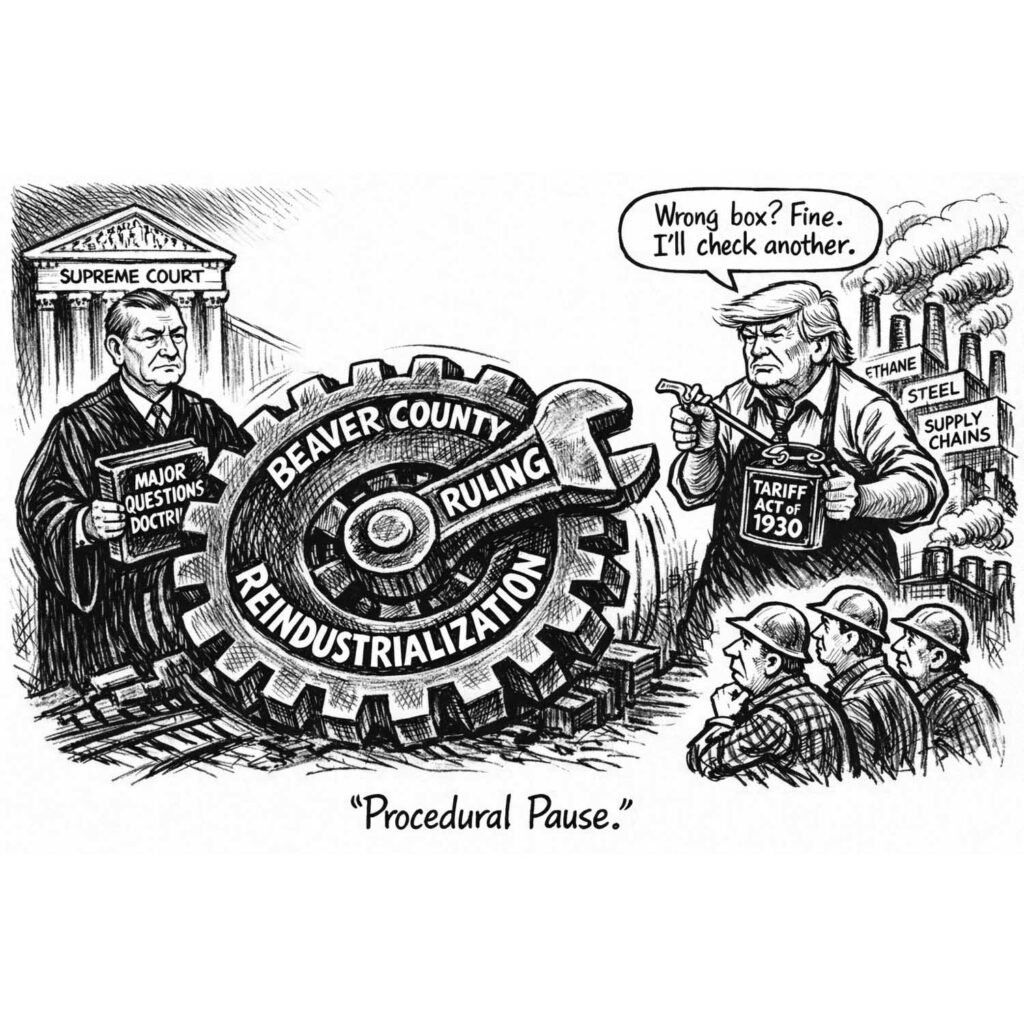
The conservative trio of Chief Justice Roberts, Justice Gorsuch, and Justice Barrett invoked the “Major Questions Doctrine”—a phrase that sounds like it should come with a pipe and elbow patches. Their point was simple: when a president makes a move of “vast economic and political significance,” Congress must have clearly and expressly authorized it. IEEPA does not mention tariffs. Strike one.
Meanwhile, Justices Kagan, Sotomayor, and Jackson arrived at the same destination by a different road. Tariffs, they noted, are taxes. And “regulate” does not mean “tax.” Strike two.
And so the tariffs were knocked to the floor.
But here’s where Yale law professor Jed Rubenfeld enters the discussion like a calm referee in a prizefight.
In his “Straight Down The Middle” analysis, Rubenfeld argues that this is not a knockout. It’s more like a procedural penalty. The Court did not say the president lacks constitutional authority to impose tariffs if Congress authorizes them. It said the administration “checked the wrong statutory box.”
That is a very Washington way of saying: You filled out the wrong form.
Justice Kavanaugh’s dissent pointed to the nearly forgotten Tariff Act of 1930, which expressly authorizes the president to impose tariffs of up to 50 percent on countries placing a “burden or disadvantage” on U.S. commerce. Rubenfeld suggests that by invoking that statute, the administration could likely re-enact most, if not all, of the struck-down tariffs—without running afoul of the Court’s reasoning.
In other words, the tariffs are down. They are not necessarily out.
Which brings us, inevitably, to Beaver County.
For the better part of a decade, we have been flirting with something unfashionable in coastal zip codes: reindustrialization. The Shell cracker in Potter Township. The steady hum of rail and river traffic. The whispered hope that material sovereignty—the ability to make and source what we need at home—might once again be more than a nostalgic slogan.
Tariffs have been part of that equation.
If re-imposed under the 1930 Act or perhaps the Trade Act of 1974 (which comes with more procedural guardrails), similar levies could once again shield domestic manufacturing from subsidized foreign imports. For a county perched atop the Marcellus Shale and increasingly invested in ethane-based production, that matters. Tariffs can tilt the playing field just enough to encourage local processing, domestic supply chains, and long-term capital investment.
Material sovereignty is not a phrase you hear often at the Monaca Sheetz. But its meaning is plain: Do we make it here, or do we wait for a container ship?
The Court’s ruling introduces uncertainty—always the least favorite word in any banker’s vocabulary. If the administration must re-route its tariff policy through a different statute, there could be delays. Investors dislike delays the way steelworkers dislike pink slips.
And yet, there is another side to this judicial coin.
The ruling opens the door for companies that paid these tariffs since April to seek refunds—potentially hundreds of billions nationally. Pennsylvania businesses alone may have paid billions in similar levies. For Beaver County firms importing equipment, specialty materials, or components, refunds could mean a sudden injection of capital.
In theory, that money could be plowed right back into local expansion—new processing lines, upgraded facilities, deeper integration of our ethane and plastics ecosystem. In that scenario, the Supreme Court’s monkey wrench looks less like sabotage and more like a temporary pit stop.
The deeper question is philosophical.
For decades, American trade policy drifted toward the comforting abstraction that markets would sort everything out. If steel closed in Aliquippa, well, we would retrain. If manufacturing moved offshore, we would code.
Then came the rediscovery—sometimes polite, sometimes loud—that sovereignty requires material foundations. You cannot 3D-print your way out of a supply chain crisis if you do not control the inputs.
The Trump tariffs were, in part, an attempt to force that reckoning. The Court has not rejected the goal. It has demanded cleaner legal plumbing.
From a constitutional perspective, that is not unreasonable. The power to tax belongs to Congress. If a president wants to reshape global trade, Congress should probably have said so in unmistakable language.
From a local economic perspective, however, timing is everything. Beaver County’s reindustrialization has always depended on a fragile alignment of energy abundance, political will, and global conditions. A few months of delay can spook lenders. A few years can alter the map entirely.
Rubenfeld’s central insight is that the legal path remains “wide open.” If the administration pivots quickly to the 1930 Act, much of the tariff regime could reappear with stronger statutory footing. If Congress chooses to weigh in explicitly, the foundation could be firmer still.
So has the Supreme Court thrown a monkey wrench into Beaver County’s reindustrialization?
Perhaps.
But it may turn out to be the sort of monkey wrench that forces you to tighten the bolts properly.
In Beaver County, we have seen what happens when bolts are not tightened—mills shuttered, supply chains vanished, main streets hollowed out. We have also seen what happens when policy, energy, and grit align.
The tariffs are on the canvas. The referee is counting. But if Professor Rubenfeld is right, the bell has not rung.
And in a county that has survived more than one economic prizefight, that distinction matters.