Listen to a podcast discussion about this article.
Every generation eventually invents a new miracle substance that promises to improve the human condition without requiring the unpleasant inconvenience of actual work.
In the nineteenth century it was patent medicines—bottles of mysterious elixirs guaranteed to cure baldness, gout, melancholy, and possibly poor manners. In the twentieth century it was vitamin megadoses, protein powders, and exercise gadgets that looked suspiciously like medieval torture devices.
Now we have peptides.
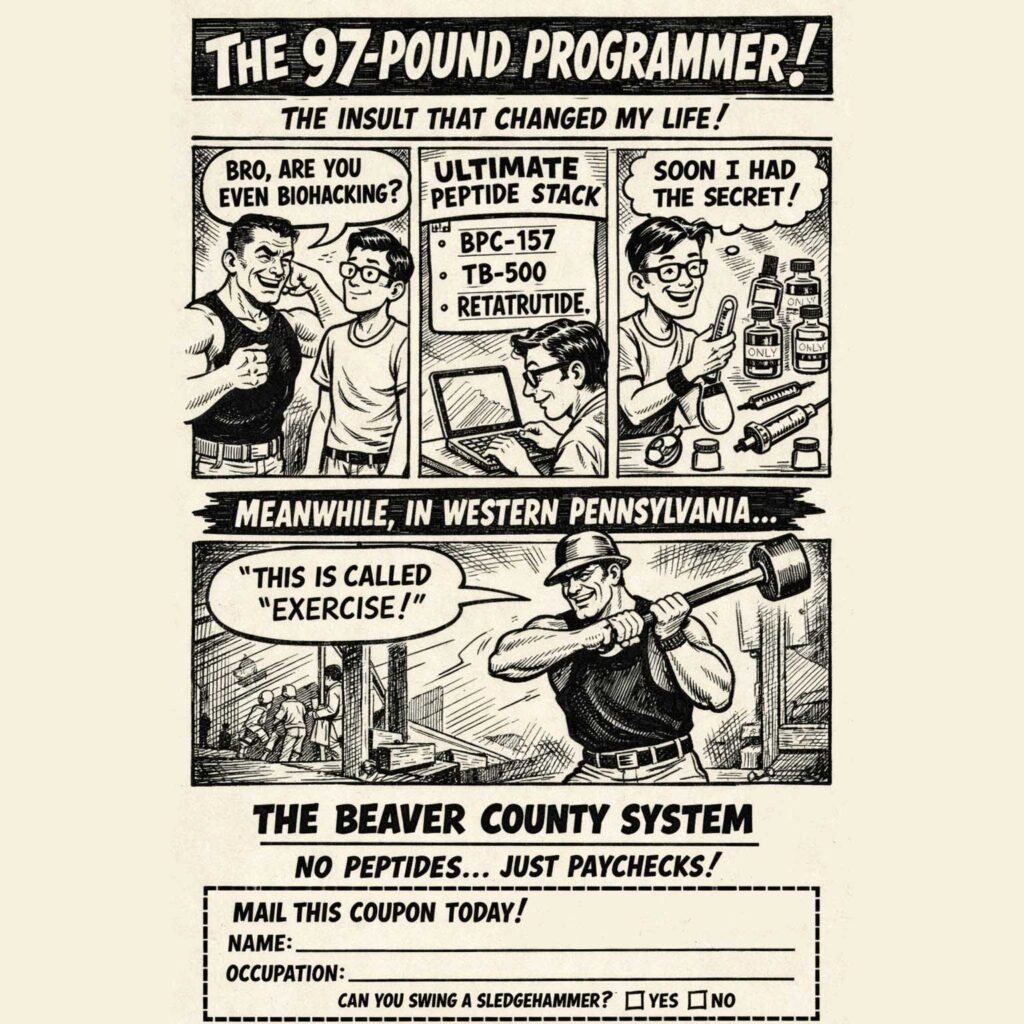
Peptides, for those who haven’t been following the latest developments in Silicon Valley’s ongoing quest to outwit biology, are tiny chains of amino acids that signal the body to do various useful things. Some are perfectly legitimate medicines. Insulin, for example, is a peptide. So are certain modern weight-loss drugs such as semaglutide, better known to the public as Ozempic.
But the current craze involves a different class of compounds—experimental peptides circulating through what might politely be described as the entrepreneurial corners of the internet.
There you’ll find substances with names that sound less like medicine and more like minor characters in a Star Wars movie: BPC-157, TB-500, CJC-1295, Ipamorelin, and something called Retatrutide, which sounds vaguely like a Scandinavian power forward.
Each promises a specific improvement to the human machine. One repairs joints. Another stimulates growth hormone. A third increases energy. There are peptides for better sleep, sharper thinking, improved skin, enhanced libido, and—in what must surely be the final frontier of human aspiration—more luxurious hair.
Silicon Valley, never one to ignore an opportunity to optimize itself, has embraced the trend with enthusiasm.
The theory behind the movement is charming in its simplicity. Why rely on the slow, unpredictable processes of nature when you can inject a carefully engineered molecule that tells your body exactly what to do?
Why spend years strengthening your joints when BPC-157 might persuade them to heal faster? Why endure the indignity of aging when copper peptides promise smoother skin? Why settle for ordinary metabolism when a triple-receptor compound like Retatrutide might melt fat at laboratory speeds?
This philosophy has produced a thriving ecosystem of what might be called do-it-yourself biochemistry.
Many enthusiasts acquire their peptides through “research chemical” websites or discreet suppliers operating on Discord servers and Reddit threads. The substances are technically sold “for laboratory use only,” which allows them to slip neatly around the regulatory machinery of the Food and Drug Administration.
Some buyers obtain them directly from factories in China, where a vial can cost as little as $15—considerably cheaper than the hundreds or thousands of dollars charged by medical spas offering peptide injections in tasteful surroundings.
Once the powder arrives in the mail, the user performs a small chemistry experiment known as “reconstitution,” mixing the compound with liquid and injecting it into the body.
It is, in effect, pharmaceutical home brewing.
Supporters call this “Pharma 2.0”—a new age in which individuals take control of their own biology using tools once reserved for elite athletes and clinical researchers.
Skeptics call it something else.
Dr. Eric Topol, a respected physician and medical researcher, has described the phenomenon more bluntly: people experimenting on themselves with substances that haven’t undergone clinical trials and may or may not contain what the label claims.
Some users report digestive problems, immune reactions, or toxicity from improper dosing. There is also the small matter that compounds designed to stimulate cell growth can occasionally stimulate things you’d rather not encourage—such as undiagnosed tumors.
But Silicon Valley has rarely been deterred by a little uncertainty. If anything, risk is part of the brand.
The goal is nothing less than biological optimization.
Engineers who spend their days building artificial intelligence systems have decided there’s no reason not to re-engineer themselves while they’re at it. The human body, in this worldview, is simply another platform awaiting upgrades.
One imagines venture capitalists discussing the matter over kale smoothies.
“Series A funding for mitochondria,” someone says.
“Excellent. Let’s scale.”
Meanwhile, back in Beaver County, the human body continues to operate according to a slightly older operating system.
Our region has always believed in physical improvement, but traditionally the method involved lifting things that needed lifted.
Steel mills, machine shops, construction sites, and rail yards offered the original full-body workout long before anyone thought of marketing peptides to repair tendon inflammation.
The men who built Beaver County’s industrial economy rarely discussed telomeres or mitochondrial peptides. Their anti-aging strategy consisted mainly of coffee, hard work, and the occasional visit to the union hall.
It is true that gyms have become popular here, as they have everywhere else. Walk into any fitness center in the county and you’ll find an admirable collection of treadmills, barbells, and determined citizens attempting to undo the effects of modern sedentary life.
But the real difference lies in how people think about effort.
In Silicon Valley the goal often seems to be finding a technological workaround for biological limits. In Beaver County the traditional solution has been simpler: do the work anyway.
If a pipefitter develops strong forearms after twenty years on the job, it isn’t because he discovered a growth hormone secretagogue on a Reddit forum. It’s because he spent two decades tightening bolts the size of dinner plates. If a construction worker’s joints ache at the end of the day, he may complain about it over coffee—but he rarely orders a vial of experimental peptides from a Chinese laboratory.
Instead he does something far more radical. He goes back to work tomorrow.
This isn’t to say that medical science has nothing useful to offer. Genuine advances in pharmaceuticals and biotechnology have improved millions of lives.
But the peptide boom illustrates a peculiar feature of modern technological culture.
We’ve become convinced that every human problem must have a biochemical solution.
Feeling tired? Stimulate your mitochondria. Gaining weight? Activate a metabolic pathway. Worried about aging? Lengthen your telomeres.
The underlying assumption is that biology is essentially a software problem waiting for the right patch.
Yet there remains a stubborn alternative method for improving health, one that has persisted from the farms of Pennsylvania to the factory floors of the industrial Midwest.
It involves sleep, exercise, sunlight, decent food, and work that engages the body as well as the mind.
None of these methods can be purchased through a Discord server.
They don’t arrive in padded envelopes from overseas laboratories.
And unfortunately, they cannot be injected with a syringe.
They must be practiced daily, usually before breakfast.
Which may explain why Silicon Valley continues searching for something easier.
Meanwhile, here in Beaver County, we’ll keep lifting things the old-fashioned way—occasionally in the gym, but more often at the jobsite, where the only peptide most people trust is the one naturally produced by honest labor.
It may not be cutting-edge biotechnology.
But it has a remarkable track record.