Listen to a podcast discussion about this article.
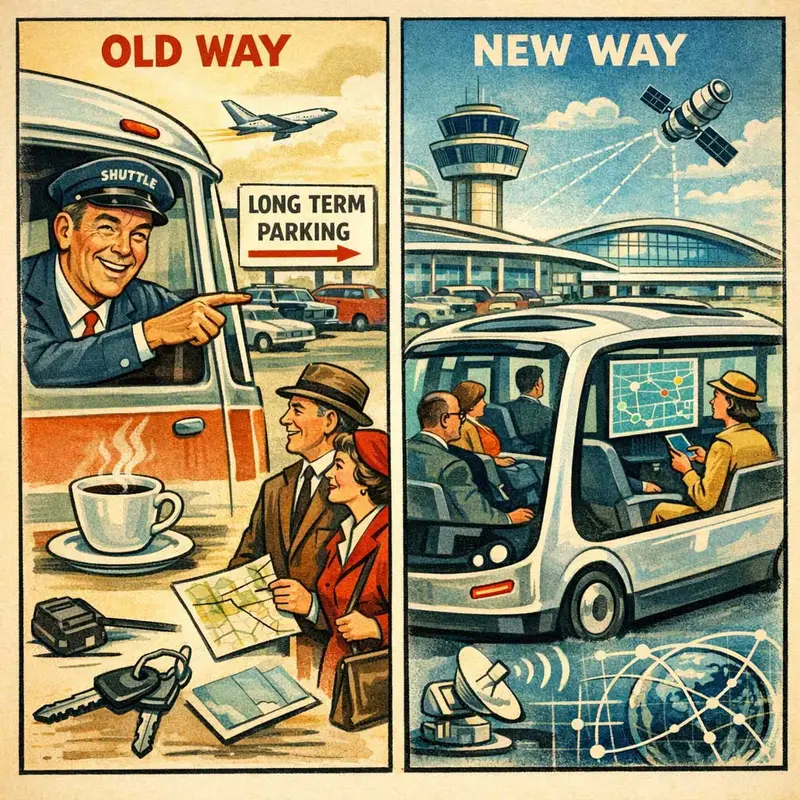
There was a time—recent enough the coffee stains are still fresh—when the most sophisticated navigation system in an airport parking lot was a man named Earl who’d been driving the shuttle since the Reagan administration and could locate your 2008 Buick by memory, instinct, and a faint disturbance in the asphalt.
Earl required no satellite, no sensor, and certainly no software update. He just squinted into the distance, took a philosophical drag on his coffee, and delivered you—against all modern expectations—to Row F, Section 12, as if guided by forces not yet available to science.
Earl, we regret to inform you, is being replaced.
Enter the Driverless Age
The Pittsburgh International Airport now envisions a fleet of autonomous shuttles linking its new landside terminal to parking lots too distant for even the ambitious traveler to walk without reconsidering the trip.
These “Level 4” vehicles don’t need drivers—provided they stay on carefully defined paths and resist any temptation to freelance. Each carries 12 to 22 passengers and runs 24 hours a day on dedicated routes, a sort of ground-level monorail powered by batteries and confidence.
Gone are the humans with mortgages and opinions. In their place: algorithms that never call in sick and do not inquire whether you packed wisely.
The Price of Progress (Paid by Someone Else)
The system is estimated at $75 million—$32 million for the vehicles and another $30 million for infrastructure designed to keep them from wandering into rental car returns or philosophical doubt.
But here’s the twist that would make even a Beaver County borough manager pause mid-meeting: the airport authority wouldn’t pay that upfront. A private company would build and operate the system, and the authority would pay an annual fee—much like its microgrid.
In local terms, this is known as “somebody else writes the first check.”
The arithmetic appears reassuring. The current shuttle system costs about $11.8 million a year to operate. The autonomous version is projected at roughly $11.4 million, suggesting that progress may, for once, cost slightly less than nostalgia.
A Half-Mile Into the Future
The route would stretch about half a mile, connecting the new terminal to long-term parking lots now considered walkable only by optimists and marathoners.
Stations would dot the route. The vehicles would follow geo-fenced paths, always knowing precisely where they are—even when you don’t.
There’s a public comment period from March 15 to April 14, during which citizens may express enthusiasm, concern, or a lingering attachment to Earl. After that, the state’s Public-Private Partnership Board will weigh in, followed by proposals and a series of meetings in which the word “synergy” will be used with admirable sincerity.
Not Pittsburgh Alone
Pittsburgh is not venturing into this future alone. Airports from Newark to Honolulu have been experimenting with autonomous shuttles, some still accompanied by attendants—just in case the future requires supervision.
Internationally, adoption is accelerating. Airports, with their controlled environments and predictable routes, are ideal proving grounds for a technology that may someday attempt the far less predictable terrain of downtown Pittsburgh at rush hour.
What began as a novelty is now a fast-growing, multi-billion-dollar industry, propelled by labor shortages, improving technology, and the realization that machines rarely take vacation.
Beaver County Watches
Here in Beaver County, we’ve learned to recognize the early signs of change. Autonomous vehicles, microgrids, data centers—these are not isolated curiosities but pieces of a larger shift.
It isn’t hard to imagine similar systems appearing closer to home, shuttling workers across sprawling industrial campuses or linking developments too large to walk and too busy to rely on traditional transit.
When that future arrives, it won’t ask whether we’re ready. It will simply pull up, open its doors, and wait with quiet efficiency.
The Human Question
Still, certain questions linger.
Who do you tip?
Who helps when you’ve left your phone behind?
Who assures you, as the shuttle glides silently into motion, that everything is going to be all right?
Engineers promise safety. Economists promise efficiency. Environmentalists promise cleanliness.
But there remains something quietly reassuring about a driver who knows every pothole by name and can find your car after three days, two gate changes, and a creeping sense of regret.
All Aboard
If the plan proceeds, Pittsburgh may soon host a future that arrives not with a roar, but with a soft electric hum—and a complete absence of conversation.
You will step aboard. The doors will close. The shuttle will move.
And somewhere, in a break room that no longer exists, Earl will be telling anyone who will listen that he could have gotten you there faster.