Listen to a podcast discussion about this article.
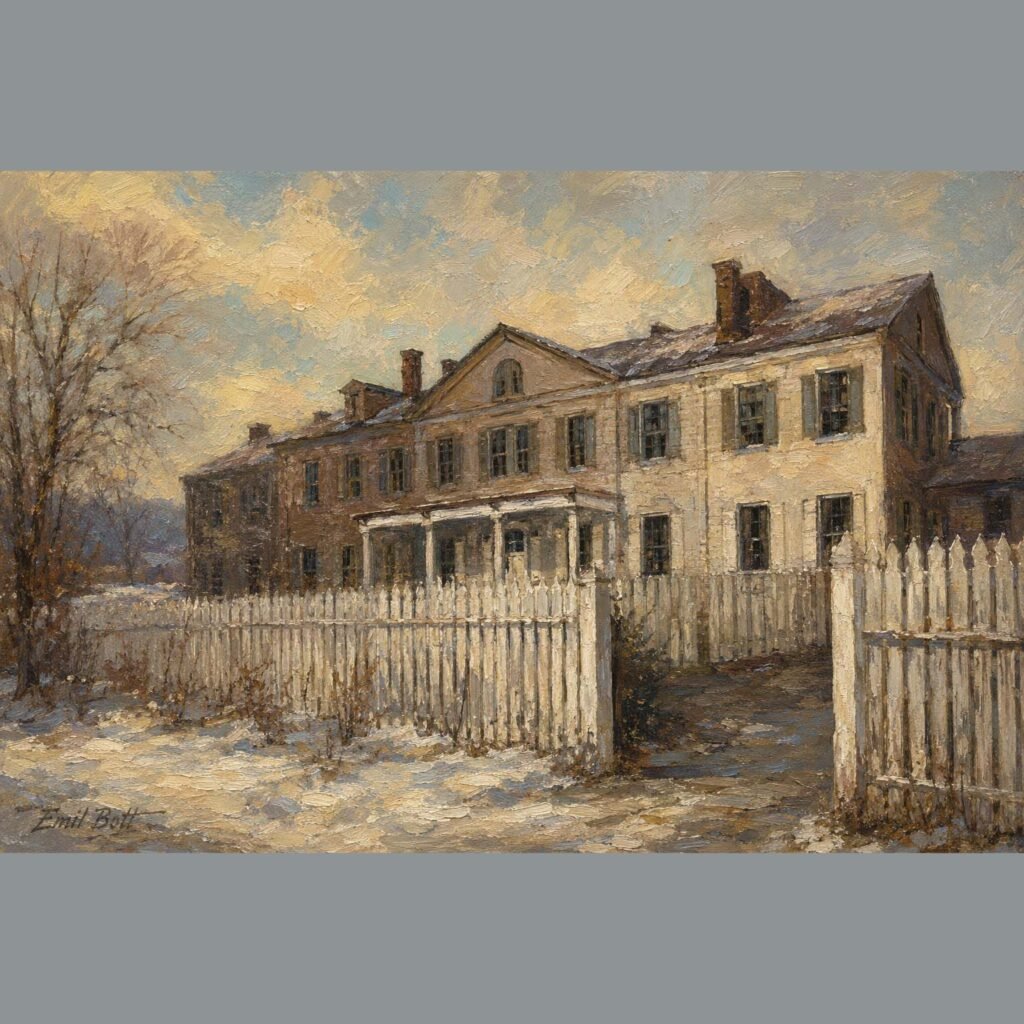
On a cold morning in Potter Township more than a century ago, a horse-drawn wagon creaked up the lane to the county poor farm. Behind its weathered fences stood rows of crops, a two-story almshouse, and dozens of men and women who had nowhere else to go. Some would spend their final years there. Some would be buried nearby. Most would eventually be forgotten.
Every county has its ghosts.
Not the theatrical kind that rattle chains in attics or appear on cable television programs hosted by men carrying infrared cameras. I mean the ordinary ghosts—the people who lived, suffered, and died so quietly that history eventually misplaced them.
In Beaver County, many of those forgotten souls ended their days on a farm in Potter Township.
Today, few residents know it ever existed.
For more than a century, Beaver County maintained what was variously called the Poor House, Almshouse, County Farm, or Poor Farm. Located on county-owned land in Potter Township, it served as the last refuge for people who had run out of options. The elderly without family. Widows without income. Men broken by illness or injury. The disabled. The mentally ill. Drifters. Alcoholics. The unlucky.
In the language of the era, they were called “paupers.”
In modern language, they were human beings who had fallen through every crack society offered.
County records indicate that the poorhouse was approved by county voters in 1851, after earlier proposals had been rejected. Deeds and county documentation show that land was purchased from George Stone and developed into what amounted to a self-sufficient agricultural community. Residents worked if they could. They planted crops, tended livestock, cooked meals, cleaned buildings, and maintained the property.
If you were healthy enough to hoe corn, you hoed corn.
If you weren’t, you sat on the porch and watched others do it.
By 1870, county records and historical accounts document a larger two-story almshouse on the property. It operated much like thousands of county poor farms scattered across America. The arrangement reflected a stern Victorian belief that poverty was best relieved through work, discipline, and fresh air.
Yet there was also a certain rough compassion in the system.
The county provided food, shelter, heat, and care to people who otherwise might have frozen in a ditch or starved in a rented room. By the mid-20th century, the institution had evolved into something closer to a nursing home. Nurses and attendants cared for aging residents. Those able to work sometimes earned modest wages. Others spent their days playing cards, reading newspapers, or simply waiting.
Many arrived knowing they would never leave.
Contemporary newspaper accounts and county reports suggest that officials understood many residents came there in the final chapter of their lives. One county official reportedly observed that people often came there “to die.”
And many did.
Which raises a haunting question.
What happened to them afterward?
That is where the historical trail grows faint.
Across America, poorhouses commonly maintained what were known as Potter’s Fields—burial grounds for the indigent, unclaimed, and forgotten. The term comes from the Gospel of Matthew, where a field purchased with Judas Iscariot’s silver became a burial place for strangers.
The name endured.
When a resident of the Beaver County Poor Farm died without family, money, or someone willing to claim the body, burial expenses still had to be met. County poorhouse records in many jurisdictions document the use of institutional cemeteries, often located on or near almshouse grounds. It is reasonable to believe Beaver County followed a similar practice, although surviving local documentation is incomplete.
The dead were buried simply.
Sometimes there were small markers. Sometimes only numbers. Sometimes nothing at all.
Over the years, weather erased evidence. Records were lost or became difficult to trace in surviving archives. Memories faded.
Today, no readily available county record appears to definitively establish how many people were buried near the Potter Township poor farm. The exact location of any burial ground has not been clearly identified in the historical sources currently available. Local historical organizations and researchers have occasionally referenced graves associated with the site, but the documentary record remains fragmentary.
The result is one of Beaver County’s most intriguing historical questions.
Somewhere in Potter Township there may be the resting place of former residents whose names have long since vanished from public memory.
Their fate was hardly unique.
Just down the Ohio River stood another institution built for society’s forgotten. Dixmont State Hospital, named after reformer Dorothea Dix, opened in 1862 overlooking the river in Kilbuck Township. At its peak, it housed more than a thousand psychiatric patients. Like the poor farm, it operated its own farms, workshops, and community.
And like the poor farm, it maintained a cemetery.
Historical records from Dixmont document more than 1,300 patient burials, many beneath numbered markers rather than names. A surviving cemetery logbook preserved in archival collections allows researchers to match numbers to identities. The cemetery remains one of the few visible reminders of the lives once lived behind Dixmont’s imposing walls.
Beaver County’s poor farm appears to have left fewer surviving clues in the public record.
The institution itself closed in 1959 when residents were transferred to the newly opened Beaver County Home and Hospital in Brighton Township. County documentation from the period records the transition. That facility eventually became Friendship Ridge, later Brighton Rehabilitation and Wellness Center, and today continues under private ownership.
The old poor farm land was sold. Industry arrived. Buildings vanished.
Yet the people remain.
Or at least their stories do.
History tends to celebrate industrialists, politicians, generals, and entrepreneurs. We preserve their homes, bronze their likenesses, and name highways after them. The poor rarely receive such treatment.
Nobody erects monuments to a widow who spent her final years sewing shirts in a county almshouse.
Nobody names a bridge after an aging laborer who arrived at the poor farm with rheumatism and no surviving family.
Yet their lives mattered no less.
Perhaps one day historians working through county ledgers, deed books, commissioners’ records, cemetery files, forgotten maps, and other archival sources will uncover more answers. Modern tools such as ground-penetrating radar may also help clarify what remains uncertain. Perhaps names will be recovered. Perhaps descendants will discover where long-lost ancestors came to rest.
Until then, the forgotten souls of Potter Township remain among Beaver County’s quietest residents.
Still present.
Still waiting.
And still deserving to be remembered.