Listen to a podcast discussion about this article.
It has become one of Washington’s more durable hobbies to explain Donald Trump with the same foreign-policy handbook that got us through the Cold War. This is rather like trying to understand a Tesla with the owner’s manual from a 1957 Buick. The language is familiar. The machinery is not.
For nearly eighty years America occupied a curious position in the world. We were the fellow who insisted on paying for dinner, drove everyone home afterward, and then apologized if dessert wasn’t quite satisfactory. We patrolled the oceans, guaranteed the security of wealthy allies, kept our markets generously open, and occasionally undertook the additional responsibility of reorganizing distant civilizations that had neglected to ask for our assistance.
It was an ambitious arrangement.
It was also an expensive one.
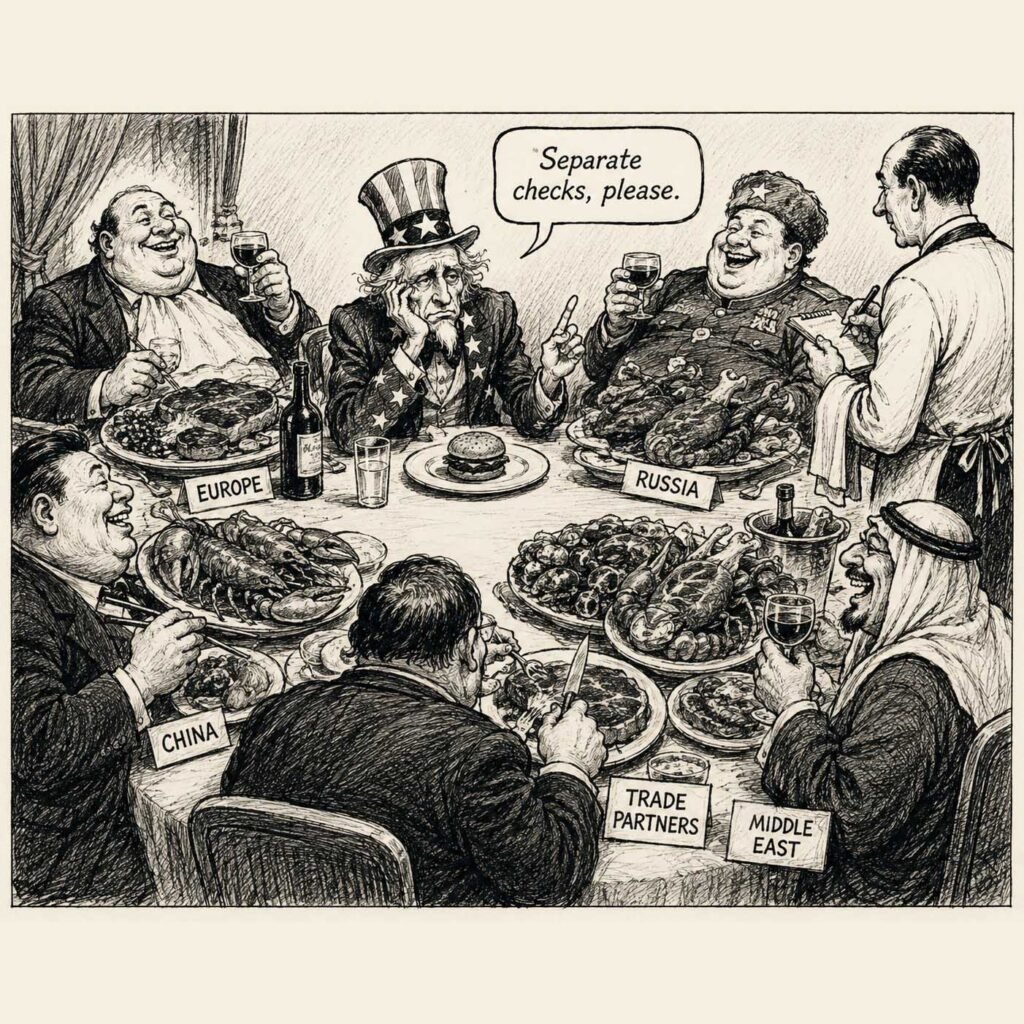
The beneficiaries were easy enough to identify. Multinational corporations prospered. International institutions multiplied. Trade expanded. Economists produced charts showing how marvelously interconnected everything had become.
Back home, however, another set of charts was quietly taking shape.
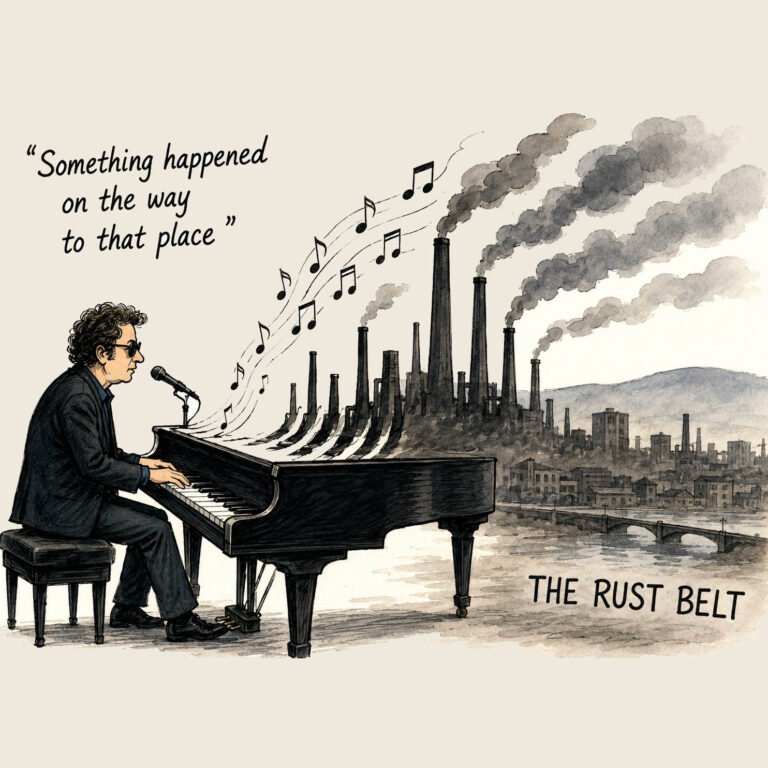
Factories disappeared. Mill towns lost their mills. Wages acquired the disagreeable habit of standing still while everything else became more expensive. Young Americans discovered there was an endless supply of deserts requiring military attention. Meanwhile, countries that had once depended on the American-led trading system became remarkably adept at using it to build industrial powerhouses of their own.
No single president caused any of this.
Neither could any single president reverse it.
Eventually enough Americans looked around their own communities and began wondering whether the world’s bookkeeping had somehow overlooked their page in the ledger.
That, it seems to me, is the best way to understand Trump’s foreign policy—not as isolationism but as an attempt to renegotiate the family budget. Instead of treating the United States as the permanent underwriter of the international order, the new philosophy asks an unfashionably simple question: What does America receive in return?
Washington has rarely been comfortable asking questions quite that bluntly.
The old foreign-policy establishment preferred the language of ideals, obligations, and leadership. Trump speaks the language of contracts, leverage, and invoices. To traditional diplomats, this can sound distressingly commercial, rather as though someone had wandered into a cathedral carrying a cash register.
Yet nations, unlike churches, eventually have to balance their accounts.
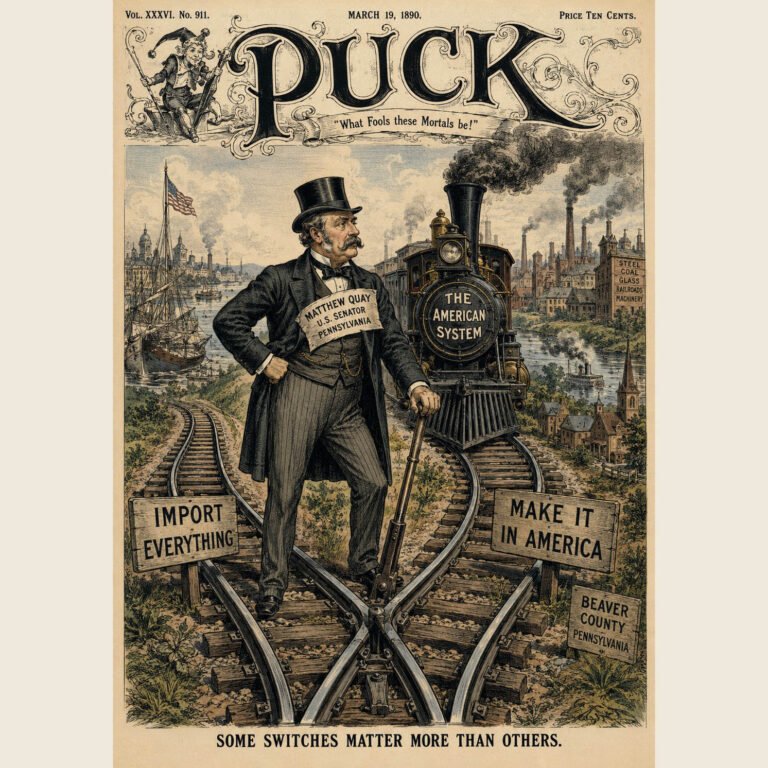
Viewed through that lens, tariffs become something other than economic tantrums. They are bargaining chips. Sending a tariff notice to another country is considerably cheaper than sending the 82nd Airborne.
Steel offers an obvious example. The administration restored and expanded tariffs on imported steel, aluminum, copper, automobiles, and auto parts. Critics saw protectionism. Supporters saw breathing room for industries that had spent decades competing against governments willing to subsidize production on a scale Americans never attempted.
In places like Beaver County, where blast furnaces are remembered less as historical curiosities than as family members, that distinction is hardly academic.
The same transactional instinct appears elsewhere. The Abraham Accords were never sold as the end of ancient quarrels. They were presented as a practical arrangement through which countries that disagreed about almost everything might nevertheless agree that trade, investment, and stable energy markets were preferable to endless hostility.
History suggests commerce has occasionally succeeded where sermons have failed.
The broader strategy follows the same pattern. Rather than dividing the world permanently into saints and villains, it assumes nations will pursue their interests because that is what nations have always done. The trick is arranging matters so America’s interests are difficult to ignore.
Competition with China and Russia likewise becomes less an ideological crusade than a permanent negotiation. Neither country is expected to disappear. Neither is expected to become a Jeffersonian democracy next Tuesday. The objective shifts from converting rivals into friends toward preventing rivals from dominating the board.
It is a less romantic view of international affairs.
It is also, one suspects, closer to the way history usually works.
Naturally, this unsettles people who built careers administering the previous order. Institutions seldom applaud reforms that make themselves less indispensable. Allies accustomed to generous American guarantees are understandably surprised to discover the bill has arrived with several decades of accumulated interest.
None of this promises an effortless transition. There will be negotiations that fail, allies who complain, rivals who exploit opportunities, and critics who interpret every tactical adjustment as strategic collapse.
History, after all, has never been known for tidy project management.
Still, the underlying question refuses to disappear.
Can the United States continue indefinitely financing a global order that increasingly asks more of American taxpayers than it returns to American workers?
For communities that watched factories close, supply chains migrate overseas, and public debt climb into the stratosphere, that question feels considerably less theoretical than it once did. A strategy emphasizing domestic manufacturing, secure energy, more reciprocal trade, and negotiated rather than automatic commitments will not restore every steel mill or solve every economic frustration.
It might, however, represent an overdue attempt to stop making withdrawals from the national checking account before asking whether anyone intends to make another deposit.
Whether the experiment succeeds is a question history will answer in its own leisurely fashion. History has never been especially responsive to polling data.
The old bifocals served well enough in their day. The difficulty is that landscapes have an inconvenient habit of changing, even while the people wearing the glasses continue insisting everything still looks exactly as it did in 1949.