Listen to a podcast discussion about this article.
There are many people nowadays who claim to be fixing America. They appear hourly on cable television, armed with charts, slogans, and facial expressions suggesting they alone stand between civilization and complete collapse. Curiously, very few of them can repair a screen door.
Which is why the passing of Joe Negri on May 30, 2026, feels like the loss of something larger than a musician. Joe belonged to a generation that spent less time announcing its importance and more time getting on with the job. If a tune needed playing, he played it. If a student needed teaching, he taught. If King Friday’s castle needed repairing, he put on the tool belt and got to work—despite privately admitting he wasn’t much of a handyman.
Joe died at 99, just ten days shy of his 100th birthday. One suspects he would have viewed the milestone the way he viewed most things: with quiet amusement and a guitar within arm’s reach.
Born Joseph Harold Negri in Pittsburgh on June 10, 1926, to Italian immigrant parents, Joe entered show business before most children have mastered tying their shoes. His father, a bricklayer, handed him a ukulele at age three or four. Pittsburgh fathers of that era believed in practical gifts. By his teens, Joe was touring nationally with big bands such as Shep Fields and His Rippling Rhythm. He served in the Army during World War II, returned home, studied composition at Carnegie Mellon, and settled into a career that made Pittsburgh a far richer cultural city than outsiders realized.
Which brings us to 67 Melody Lane.
In the 1950s, television was still an experimental contraption displaying pictures only slightly sharper than weather radar. Yet amid this primitive wilderness emerged a delightful syndicated program hosted by organist Ken Griffin. Joe appeared regularly alongside the extraordinary pianist Johnny Costa. Their performance of “After You’ve Gone” remains a small, perfect artifact of that era—Costa’s elegant piano lines dancing around Joe’s clean, swinging guitar. It was the sort of playing that says we know this tune has been around since 1918, but we’re going to make it feel brand new anyway. No smoke machines, no laser shows. Just two musicians listening harder than they played loud.
The remarkable thing about Pittsburgh in those years was how much talent wandered around without making a fuss. One could scarcely throw a pierogi without hitting a world-class musician. Which is how Joe eventually crossed paths with Fred Rogers.
Rogers was assembling Mister Rogers’ Neighborhood, a children’s program built on the radical notion that youngsters possessed functioning brains. When he needed music, he called Joe.
“How would you like to be the Handyman?” Rogers asked.
Joe replied that he wasn’t much of a handyman.
Many producers would have regarded this as disqualifying. Fred Rogers regarded it as a minor detail. And so Handyman Negri was born.
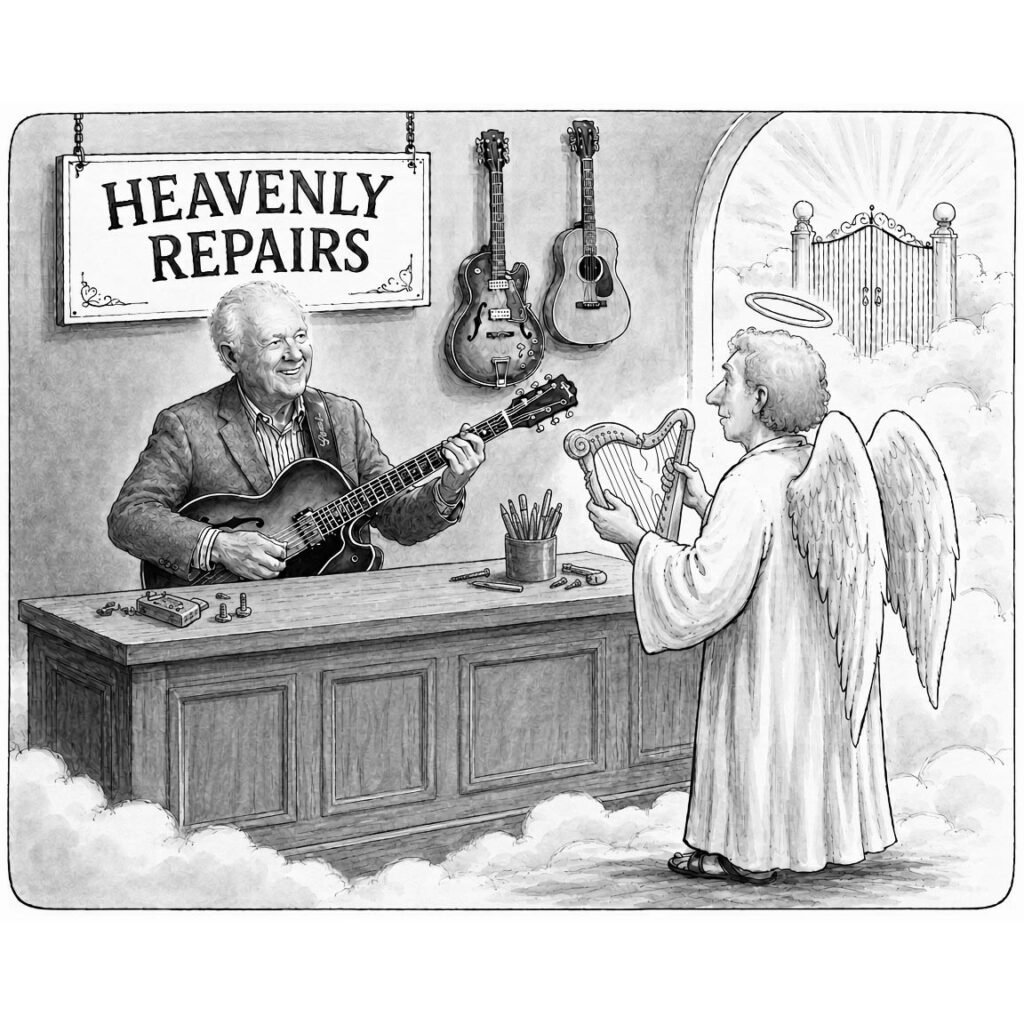
For nearly forty years, Joe appeared in millions of American homes as the Neighborhood’s resident repairman, castle caretaker, music shop proprietor, and all-around dependable fellow. Generations of children grew up believing a handyman ought to be kind, patient, modest, and occasionally capable of a jazz guitar solo. Frankly, the country could use more of that.
What made Joe unique was that he never talked down to children. The music wasn’t kiddie music. It was music—real jazz with sophisticated harmonies and genuine swing. Johnny Costa’s arrangements were among the most advanced ever heard on children’s television, and Joe fit effortlessly.
At the same time, he taught for decades at the University of Pittsburgh, helping establish jazz guitar as a serious academic discipline. His instructional book, A Common Sense Approach to Improvisation for Guitar, may contain the most Pittsburgh title ever given to a music textbook. Common sense. A bricklayer’s son explaining chords the way sensible people explain plumbing.
Joe never chased Hollywood. He stayed in Pittsburgh, married Joan in 1954, and remained devoted to her for more than seven decades. He raised a family, recorded albums, performed with everyone from Tony Bennett to Yo-Yo Ma, and quietly became one of the finest jazz guitarists this country produced.
In our current age of relentless self-promotion, Joe belonged to a generation that considered competence more impressive than publicity. He showed up. He played well. He helped others. He went home. Somehow that was enough.
In the end, Joe Negri fixed quite a few things. He fixed young musicians’ technique. He fixed a few television props. He fixed countless afternoons by making them sound better. And he helped repair, in his quiet way, the notion that excellence and humility can occupy the same room.
As the old standard he and Johnny Costa played so beautifully reminds us, life goes on “after you’ve gone.” But some people leave behind more than memories. They leave behind a sound.
And if you listen carefully, somewhere between Pittsburgh and the Neighborhood of Make-Believe, Joe Negri’s guitar is still ringing.