Listen to a podcast discussion about this article.
Every Fourth of July, Americans gather in backyards to celebrate the Declaration of Independence with hot dogs, potato salad, and fireworks purchased from a temporary tent that appeared in a Walmart parking lot about fifteen minutes after Memorial Day.
Eventually somebody asks, “Can you believe this country is 250 years old?”
To which I’m tempted to reply, “Sure. But where were yinz at when they signed the Declaration of Independence?”
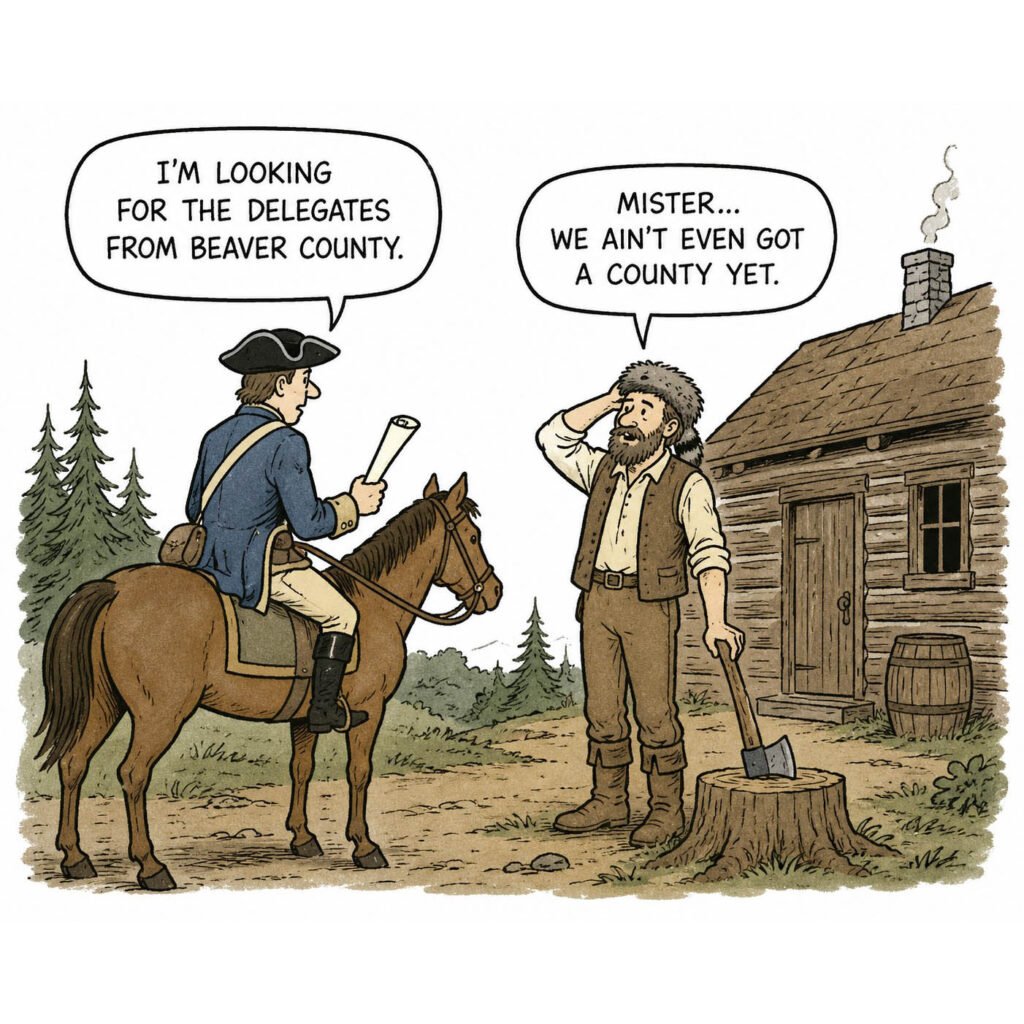
Not “we” as in the United States. We know where they were. Fifty-six gentlemen in Philadelphia were busy committing what King George III regarded as high treason. Nine represented Pennsylvania, but every one came from the eastern part of the colony. Benjamin Franklin was there, along with Robert Morris, James Wilson, and the rest of Pennsylvania’s distinguished delegation.
But what about Western Pennsylvania?
What about Beaver County?
What about… yinz?
The answer is both disappointing and oddly reassuring.
Nobody from Western Pennsylvania signed the Declaration.
Nobody from Beaver County signed it.
In fact, there wasn’t a Beaver County. It wouldn’t be created until 1800. In 1776 this was a rugged frontier of forests, rivers, Native villages, scattered trading posts, and enough uncertainty to discourage anyone looking for a quiet neighborhood with good schools.
The largest settlement nearby wasn’t Beaver. It was Logstown, a thriving Native American town where French traders, British officers, and tribal leaders negotiated, traded, and occasionally lied to one another with impressive diplomatic skill. George Washington had already passed through as a young surveyor and militia officer, learning lessons that would shape the commander he would become.
Meanwhile, back in Philadelphia, the Declaration was signed.
If someone had climbed a hill overlooking the Ohio River that July, he wouldn’t have seen a parade or heard a brass band.
He would have seen trees.
Lots of trees.
Perhaps a canoe.
Possibly a bear.
Almost certainly mosquitoes.
History has a way of making everything seem inevitable. It wasn’t. The Declaration proclaimed America’s independence.
It didn’t secure it.
Ink is persuasive.
Armies are more so.
That’s where Beaver County entered the story.
The first chapter came in 1778, when the Continental Army built Fort McIntosh at the mouth of the Beaver River. Named for General Lachlan McIntosh, it was the first American fort north of the Ohio River. More than a military outpost, it announced that the United States intended to become more than thirteen rebellious colonies hugging the Atlantic coast.
From Fort McIntosh, soldiers protected frontier settlements, launched expeditions into the Ohio Country, and projected the authority of a government that was still very much an experiment.
In 1785, the fort hosted one of the young nation’s first treaties with Native nations. The Treaty of Fort McIntosh proved controversial and failed to produce lasting peace, but it underscored Beaver County’s growing importance in the struggle to transform revolutionary ideals into governing reality.
Peace, however, remained stubbornly out of reach.
By the early 1790s, Native confederations had inflicted a series of devastating defeats on American armies, while British forces still occupied forts around the Great Lakes. The Revolution had been won, but the Northwest remained beyond the new nation’s control.
President George Washington turned to Anthony Wayne.
Wayne chose a bluff overlooking the Ohio River between present-day Baden and Ambridge to create what historians recognize as America’s first formal basic training camp. At Legionville, he transformed an assortment of eager recruits into the disciplined Legion of the United States.
Only then did he march west.
His victory at Fallen Timbers in 1794, followed by the Treaty of Greenville, finally secured much of the Northwest Territory for American settlement.
So, from Beaver County’s perspective, America’s founding unfolded in three acts.
First came the Declaration, where independence was proclaimed.
Then came Fort McIntosh, where the new nation planted its flag on the upper Ohio and began governing the frontier.
Finally came Legionville, where Anthony Wayne forged the army that gave those soaring words from Philadelphia a fighting chance.
That strikes me as a very Beaver County sort of accomplishment.
We’re not generally the people making speeches beneath crystal chandeliers.
We’re the people who show up afterward with shovels, muskets, steel, concrete—and, when circumstances require, a very large wrench.
So if someone asks where yinz were at when they signed the Declaration of Independence, the answer is simple.
We weren’t in the room.
We were waiting for history to arrive.
And when it did, Beaver County quietly helped build the country those gentlemen in Philadelphia had only begun to imagine.