Listen to a podcast discussion about this article.
Every person has a place that occupies more space in memory than it does on a map. Mine is Chippewa Township.
I grew up on our 156-acre farm on Morrow Road, just off Achortown Road. Both of my parents lived there until they died. Consequently, Chippewa occupies a special place in the geography of my heart.
Long before it became the pleasant suburban township we know today, Chippewa was frontier.
The land opened to widespread American settlement after the Treaty of Greenville in 1795, when General Anthony Wayne’s victory finally brought peace to much of the Ohio Country. The township derives its name from “Chipwayanwok,” a reference to Native people who once lived here, remembered for the fringed animal skins they wore. Peace accomplished what armies rarely can. It invited settlers carrying plows instead of muskets.
By the turn of the nineteenth century, Scotch-Irish pioneers arrived with axes, livestock, and an astonishing confidence that enough hard work could transform forests into farms. They found steep hills, sandstone ravines, harsh winters, wolves, and timber so dense that daylight occasionally seemed optional.
Beaver County was created in 1800, and in January 1816 the Beaver County courts carved Chippewa Township from South Beaver Township. For a brief period it bore the name Adams Township, honoring early settler Dr. Samuel Adams. Thankfully, the experiment didn’t last.
The township was once much larger than it is today. White Township and West Mayfield eventually split away, leaving the familiar boundaries we know today.
It was never easy country to farm.
The hills rolled rather than cooperated. Productive fields occupied the hilltops while streams carved deep valleys below. Yet families established farms raising dairy cattle, wheat, corn, oats, hay, and orchards of apples, cherries, peaches, and pears.
Reading those old accounts, I sometimes realize I didn’t simply learn Chippewa’s history—I lived its closing chapter.
Our farm produced horses, Black Angus cattle, corn, oats, hay, straw, cherries, apples, chestnuts, and persimmons. The woods yielded sassafras, teaberries, wild strawberries, blueberries, and blackberries in quantities that convinced me supermarkets were one of civilization’s more overrated inventions. Wildlife was everywhere. Deer wandered through the fields. Wild turkeys held noisy conventions. Foxes, rabbits, raccoons, skunks, woodchucks, hawks, owls, pheasants, and enough squirrels to keep every dog occupied shared the property with us. The barn also supported a population of cats that no census taker would have volunteered to count.
Only two residents would have surprised Chippewa’s early settlers. One was a succession of elegant Weimaraners raised by my parents. The other was Tamale, a thoroughly opinionated Mexican burro who regarded fences as suggestions rather than obligations. Aside from those two eccentricities, our place looked much like dozens of other farms scattered across the township.
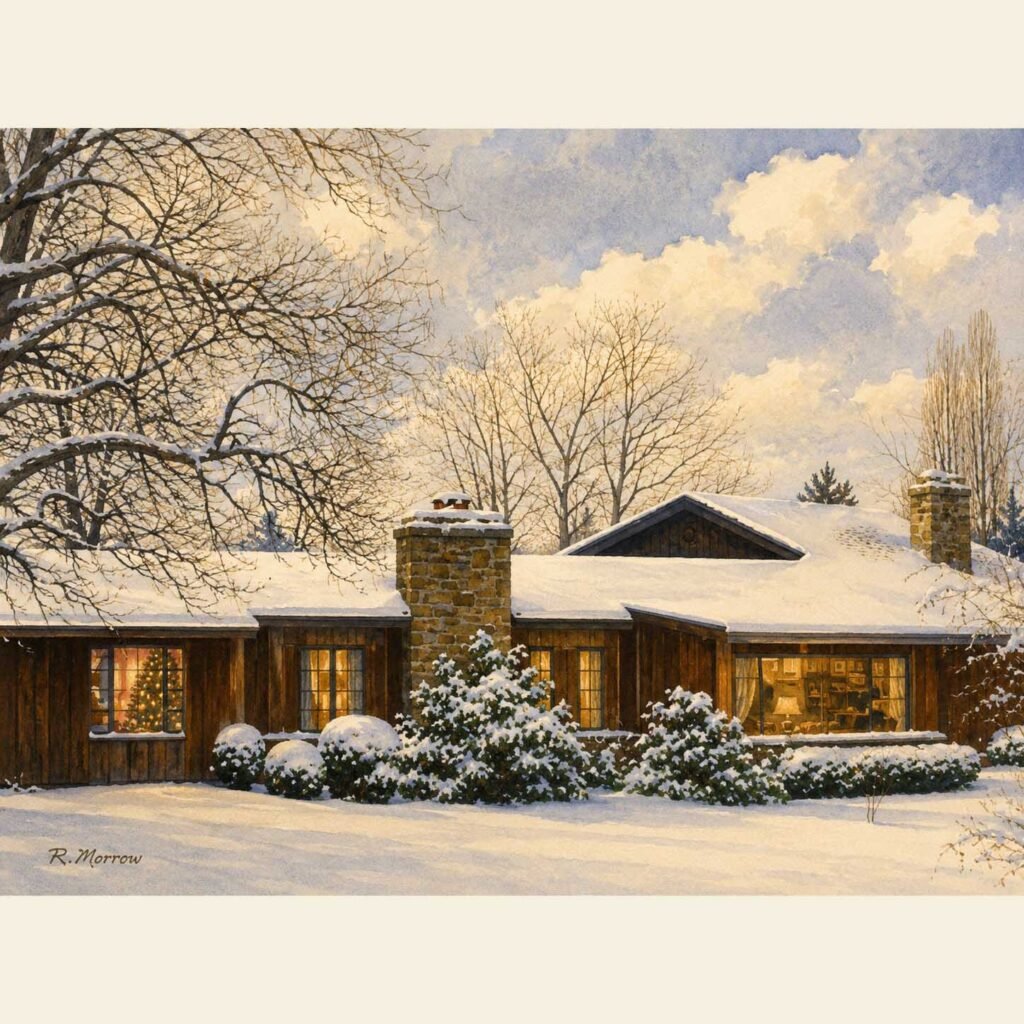
Our mid-century modern house, built on the foundation of the original farmhouse, sat on a hill above Morrow Road. From the front windows you could watch the seasons work their way across the valley. It was a wonderful place to grow up.
The farm itself, however, dipped into a low hollow where cold air settled every winter with remarkable determination. While neighbors elsewhere merely endured cold weather, our little valley seemed committed to advancing the science of refrigeration. My mother settled the matter by christening it “Little Siberia.” On January mornings, no one thought she was exaggerating.
Among Chippewa’s earliest settlers were Revolutionary War veteran Matthias Shanor, Robert Herron, who became both justice of the peace and a Presbyterian elder, the Stratton family, Robert McFarland, and later German immigrants whose dairy farms became local landmarks.
Like nearly every successful frontier community, Chippewa was built as much by churches as by farms. Although many settlers were Presbyterian, the township’s first organized congregation was Methodist. The Old Stone Methodist Episcopal Church, built of native sandstone in 1810, still stands as one of Beaver County’s enduring landmarks. Its adjoining cemetery contains graves dating to the closing years of the eighteenth century, including veterans of the Revolutionary War.
As agriculture matured, the Chippewa Grange became the township’s social center, where neighbors exchanged ideas, solved problems, and occasionally disagreed without the assistance of social media.
Modernization arrived gradually. Sawmills gave way to natural gas development around 1900. Country blacksmiths and general stores appeared. In 1927, residents organized the Chippewa Township Volunteer Fire Department, another reminder that healthy communities are built by citizens who volunteer before they’re asked.
The population grew slowly for more than a century before suburban development accelerated after World War II. Today more than 8,000 people call Chippewa home.
Many know it simply as an attractive suburb outside Beaver Falls.
They’re right.
But they’re also missing something.
Places acquire character, just as people do. Chippewa has always struck me as quietly competent. It has never sought attention. It simply raises families, educates children, maintains roads, supports volunteer firefighters, coaches Little League, and produces citizens who understand the difference between showing off and showing up.
That sort of character rarely attracts headlines. It does, however, produce communities worth calling home.
Whenever I drive down Morrow Road, the trees seem taller, and the distances somehow shorter. Time performs those tricks on all of us. Yet the hills remain where they have always been, Brady’s Run still winds through the valleys, and the same ridges that challenged pioneer farmers continue catching the first light of morning.
It is fashionable these days to believe progress requires forgetting where we came from.
Chippewa suggests otherwise. It reminds us that communities are built one family, one farm, one church, one generation at a time. They grow so gradually that we scarcely notice until one day we realize they have become part of us.
There may be grander places than Chippewa Township. There are certainly larger ones. But whenever someone asks where I grew up, I don’t simply name a township. I tell them I was fortunate enough to grow up in Chippewa, and I answer with gratitude—for a place that helped make me who I am.