Listen to a podcast discussion about this article.
There are some things you assume will outlive you. The Steelers will exasperate their fans. Road construction on Route 51 will continue into eternity. And Giant Eagle will always be where Western Pennsylvanians go to spend $87 on the three items they forgot to buy yesterday.
It turns out one of those assumptions was wrong.
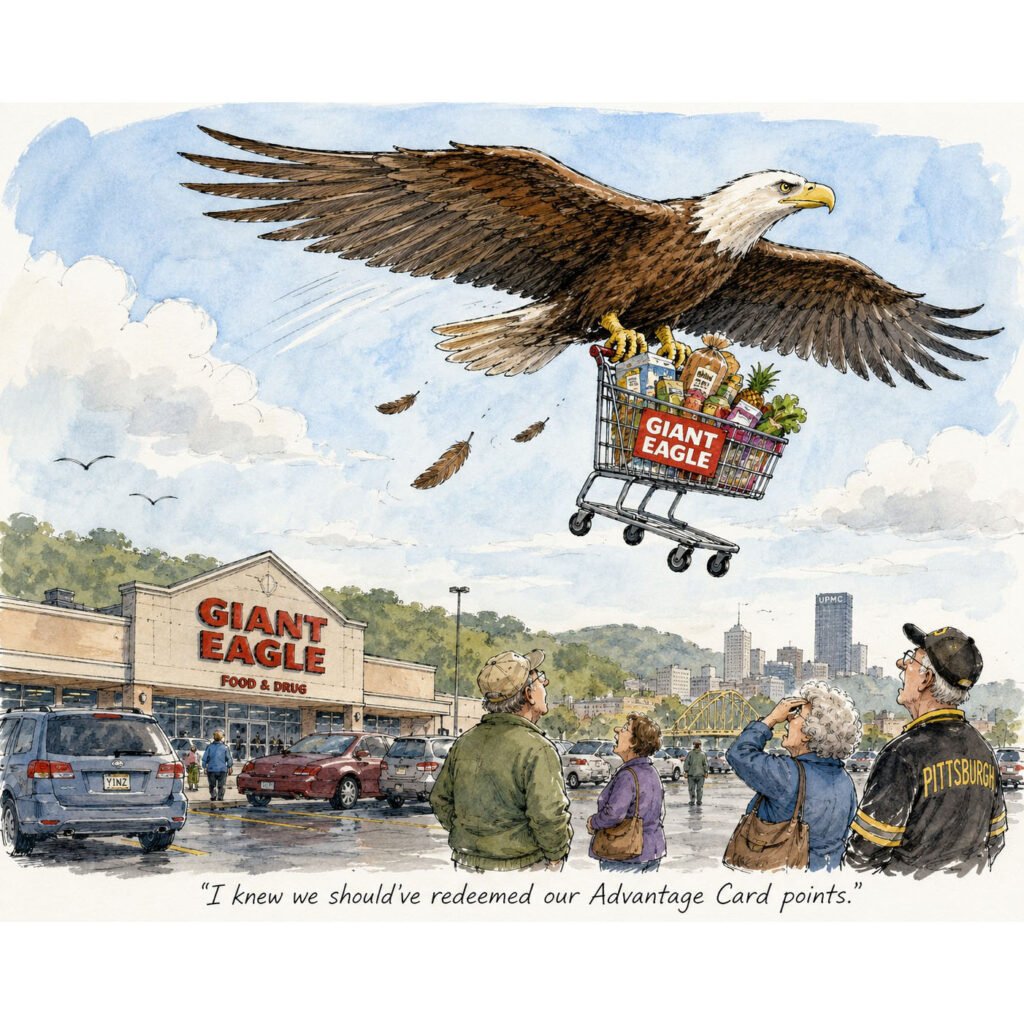
After nearly a century as one of Western Pennsylvania’s defining companies, Giant Eagle is being sold to Kroger for $1.65 billion. Subject to regulatory approval, sometime next year the region’s largest hometown grocer will become another division of America’s largest supermarket operator.
It’s a perfectly rational business decision.
It also feels a little like discovering your childhood church has been converted into luxury condominiums.
For anyone who grew up around Pittsburgh, Giant Eagle wasn’t merely where you bought milk. It was part of the local landscape, as familiar as Primanti sandwiches, the Steelers, and arguing over whether Route 65 was really faster than Interstate 79. Every neighborhood seemed to have one. Every family had opinions. Mine usually involved standing in the checkout line wondering why the customer ahead of me had chosen that precise moment to discover coupons tucked into the bottom of a purse last opened during the Reagan administration.
Giant Eagle wasn’t simply selling groceries. It was selling continuity.
That continuity stretches back to 1931, when three Pittsburgh-area grocery families joined forces during the Great Depression. From those modest beginnings grew one of the nation’s largest privately owned supermarket chains, operating nearly 200 supermarkets and pharmacies across Western Pennsylvania, northern Ohio, West Virginia, Maryland, and Indiana while generating roughly $9 billion in annual sales.
Not bad for a hometown company.
Now comes Kroger.
To be fair, this isn’t a corporate raider swooping in to dismantle the place for scrap. Kroger is itself one of America’s great grocery institutions. Its executives have praised Giant Eagle’s fresh foods, pharmacy business, private-label products, and fiercely loyal customers.
Translation: they’re buying a very good company.
Giant Eagle CEO Bill Artman struck exactly the right note, promising better quality, better service, better value, and greater opportunities for employees. One hopes he’s right.
Consolidation has become the defining story of American business over the past half-century. Local banks become national banks. Independent hospitals become sprawling health systems. Family-owned manufacturers become subsidiaries of multinational corporations. Now grocery stores join the list.
There are undeniable advantages.
A company Kroger’s size possesses enormous purchasing power. It can negotiate better prices, invest heavily in technology, strengthen supply chains, and spread innovation across thousands of locations. Customers may indeed benefit from lower prices and improved selection.
Given the price of groceries these days, nobody is going to complain if eggs stop behaving like luxury goods.
But something else is always surrendered.
Regional companies develop personalities. They sponsor Little League teams because somebody in management coached third base there. They donate to community festivals because their executives actually attend them. Decisions are made by people who know that “yinz” is not a typographical error but a complete sentence.
Corporate scale brings efficiencies.
It also brings distance.
One of Western Pennsylvania’s great strengths has always been its ability to produce companies that became nationally significant without forgetting where they came from. Think of Westinghouse, Heinz, Alcoa, Dick’s Sporting Goods, and Giant Eagle. They reflected something distinctive about this corner of America: practical people solving practical problems while remaining rooted in their communities.
As those companies change ownership—or move their headquarters elsewhere—we lose a little more than a familiar logo.
We lose another headquarters where important decisions are made locally. We lose another generation of executives whose charitable giving, civic leadership, and volunteer work naturally flowed back into Western Pennsylvania because this was home.
Economic developers sometimes talk about “headquarters jobs” as though they’re simply another employment category.
They’re much more than that.
Headquarters create ecosystems. They attract accountants, lawyers, advertising agencies, technology firms, consultants, nonprofits, and entrepreneurs. Decisions made in executive conference rooms ripple outward through an entire regional economy.
That’s why communities compete so fiercely to attract corporate headquarters.
Once they’re gone, they rarely come back.
Still, history has a way of surprising pessimists.
Western Pennsylvania has reinvented itself before. Steel gave way to healthcare. Healthcare is now being joined by robotics, advanced manufacturing, energy, and artificial intelligence infrastructure. Here in Beaver County, we stand on the threshold of what could become one of America’s leading centers for AI-powered economic development.
Perhaps Giant Eagle’s next chapter under Kroger will prove beneficial both for the company and for the communities that built it.
I hope so.
But I also hope Kroger’s executives spend a little time wandering the grocery aisles of Western Pennsylvania—not studying spreadsheets, but listening.
They’ll hear conversations that begin with the weather and somehow end with the Pirates. They’ll meet shoppers who’ve been buying birthday cakes from the same bakery counter for thirty years. They’ll discover that around here, a grocery store has never been merely a place to buy groceries. It’s where neighbors run into neighbors, church bulletins get discussed, grandchildren are shown off, and somebody inevitably asks whether you know their cousin from Hopewell.
Because in Western Pennsylvania, we never really believed Giant Eagle belonged solely to the family that owned it.
We thought, perhaps a bit sentimentally, that it belonged to all of us.
Now the eagle has flown.
The question is whether it remembers where it first learned to spread its wings.