Listen to a podcast discussion about this article.
Mark Twain once observed that October was “one of the peculiarly dangerous months to speculate in stocks.” The others, he added, were “July, January, September, April, November, May, March, June, December, August and February.”
Twain understood something that generations of investors have struggled to learn: markets change, but human nature rarely does.
There comes a point in every bull market when sensible people begin saying wonderfully foolish things. “This time it’s different.”
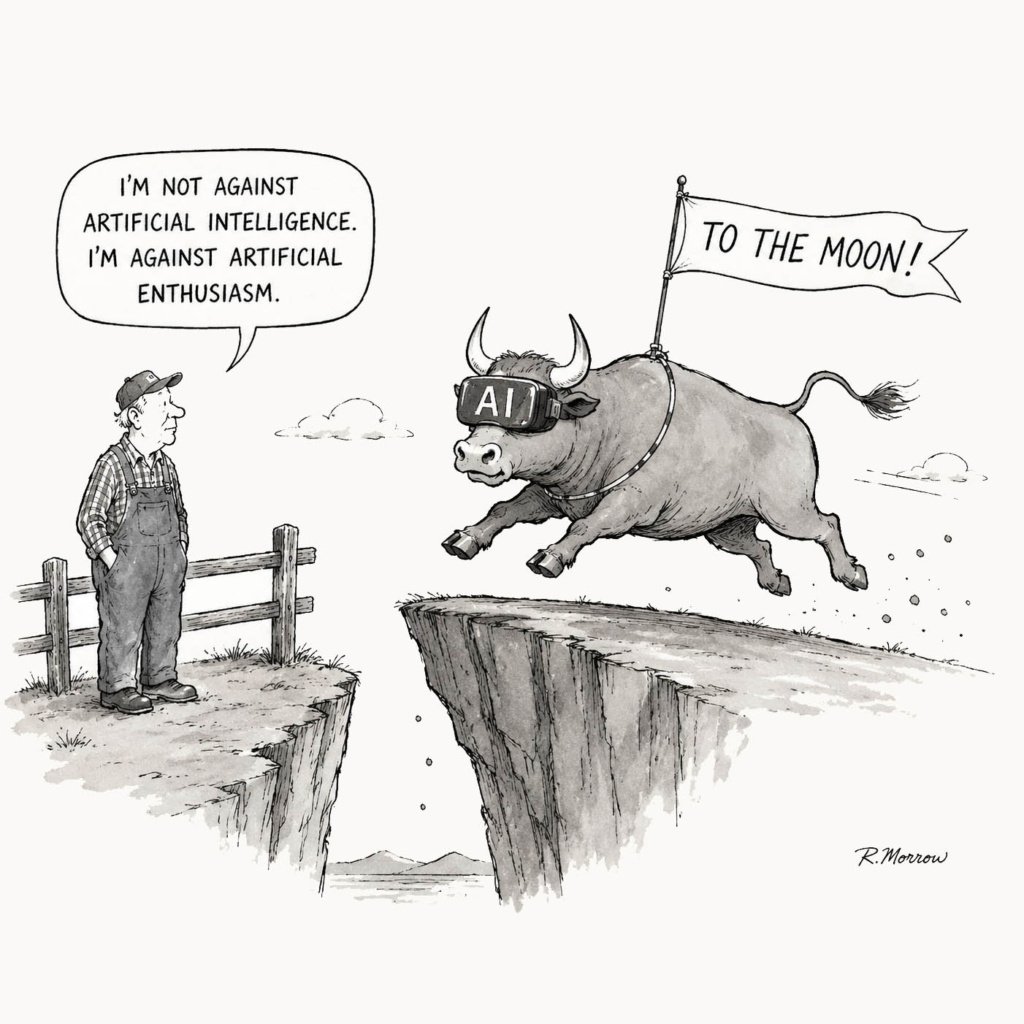
Here in Beaver County—and across Western Pennsylvania—we’ve been hearing a happier version of that refrain lately. Artificial intelligence, new data centers, expanded electric generation, advanced manufacturing, and billions of dollars in announced investment have given this region something it hasn’t enjoyed in quite a while: genuine optimism. Unlike many speculative crazes, much of that optimism is well founded. Real projects are being built. Real workers are being hired. Real wealth is being created.
But as every steel town eventually learned, and every oil boom before it, genuine opportunity and excessive speculation are not the same thing.
History, unfortunately, has a habit of replying, “No, it isn’t.”
Jeremy Grantham has made a career out of remembering that little detail. At 87, the billionaire co-founder of GMO has seen enough booms and busts to qualify as Wall Street’s resident curmudgeon. Think of him as the financial equivalent of the fellow at the end of the bar who keeps insisting the weather is about to change—and is annoying chiefly because he’s often right.
In a recent interview, Grantham issued a warning broad enough to make even an optimist reach for the antacids. According to him, we’re simultaneously inflating an AI stock bubble, poisoning ourselves with industrial chemicals, widening the gap between rich and poor, and measuring national success with all the wrong yardsticks.
Happy Tuesday.
His first concern is the one investors will notice immediately.
Artificial intelligence, he argues, is real. It is transformative. It may well change civilization in ways we cannot yet imagine. That’s precisely why it has become dangerous.
History’s great bubbles weren’t built on frauds. They were built on genuine revolutions. Railroads changed the world. The Internet changed the world. AI almost certainly will, too.
The mistake isn’t believing in the technology.
The mistake is believing that every company with the letters “A” and “I” somewhere in its PowerPoint presentation deserves a trillion-dollar valuation.
Grantham compares today’s enthusiasm to the Dot-Com bubble, when perfectly respectable adults convinced themselves profits were optional and earnings were quaint relics of the twentieth century. When the music stopped, the NASDAQ fell roughly 82 percent.
Markets eventually recover.
Investors don’t always.
His advice is delightfully old-fashioned: own some cash, some quality bonds, a little gold, diversify internationally, and don’t assume American technology stocks will climb forever simply because they have lately.
In other words, your grandmother’s investment philosophy may yet outperform Silicon Valley’s.
That’s a distinction worth remembering in Beaver County. The data-center campuses being planned here, the investments in electric generation, and the resurgence of advanced manufacturing are tangible assets, not stock-market slogans. The companies financing those projects, however, are still subject to the same emotional swings that have governed markets since Dutch merchants started bidding up tulip bulbs.
We’ve learned this lesson before. We watched steel collapse after appearing invincible. We watched the shale boom transform local economies almost overnight. We’ve seen industries rise, stumble, reinvent themselves, and rise again.
Booms are real.
So is gravity.
The interview takes an unexpected turn into public health, where Grantham displays nearly as much concern about what we’re putting into our bodies as what we’re putting into our portfolios.
He worries about PFAS “forever chemicals,” pesticides, microplastics, endocrine-disrupting compounds, and declining fertility. Some of his concerns are widely shared by scientists. Others remain the subject of active debate and ongoing research. The precise causes of declining sperm counts, for example, are far from settled.
Still, it’s difficult to dismiss the broader point.
When Europe bans hundreds of chemicals that America continues to permit, perhaps it’s worth asking why.
When common sense says pregnant women should minimize unnecessary chemical exposure, perhaps that’s simply common sense.
You needn’t become an organic evangelist to conclude that fewer questionable chemicals is generally preferable to more.
For communities like ours, whose prosperity has long depended upon manufacturing, energy production, and heavy industry, these questions deserve thoughtful discussion rather than ideological shouting matches. Economic growth and environmental stewardship are not mutually exclusive. The most successful regions of the future will almost certainly insist upon both.
Grantham’s final warning may be the most important—and the least discussed.
He argues that societies ultimately succeed or fail not because their stock indexes reach new highs, but because ordinary people are healthy, hopeful, and able to build stable lives.
Gross Domestic Product is useful.
So is the S&P 500.
But neither tells you whether your neighbor can afford insulin, whether young families feel confident enough to have children, or whether a community still possesses enough civic trust to solve problems together.
Those things don’t appear in quarterly earnings reports.
Yet they determine whether civilization remains worth investing in.
I don’t agree with everything Grantham says. Few thoughtful readers should.
Market prophets have expiration dates. Even Grantham has been early on some predictions, and being early on Wall Street can look remarkably similar to being wrong.
But I do appreciate his willingness to ask uncomfortable questions while everyone else is busy celebrating.
It’s easy to become intoxicated by rising markets.
It’s harder to ask whether rising markets are producing a healthier, happier, more resilient society.
Beaver County’s future looks brighter today than it has in many years. That’s something to celebrate. But optimism should never require us to suspend our judgment. If anything, prosperity demands even more discipline than adversity.
Artificial intelligence may indeed transform the world. It may transform Beaver County along with it.
Let’s just make sure it doesn’t persuade us to forget the difference between a great investment and a great civilization.