Listen to a podcast discussion about this article.
Every few years, Americans discover something new to panic about. Comic books would corrupt our youth. Television would destroy reading. Personal computers would eliminate office workers. The internet would put every newspaper out of business. Self-checkout lanes would leave us wandering supermarkets in existential despair. Somewhere along the way, someone probably predicted that the electric pencil sharpener would spell the end of Western civilization.
Now it is artificial intelligence’s turn.
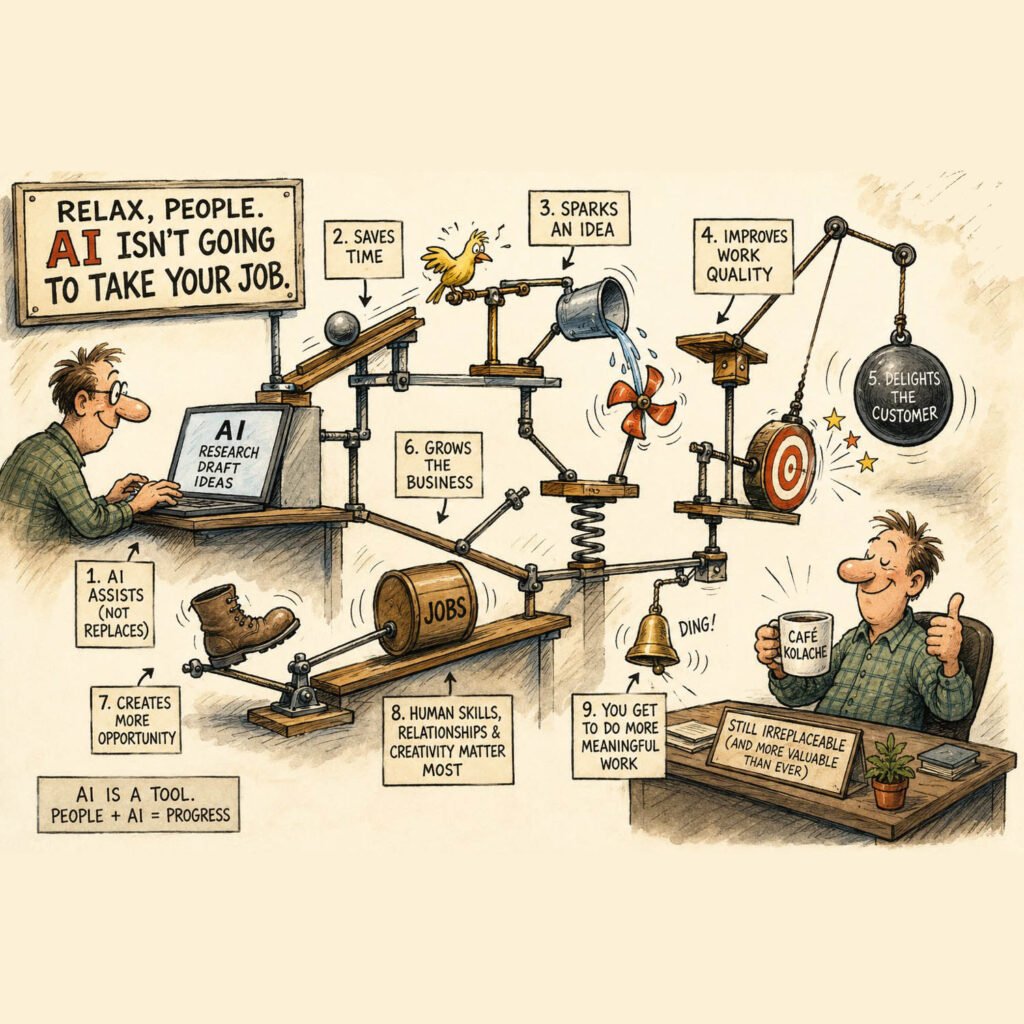
Spend ten minutes on social media and you would think ChatGPT is already roaming corporate office buildings carrying cardboard boxes, politely informing accountants, engineers, lawyers, journalists, and graphic designers that security will escort them to the parking lot by noon.
Relax.
History has a funny way of disappointing prophets of doom.
Consider the humble ATM. When automated teller machines first appeared, nearly everyone “knew” they would eliminate bank tellers. Why employ people to hand out cash when a machine could do it around the clock without taking coffee breaks or calling in sick? It sounded perfectly logical. Except that reality, as it often does, refused to cooperate. Banks became less expensive to operate, which meant they could afford to open more branches. The tellers who remained no longer spent their days counting twenties. They became financial problem-solvers, helping customers with loans, investments, fraud prevention, and the increasingly complicated business of personal finance. Over the following decades, both ATMs and bank tellers multiplied. The machine didn’t replace the people. It promoted them.
That happens more often than we notice.
Commercial aviation offers another example. Modern airliners have flown with sophisticated autopilot systems for decades. In poor weather, today’s aircraft can practically land themselves. If automation truly destroyed jobs, airline pilots should now be as rare as switchboard operators. Instead, automation made flying safer, more reliable, and less expensive. More people flew. Airlines expanded their routes. Entire new markets opened. And because the industry grew, demand for highly trained pilots exploded. Automation didn’t reduce aviation. It made vastly more aviation possible.
The same story played out quietly in offices everywhere. When electronic spreadsheets arrived, accountants were supposedly doomed. Word processors were expected to decimate clerical staffs and perhaps a few writers for good measure. Instead, businesses simply demanded more analysis, more reports, more forecasting, more editing, more communication, and faster turnaround. The software eliminated drudgery, not judgment. It removed repetitive labor while raising expectations for the work only human beings could perform. Accountants became advisors. Writers became publishers. White-Out quietly slipped into retirement.
Artificial intelligence appears to be following precisely the same path.
One of the most illuminating ideas I’ve encountered recently is that AI often competes not against existing workers but against non-consumption—all the things people never attempted because they were simply too expensive, too complicated, or too time-consuming. Imagine a manufacturer that wants a single custom prototype. A generation ago, creating specialized molds might have cost tens of thousands of dollars before the first part ever emerged from the factory. The project died before it began. Today, AI-assisted design, inexpensive 3D printing, and rapid prototyping allow that same idea to become reality in an afternoon. Nobody loses a job because the work wasn’t being done in the first place. Entirely new work comes into existence.
That is how economies grow.
MIT economist David Autor has pointed out that roughly 60 percent of the jobs Americans hold today didn’t even exist fifty years ago. Pause over that statistic for a moment. Cybersecurity analyst. Cloud architect. Drone operator. Data scientist. Podcast producer. Social media manager. Prompt engineer. None of those occupations would have appeared in your high school guidance counselor’s handbook in the 1970s. Technology has an extraordinary habit of creating tomorrow’s careers while eliminating yesterday’s routines, and history suggests the creative side of that equation usually wins.
There is, admittedly, one famous exception.
The manual elevator operator really did disappear. Once upon a time, people spent their working lives standing inside elevators moving levers up and down all day. Eventually skyscrapers became so tall and passenger traffic so complicated that computers genuinely became better at routing elevators than human beings ever could. The occupation vanished because the machine mastered the entire task. Most jobs simply don’t work that way. They combine technical knowledge with judgment, relationships, persuasion, ethics, creativity, experience, and common sense. Those qualities remain stubbornly resistant to automation.
Artificial intelligence is remarkably good at searching documents, summarizing information, generating first drafts, analyzing data, and removing what one might politely call the mind-numbing parts of knowledge work. What it cannot do is build trust over breakfast at Café Kolache. It cannot reassure an anxious client whose shipment has gone missing. It cannot persuade skeptical investors to finance an ambitious project. It cannot read the room during a difficult negotiation. And despite Silicon Valley’s considerable confidence, it still hasn’t mastered Beaver County’s peculiar blend of dry humor, practical wisdom, and healthy skepticism.
Which brings us to the real lesson.
Artificial intelligence probably won’t take your job. Someone who knows how to use artificial intelligence almost certainly can.
The employee who insists on spending two hours formatting reports by hand will eventually find himself competing against a colleague who finishes the same assignment in ninety minutes and spends the remaining half-hour solving customer problems, developing new business, or thinking creatively about tomorrow instead of yesterday. The technology doesn’t make the second employee more intelligent. It simply makes that intelligence more productive.
Here in Beaver County, where manufacturing, healthcare, engineering, logistics, energy, and professional services are all entering a new era, that distinction matters. Our competitive advantage has never been cheap labor. It has always been capable people willing to learn new tools, master new skills, and adapt to changing circumstances. Artificial intelligence is simply the latest tool in a very long line stretching from the steam engine to the spreadsheet.
So don’t fear the machine.
Learn to drive it.
History suggests that’s where the jobs—and the opportunity—will be.