Listen to a podcast discussion about this article.
In 1753, George Washington was not yet the Father of His Country. He was simply an ambitious 21-year-old major from Virginia with muddy boots, a borrowed sense of confidence, and an assignment that seemed destined to end either in diplomatic success or an unmarked grave somewhere in the wilderness.
The recently released Young Washington captures that remarkable transformation with uncommon intelligence. It reminds us that Washington did not learn leadership in a classroom. He learned it in places where mistakes could get you killed.
One of those places was Beaver County.
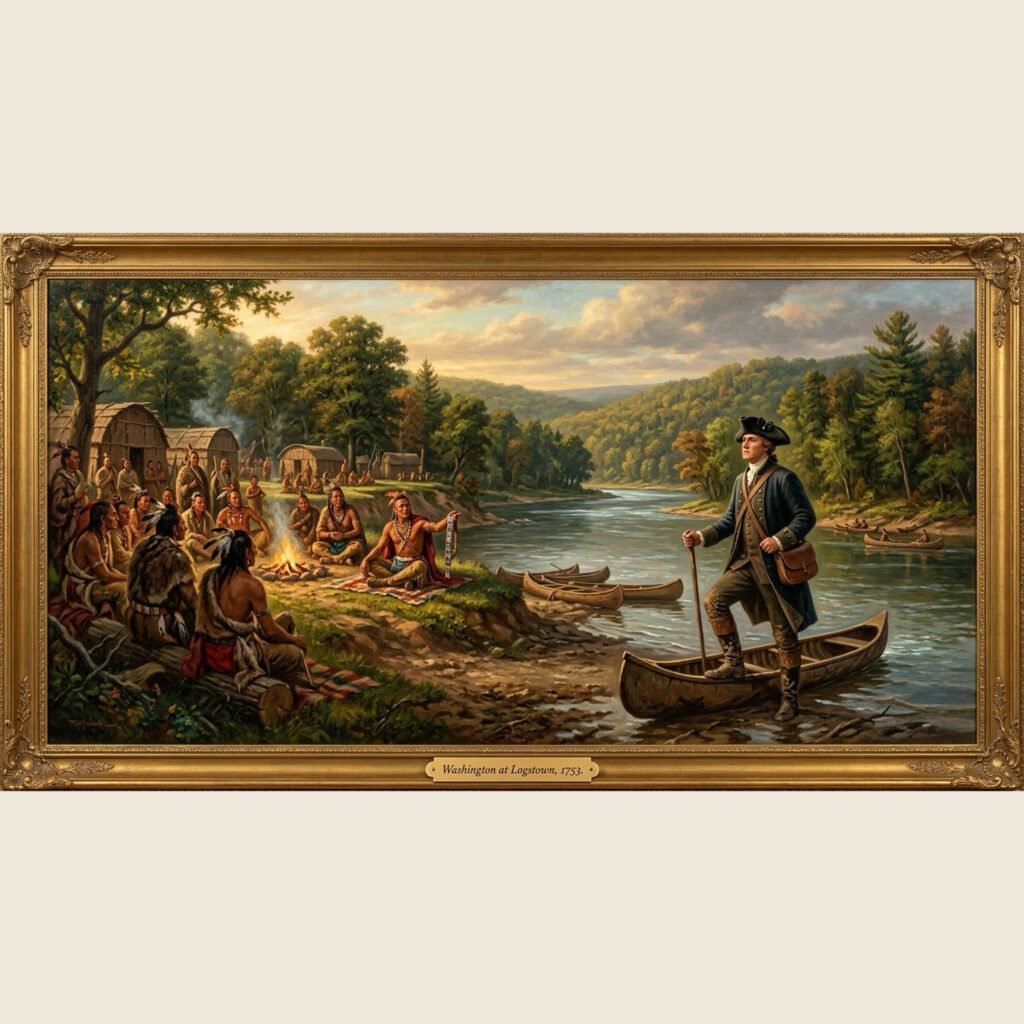
If you’ve seen the film, you know the Ohio Valley is more than scenery. It is practically another character. The forests are immense, the rivers untamed, and civilization little more than an optimistic rumor. Looking at those landscapes, it becomes easier to understand why whoever controlled this valley controlled the future of North America.
That was true in 1753.
It may still be true today.
Washington’s assignment from Virginia Governor Robert Dinwiddie sounded deceptively simple: carry a letter to the French demanding they leave the Ohio Country. It was rather like sending a young lieutenant to Moscow with instructions to politely ask the Kremlin to pack up and go home.
The French, unsurprisingly, declined.
But Washington’s real accomplishment had less to do with diplomacy than reconnaissance. His remarkable journal reveals something already evident in Young Washington: the young officer possessed a surveyor’s eye. He noticed everything—river depths, soil quality, military positions, travel times, fortifications, supply routes, and the disposition of Native leaders.
Good leaders observe before they decide.
Washington reached Logstown—today in Harmony Township, just a few miles from where many of us drink our morning coffee—after nearly a month of miserable travel through rain, snow, swollen rivers, and dense forests.
Logstown was no sleepy frontier hamlet.
It was one of the most strategically important communities in North America.
Shawnee, Lenape, Delaware, and representatives of the Six Nations met there to trade, negotiate, and decide the future of the Ohio Country. Whoever won Logstown’s friendship stood a reasonable chance of winning the valley itself.
Washington understood that instinctively.
Instead of barging in with demands, he followed Native diplomatic customs. He presented wampum. He listened before speaking. He met privately with the Iroquois leader Tanacharison—the famous Half-King—and carefully built trust. The journal records long conversations, respectful exchanges, and symbolic gestures that modern diplomats would still recognize.
Not bad for someone barely old enough to rent a car today.
The Half-King agreed to accompany Washington north to meet the French commandant, bringing several warriors with him. Even more significant, he agreed to return French wampum belts—a ceremonial declaration that old alliances were being broken.
Washington immediately grasped its importance.
“I knew,” he wrote, “that returning of Wampum was the abolishing of Agreements.”
That is not the language of an inexperienced adventurer.
It is the language of a strategist.
The French commander at Fort Le Boeuf politely rejected Washington’s demands, and the mission officially failed. Yet history sometimes has an odd habit of rewarding unsuccessful missions.
Washington returned with something arguably more valuable than French compliance.
He brought intelligence.
His journal cataloged French troop strength, fort locations, supply routes, geography, and Native politics with extraordinary precision. Published in 1754, it made the young Virginian famous throughout the colonies and established his reputation as someone who could survive hardship while keeping his head.
That reputation eventually carried him to Valley Forge, Yorktown, Philadelphia, and immortality.
But first it carried him through Beaver County.
The Ohio Valley mattered because it was the continental crossroads. Whoever controlled the Forks of the Ohio controlled river traffic connecting the Great Lakes, Canada, the Mississippi, and eventually the vast interior of the continent. It offered fertile farmland, abundant timber, rich fur resources, and transportation corridors that modern logistics companies would envy.
The French understood that.
The British understood that.
The Native nations certainly understood that.
The struggle for the Ohio Valley was never merely about wilderness.
It was about the economic future of North America.
Britain’s eventual victory expelled France from Canada and lands east of the Mississippi, opening the continent to British settlement. Ironically, the enormous cost of that victory prompted London to tax its American colonies more aggressively, planting many of the grievances that blossomed into the American Revolution.
In other words, the road to American independence ran straight through the Ohio Valley.
There is another lesson here for Beaver County.
For generations we have tended to think of ourselves as Pittsburgh’s northern suburb or western Pennsylvania’s industrial appendix. History tells a different story. Long before steel mills, cracker plants, or data centers, this valley sat at the strategic center of the continent.
Its importance has merely changed forms.
Yesterday it was fur, farmland, rivers, and military logistics.
Today it is energy, advanced manufacturing, artificial intelligence infrastructure, river transportation, and abundant electricity.
The strategic logic remains surprisingly familiar.
Watching Young Washington, I found myself less impressed by Washington’s courage than by his curiosity. Before he became the indispensable general, he became an extraordinary observer. He studied landscapes. He listened to allies. He gathered facts before forming opinions.
It strikes me that Beaver County could profit from adopting the same habit.
After all, if a 21-year-old George Washington could recognize the importance of the Ohio Valley while standing ankle-deep in November mud at Logstown, perhaps we should recognize it while standing on a paved parking lot with a smartphone in our pocket.