Listen to a podcast discussion about this article.
Washington has an astonishing talent for announcing the arrival of ideas that have been around longer than the Capitol dome. Every few years, politicians hold solemn press conferences to explain that America ought to make more of the things it uses, invest in its infrastructure, and stop becoming dangerously dependent on foreign manufacturers. The speeches change. The graphics become more colorful. The applause lines are updated.
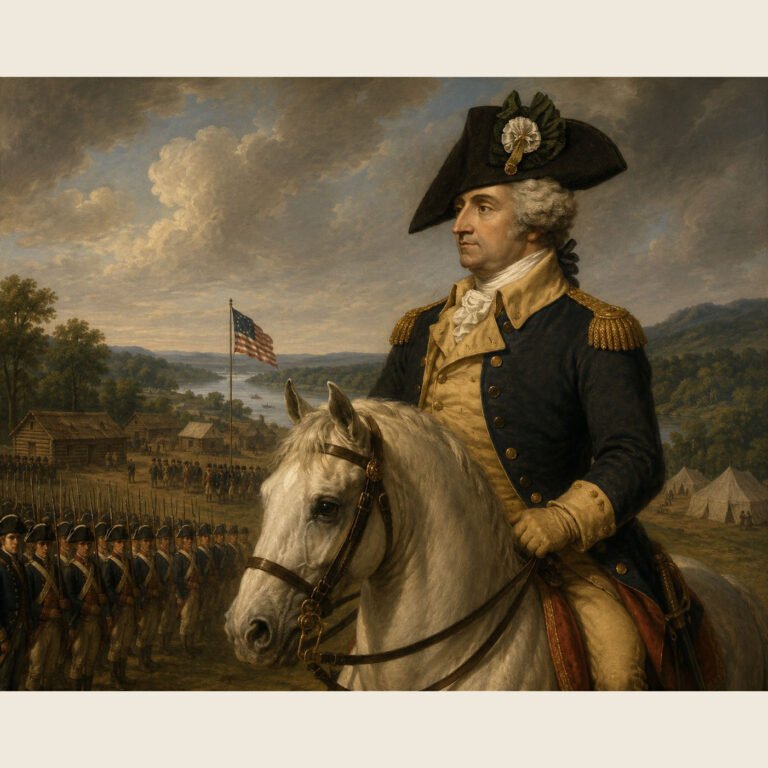
The idea itself hasn’t changed much since Alexander Hamilton first laid it out in the 1790s.
Hamilton believed the young republic could never become truly independent if it remained little more than Europe’s supplier of timber, grain, iron ore, and other raw materials. America needed factories every bit as much as it needed farms. Henry Clay later gave that vision a name: the American System. It rested on three pillars—protective tariffs, stable credit through a national bank, and public investment in roads, canals, railroads, and other infrastructure that tied the nation together.
To many Americans, it sounded like common sense.
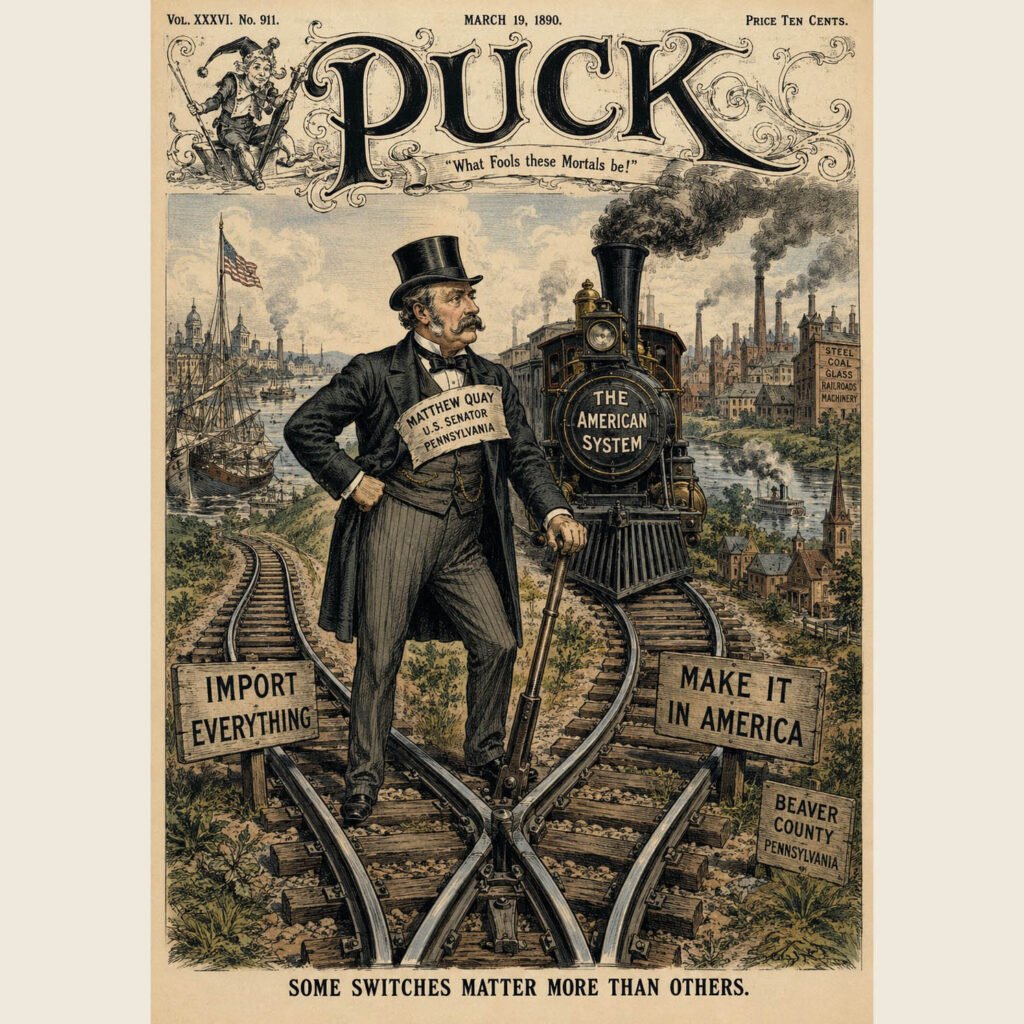
To Matthew Quay, it sounded like Pennsylvania.
Today Quay is remembered—if he is remembered at all—as a political boss with an uncanny ability to count votes before anyone else had finished counting noses. Mark Twain might have admired the craftsmanship while keeping one hand on his wallet. Yet reducing Quay to machine politics misses something important.
He understood that Pennsylvania’s prosperity rested on blast furnaces, rolling mills, coal mines, railroads, glass factories, and the men and women who turned raw materials into finished products. So Quay became one of the nation’s fiercest defenders of the protective tariff, the most enduring feature of Clay’s American System.
As chairman of the Republican National Committee, Quay helped elect Benjamin Harrison in 1888 on a platform proudly endorsing “the American system of protection.” Two years later, he defended the McKinley Tariff, and when Democrats sought to lower tariffs through the Wilson-Gorman Act, Quay fought them every step of the way, even staging a memorable filibuster.
To modern ears, tariff debates often sound like obscure economic plumbing.
In Quay’s Pennsylvania, they were about paychecks.
A tariff meant that a steel mill in Beaver Falls, a foundry in Pittsburgh, or a glass plant along the Ohio River had a better chance of competing against foreign imports. Whether one agrees with that policy today is almost beside the point. For Quay’s generation, protecting American industry meant protecting American communities.
Few places demonstrated that connection better than Beaver County.
By the late nineteenth century, Beaver County had become one of America’s great industrial landscapes. Railroads linked mills and markets. Coal fueled furnaces. The Ohio and Beaver rivers carried finished products to the rest of the nation. Communities prospered because local industries prospered.
Henry Clay never visited Beaver County.
Yet Beaver County became one of the finest demonstrations of his economic philosophy.
The mills created jobs. Those jobs built neighborhoods, churches, schools, newspapers, banks, and the countless small businesses that form the backbone of every healthy community. None of it happened by accident. It reflected public policies that encouraged investment, rewarded production, and viewed manufacturing as the foundation of national prosperity.
That consensus endured for much of the twentieth century. Only in recent decades did many policymakers begin assuming America could prosper by designing software, managing financial portfolios, and importing everything else.
Beaver County has spent a generation living with the consequences of that assumption.
Which helps explain why the old arguments suddenly sound remarkably current.
During a rally in Louisville in 2017, President Donald Trump reached back to Henry Clay’s long-neglected philosophy. Clay, Trump said, believed in the “American System,” using tariffs “to protect American industry and finance American infrastructure.” He called Clay “a fierce advocate for American manufacturing” and praised the principle that trade should be “fair, equal and reciprocal.”
Whether one agrees with Trump’s policies or not, the history was unmistakable. He was reviving an economic tradition that stretches from Hamilton through Clay and, in Pennsylvania, through Matthew Quay.
Artificial intelligence may dominate today’s headlines, but somebody still has to manufacture the transformers, turbines, transmission lines, steel, and electrical equipment that make it possible. Data centers do not spring from the earth. They are built with skilled labor, abundant energy, and American industry.
That is why Beaver County once again finds itself standing where history and opportunity intersect. New investment in energy and advanced manufacturing echoes ideas that Hamilton first articulated, Clay named, and Quay defended more than a century ago.
History has an odd habit of changing costumes while delivering the same lines.
Matthew Quay probably wouldn’t recognize today’s debates over artificial intelligence or data centers. But he would instantly recognize the larger question: Should America build the industries of the future here at home, or buy them from someone else?
For all his legendary political maneuvering, that may be his most enduring legacy.
He understood that economic independence is rarely an accident. It is the result of deliberate national choices.