Listen to a podcast discussion about this article.
There was a time when the most important business meeting in the Upper Ohio Valley wasn’t held in a boardroom.
It was held over dinner.
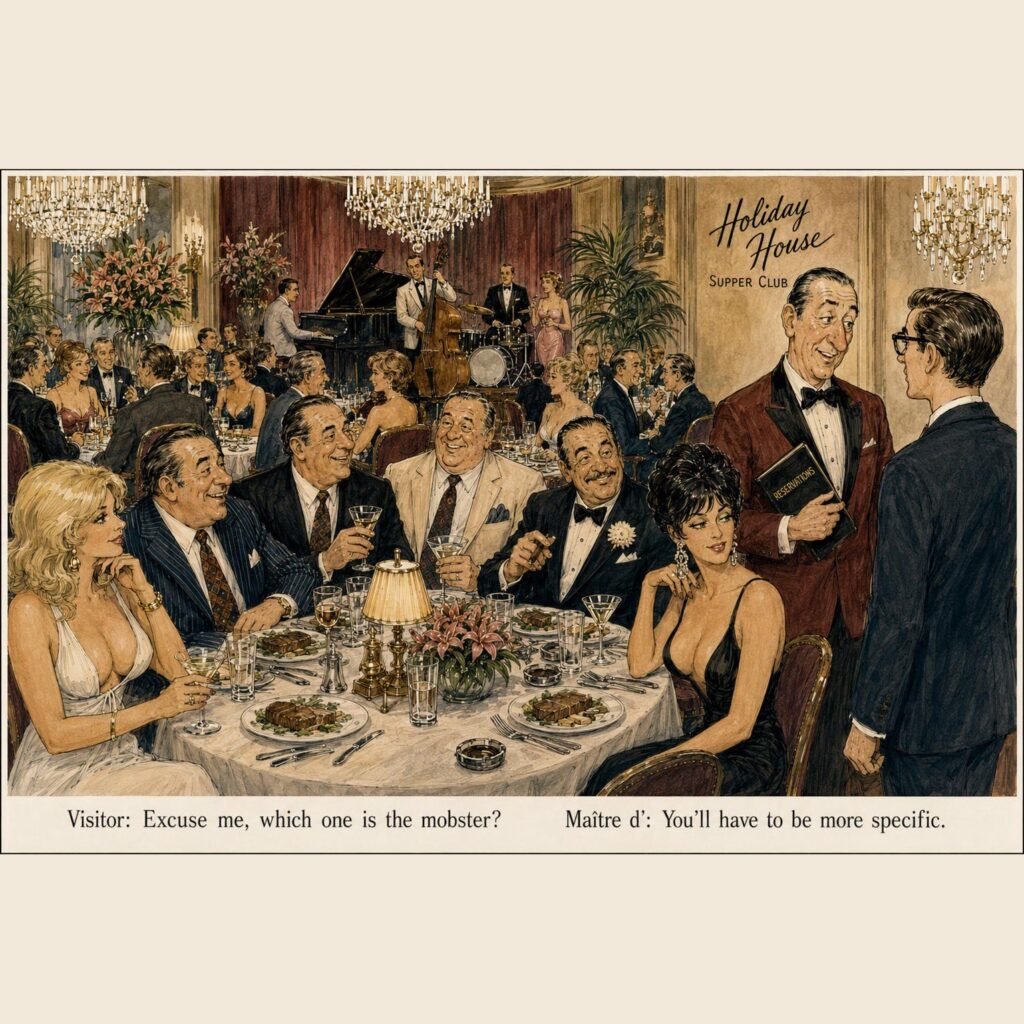
Hollywood has taught us that organized crime happened in abandoned warehouses where nervous men whispered beneath a single hanging light bulb. Around here, however, the underworld had better taste. It preferred linen tablecloths, dance orchestras, polished mahogany bars, and waiters who knew precisely when to refill your martini.
The boss wasn’t hiding in an alley.
He was reserving the best table in the house.
The Upper Ohio Valley was once a single economic organism. Pittsburgh, Beaver Falls, Aliquippa, New Castle, Youngstown, East Liverpool, Steubenville, and Wheeling were tied together by steel mills, railroads, rivers, and two-lane highways. Money flowed freely among them. So did people. A fellow might have lunch in Beaver, dinner in Youngstown, stop in Wheeling to watch the trotters, and be home before sunrise with a pocket full of business cards—and perhaps a betting slip tucked discreetly behind them.
The remarkable thing wasn’t that organized crime existed.
Every industrial city had an underworld.
What made ours distinctive was how respectable it often looked.
Pittsburgh’s Ankara on Route 51 may have been the region’s gold standard. Opened in 1946, it offered fine dining, nationally known entertainers, and even an ice rink hidden beneath its dance floor. But it was hardly alone. The Holiday House in Monroeville became a destination for politicians, entertainers, athletes, and executives passing through town. Tony Grosso’s Living Room in Bethel Park was nearly as famous for the conversations around its tables as for the meals served upon them. Downtown, Tambellini’s attracted lawyers, judges, newspaper editors, politicians, and businessmen who understood that a good lunch often accomplished more than a dozen telephone calls.
Youngstown sang much the same tune. Restaurants like the Colonial House and Cicero’s became gathering places for politicians, labor leaders, contractors, judges, steel executives, entertainers, and the occasional gentleman whose income was difficult to explain on a tax return. Good food has always been civilization’s most effective camouflage.
New Castle preferred a quieter style. Its Italian restaurants, taverns, and private clubs became places where everybody knew everybody else’s business but possessed the good manners not to discuss it until after Sunday services. Mill paydays fueled card games. Card games attracted bookmakers. Bookmakers attracted fellows in expensive suits who somehow never seemed to have ordinary jobs.
Nature, as they say, abhors a vacuum.
It also appears to attract gambling.
Then there was Wheeling.
Long before casinos became respectable, Wheeling Downs drew harness-racing fans from throughout the Valley, while Wheeling Island’s greyhound track offered another reason to cross the river after work. A successful afternoon negotiating a steel contract could easily be followed by an evening at the races and dinner at the McLure Hotel, the Fort Henry Hotel, or one of downtown Wheeling’s elegant dining rooms. Gambling, hospitality, and commerce blended together so naturally that one scarcely knew where one ended and the other began.
Not every after-hours destination featured linen napkins and chateaubriand, of course. Downtown Pittsburgh had its own ecosystem of massage parlors, topless bars, private clubs, and back-room gambling joints tucked only blocks from law firms, department stores, banks, and corporate headquarters. The respectable city and the shadow city occupied the same streets. They simply kept different business hours.
Beaver County occupied the middle of this web.
Not because our restaurants were criminal enterprises—they weren’t—but because they served exactly the same purpose. The Red Bull Inn in Beaver Falls, Pappan’s Ark in Bridgewater, Ciro’s Top of the Mall, Diddio’s in Rochester, and the Fez in Hopewell became places where bankers, contractors, physicians, lawyers, politicians, newspaper publishers, steel executives, union officials, and the occasional colorful character inevitably crossed paths.
If you wanted to know what was happening in Beaver County, you could spend a morning reading the newspaper.
Or an hour walking through one of those dining rooms.
Restaurants were the Upper Ohio Valley’s unofficial chambers of commerce.
The Valley, after all, wasn’t really a collection of separate cities.
It was one long dinner party.
A steel executive from Aliquippa might be seated beside a labor leader from Youngstown. A banker from Beaver could be meeting a contractor from New Castle. A Wheeling horse owner drifted over to congratulate an East Liverpool pottery manufacturer. Somewhere across the room sat a bookmaker pretending to be in the trucking business, while an actual trucking executive quietly wondered whether he’d chosen the wrong profession.
The orchestra never stopped playing.
Looking back, it’s tempting to romanticize the era. Dinner lasted three hours. Couples danced to live music. Waiters wore tuxedos. Parking attendants wore uniforms. Even ordinary restaurants possessed a degree of grace that’s difficult to imagine today.
The photographs look like scenes from Mad Men.
Only with better food.
What the photographs don’t show are the quieter costs. Illegal gambling bought influence. Influence bought protection. Honest businessmen sometimes found themselves competing against people who regarded tax laws as optional reading. Public officials occasionally forgot precisely whom they represented.
The chandeliers were genuine.
So was the corruption.
Today’s criminals rarely bother with any of that. Cryptocurrency scammers don’t sponsor dance orchestras. Ransomware gangs don’t build elegant supper clubs. Internet fraud doesn’t come with lobster tails, table-side Caesar salads, or cheesecake served with fresh coffee.
Modern crime is efficient.
The old crime, for all its faults, understood hospitality.
For nearly half a century, the Upper Ohio Valley’s real social network wasn’t built on telephones or computers. It was built on supper clubs, racetracks, hotel dining rooms, neighborhood taverns, and restaurants where everyone—from governors to gamblers—eventually found themselves sharing the same menu.
The only real mystery was who was picking up the check.