
Listen to a podcast discussion about this article.
One of the oddities of modern business is that we spend an awful lot of time admiring companies for the wrong reasons. We applaud the shiny machinery, the clever engineering, the charismatic chief executive who tweets at three in the morning. Then, years later, we discover that the real genius wasn’t the gadget at all. It was the business model quietly hiding underneath it, like the old mill foreman in Aliquippa who never wore a necktie but somehow knew where every dollar was hiding.
SpaceX is beginning to look like one of those cases.
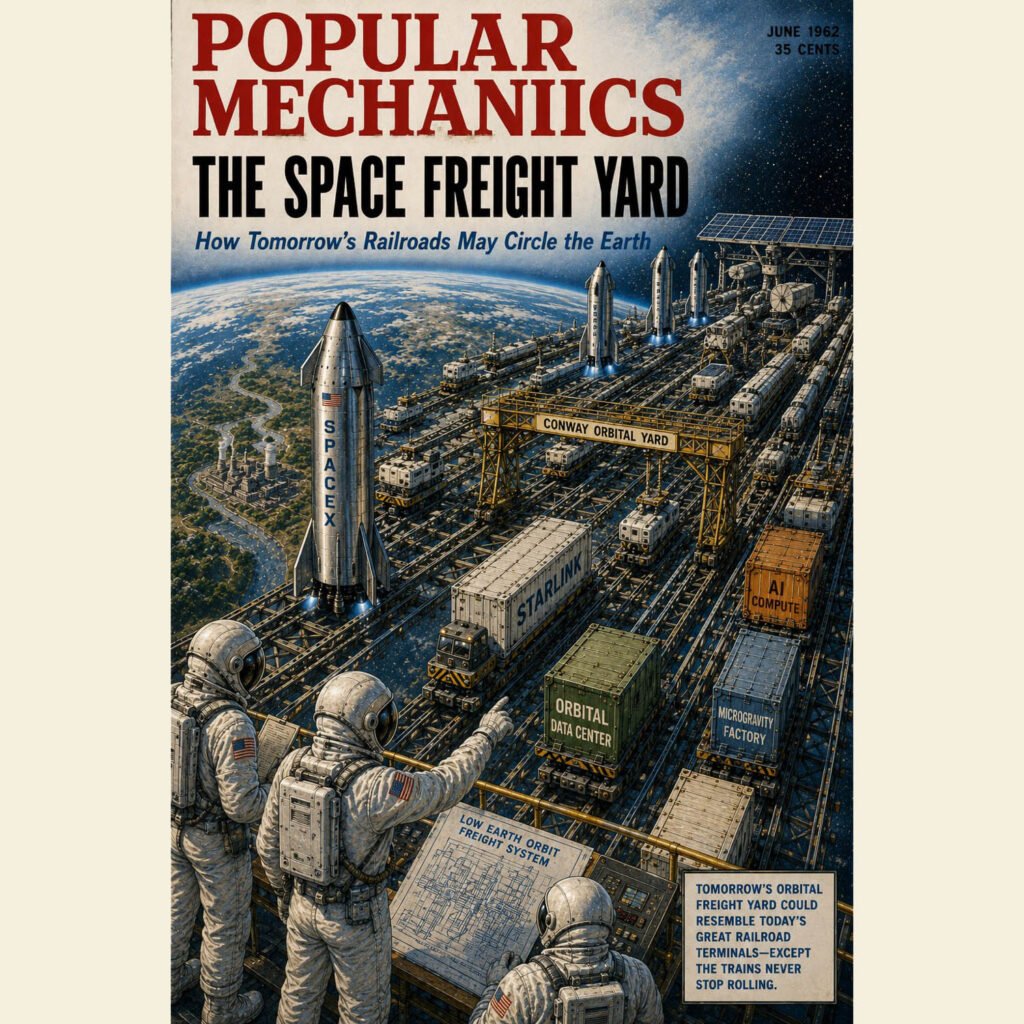
Most people think SpaceX is in the rocket business. That’s understandable. Rockets are hard to miss. They rise dramatically, belch fire, and have an unfortunate tendency, at least during testing, to imitate expensive fireworks over South Texas. Around Beaver County, we’d simply say they remind us of BOOM weekend after somebody’s had one too many Iron Citys.
But rockets are merely the delivery truck.
The valuable piece of real estate is the empty space at the very top—the payload chamber. Everything else exists to get that cargo where it needs to go.
Anyone who grew up in Beaver County instinctively understands this. We watched endless freight trains snake along the Ohio River. We admired the locomotives because they were loud and magnificent. The Pennsylvania Railroad, meanwhile, was admiring the freight cars.
Viewed this way, the question isn’t, “How much does it cost to launch a rocket?” The better question is, “How much money can you earn over the lifetime of every ton you send into orbit?”
Suppose SpaceX sells a launch to someone else. A Falcon 9 can carry roughly 17 tons into orbit for about $74 million—around $4 million in revenue per ton.
Respectable enough.
Until you compare it with what happens when SpaceX launches its own satellites.
A Starlink satellite spends years collecting subscription fees from farms, ships, military bases, and places where cable companies long ago decided civilization stopped about the time you crossed Raccoon Creek. Over its lifetime, every ton of Starlink hardware earns several times what SpaceX would make by merely selling the ride.
In other words, the smartest customer SpaceX ever found was…SpaceX.
That sounds awfully familiar.
During the nineteenth century, America’s great railroad barons eventually realized that hauling freight wasn’t where the really big money lived. The federal government handed many railroads enormous land grants along their routes. Soon they weren’t merely carrying passengers from Pittsburgh to Chicago. They owned the towns, the hotels, the warehouses, the farmland, and much of the commerce waiting at the other end.
Transportation became the means rather than the end.
Around Beaver County, we’ve seen this business model before. Jones & Laughlin didn’t simply make steel. It owned mines, rail lines, river terminals, company housing, and enough of Aliquippa to make you wonder whether the city was incorporated or merely leased. Carnegie understood it. Henry Clay understood it. Matthew Quay understood it. The transportation network mattered because it connected everything else they owned.
The airlines, by contrast, inherited the less enviable model. They own the trip but almost nothing at the destination. Hence the modern spectacle of billion-dollar companies fighting over whether passengers deserve two pretzels or three.
SpaceX has chosen to become a railroad instead of an airline.
Starlink is its company town.
In fact, most of SpaceX’s launches today aren’t carrying other people’s payloads. They’re launching more Starlink satellites, expanding the company’s own infrastructure. The rocket is working for its owner’s balance sheet rather than someone else’s.
Naturally, Elon Musk isn’t inclined to stop there.
Moving information around the globe is already lucrative. But merely transporting data is a little like shipping raw steel ingots out of Midland. The greater profit often comes from refining them before they ever leave the factory gate.
That’s why the next frontier may not be Mars at all. It may be enormous data centers orbiting the Earth, powered continuously by sunlight and cooled by the vacuum of space, processing information before transmitting only the finished results back to Earth. If communications satellites dramatically improve the lifetime return on every ton launched into orbit, orbital computing could improve it again.
And suddenly Starship begins making sense.
Many people hear “Starship” and picture Mars colonies, little greenhouses beneath transparent domes, and Matt Damon growing potatoes in inconvenient places.
Perhaps someday.
But Mars isn’t the immediate business case.
Starship’s purpose is much more prosaic—and much more profitable. By carrying many times more cargo than today’s Falcon 9 while dramatically reducing the cost per ton, it makes larger satellites, orbital factories, and entirely new industries economically practical. Businesses that today sound like science fiction begin looking awfully like the sort of capital investment proposal that once landed on a conference table at Westinghouse or Babcock & Wilcox.
History has a way of repeating itself, though it usually changes the costumes.
In the nineteenth century, fortunes were built by laying steel rails across empty continents and then owning what sprang up alongside them.
In the twentieth century, Beaver County prospered because it sat where rivers, railroads, mills, and electric power all met in one industrious little corner of Pennsylvania.
In the twenty-first century, the rails may be invisible, stretching through low Earth orbit rather than across Kansas. The locomotives are reusable rockets instead of steam engines. The company towns are constellations of satellites instead of grain elevators and depots.
The principle, however, remains delightfully old-fashioned.
The people who make the most money from transportation are rarely the ones who merely sell tickets.
They’re the ones who own what’s waiting at the other end.