Listen to a podcast discussion about this article.
Every family has its peculiar obsessions.
Some collect antique clocks. Some spend weekends haunting flea markets in search of Depression glass. My mother collected stone houses.
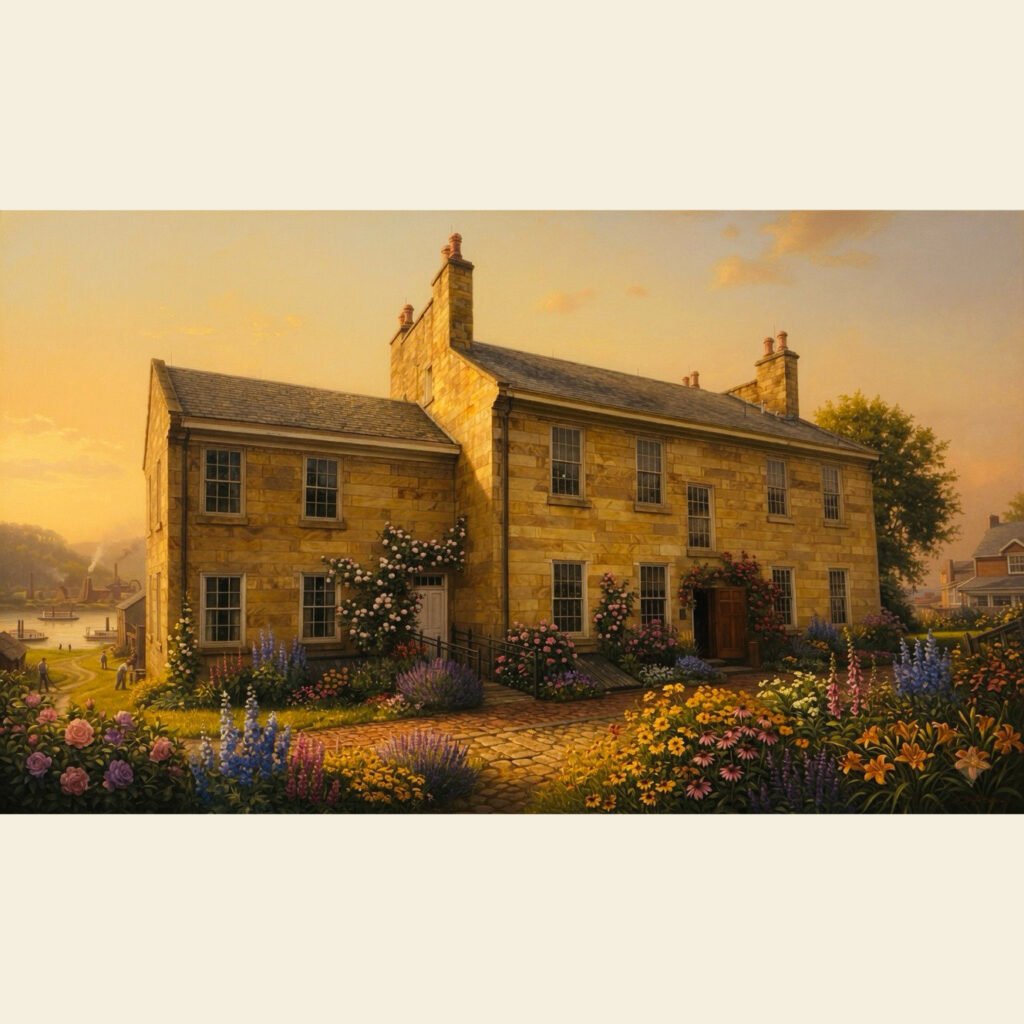
Not literally, of course. The zoning laws would have frowned on that. But whenever we were driving through western Pennsylvania and one appeared around a bend—a sturdy old farmhouse or Georgian mansion built from native sandstone—she would slow the car and admire it with the reverence other people reserve for cathedrals.
My father used to joke that she wanted “a small house with a lot of big rooms in it.”
He was only half kidding.
Her favorite of them all was the Vicary Mansion in Freedom.
She dreamed of building one like it on our farm on Morrow Road.
This was a wonderfully impractical ambition. Even in the 1960s it would have required enough sandstone to reshape half of Chippewa Township and enough skilled masons to keep Beaver County employed for a decade. Fortunately for my father’s checkbook, the dream never advanced beyond conversation.
Still, I understood the attraction.
Stone houses possess an air of permanence that frame houses can only envy. They seem less built than discovered, as though someone simply brushed away the soil and found them waiting there.
The Captain William Vicary House has that quality.
Completed in 1829, it rises above the Ohio River in Freedom with the quiet confidence of a building that has already survived everything history could think to throw at it. Nearly two centuries have passed since Captain William Vicary selected locally quarried sandstone and began assembling what was then one of the finest homes in western Pennsylvania.
The remarkable thing is not merely that it still stands.
It is that its story has endured almost as well as its stonework.
William Vicary was unquestionably a successful merchant sea captain who prospered in Atlantic commerce before bringing his fortune west. For generations, however, Beaver Countians embroidered his biography with an even grander tale: that he had fought as a naval hero in the War of 1812, captured four British vessels, and been rewarded with western Pennsylvania land for his service.
It’s exactly the sort of story an old mansion ought to have.
Unfortunately for storytellers—and fortunately for historians—modern research has uncovered little evidence that any of it happened. Vicary certainly was “Captain” Vicary, but the title appears to have come from his years at sea as a merchant mariner rather than from the United States Navy. The land beneath the mansion was purchased, not awarded. Like many local legends, the story seems to have grown a little more impressive each time it was retold.
The truth is no less remarkable.
After acquiring more than 600 acres near Economy, inspired in part by the industrious Harmony Society at nearby Old Economy Village, Vicary laid out a community he called St. Clair in 1837 and proceeded to build himself a mansion costing more than $4,000—a princely sum in the late 1820s.
The house reflected both prosperity and confidence.
Its massive sandstone walls, carefully fitted by skilled craftsmen, remain among the finest examples of early nineteenth-century masonry in western Pennsylvania. The elegant proportions, double chimneys, and restrained classical details speak of a man who believed permanence was worth investing in.
He wasn’t wrong.
Vicary lived there until his death in 1842, although even success had its complications. A dispute with one of the builders eventually grew into a lawsuit that reached the Pennsylvania Supreme Court. It seems contractors and clients have been disagreeing about construction projects for as long as people have been building houses.
Some things never change.
His descendants remained in the mansion until 1912, after which it passed through several owners and endured the sort of indignities that often befall historic buildings. Portions of the interior were divided into apartments. Architectural details disappeared. A porch was added. Fireplaces vanished.
Then came the greatest threat of all.
In the 1960s, Route 65 nearly erased the house from the landscape. Progress has an unfortunate habit of treating old buildings as obstacles rather than assets. Fortunately, local citizens disagreed. A grassroots preservation effort saved the mansion from demolition, and today Beaver County owns the property while the Beaver County Historical Research and Landmarks Foundation operates it as a museum.
It is difficult to imagine Freedom without it.
Historic buildings do more than preserve old furniture and faded wallpaper.
They preserve ambition.
The Vicary House reminds us that Beaver County did not begin with steel mills, railroads, or cracker plants. It began with men and women willing to invest astonishing amounts of labor, money, and optimism into a place they believed had a future.
Perhaps every old house acquires a legend or two, just as every old family acquires an uncle who once nearly shook hands with Abraham Lincoln. The Vicary Mansion doesn’t need imaginary naval victories to justify its place in Beaver County history. A successful merchant captain who came west, invested his fortune, and built one of the finest homes on the upper Ohio accomplished more than enough.
Whenever I visit the mansion, I think of my mother standing quietly before those sandstone walls, mentally relocating them to Morrow Road. She wasn’t really dreaming about architecture.
She was dreaming about permanence.
She wanted a house that would still be standing long after we were gone.
As it turned out, she already knew one.
The Vicary Mansion remains one of Beaver County’s great survivors—a reminder that while people pass through history rather quickly, well-built ideas have a way of outliving us all.
If You’re Going
The Vicary House is open Monday through Friday from 10 a.m. to 2 p.m., except on major holidays. Because tours depend on volunteer availability, it’s a good idea to call ahead at (724) 775-1848 to make sure someone is available to show you through the house. The Beaver County Historical Research & Landmarks Foundation will celebrate the mansion’s birthday on Saturday, October 17, making it an especially good time to visit.