Listen to a podcast discussion about this article.
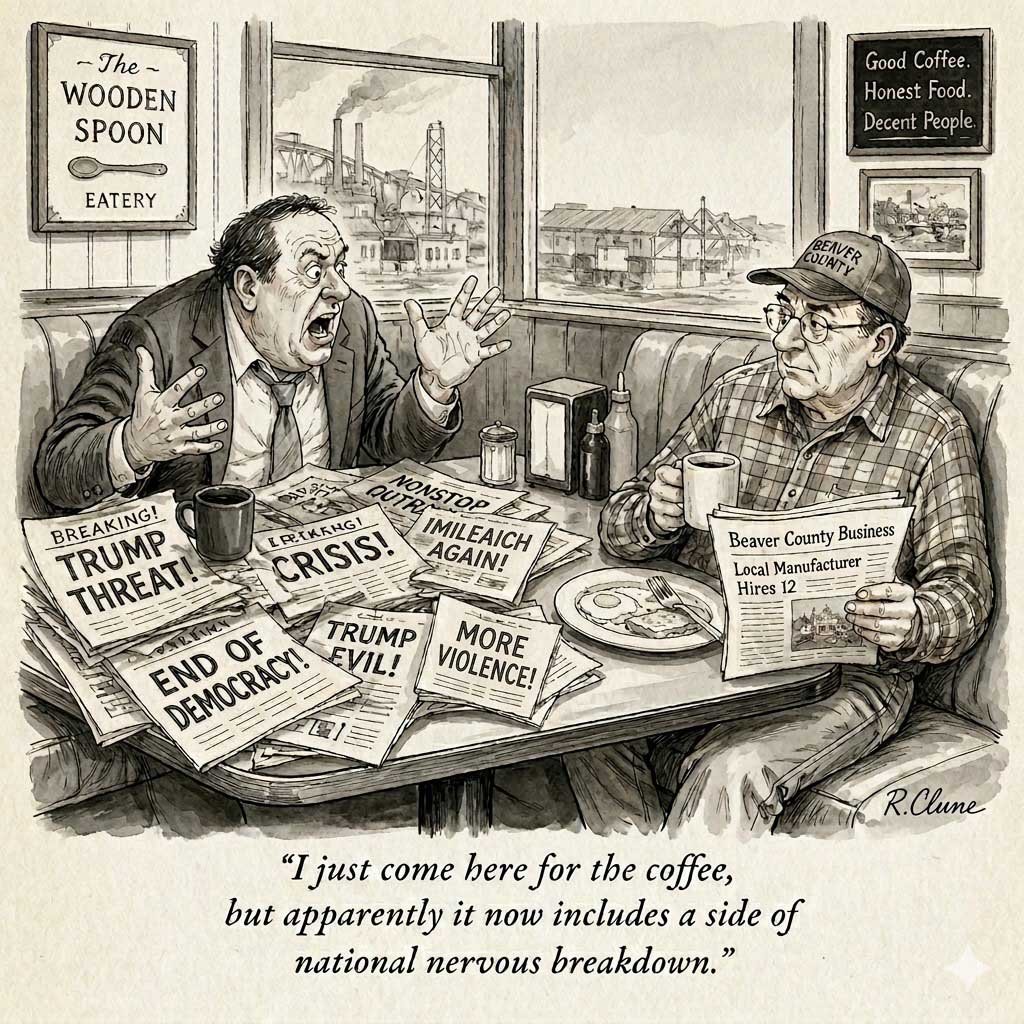
Here in Beaver County, where the biggest political crisis most mornings is deciding whether the coffee at The Wooden Spoon is strong enough to face another day of supply-chain headaches and Pennsylvania’s charming habit of taxing everything that doesn’t move, I sometimes flip on the national news just to remind myself that other people have real problems. Lately it’s been like watching a very expensive, very loud episode of The Twilight Zone. The Democrats, according to the historian Victor Davis Hanson—who has the unnerving habit of saying out loud what the rest of us only mutter into our beer—have achieved a kind of political nirvana. Not the good kind. The nihilistic kind. They have traded platforms for pure, unadulterated Trump Derangement Syndrome, and the results are something to behold if you enjoy theater of the absurd with your morning eggs.
You remember the Democratic Party of 1992 and 1996? Hanson does. So do I, dimly, the way you remember a sensible uncle who paid his bills and didn’t scream at the television. Back then the party platform sounded suspiciously like what today’s Republicans are accused of wanting: secure borders, welfare reform, balanced budgets, a foreign policy that didn’t apologize for existing. John F. Kennedy, Harry Truman, even Bill Clinton—they all operated on the quaint notion that you met the country halfway.
Today the halfway point has been relocated somewhere west of the San Andreas Fault and east of the faculty lounge at Berkeley. The new operating principle seems to be: if Donald Trump is for it, we are against it, even if “it” was our own position six months ago. Consistency is for amateurs.
The man himself, of course, is the match that lights the bonfire. Trump’s great sin is that he treats the Deep State, the prestige media, and the tenured professoriate the way a Beaver County contractor treats a subcontractor who shows up late: with open disdain and a certain theatrical bluntness. This, apparently, is intolerable. The result is a rolling national nervous breakdown that has given us two impeachments, a Russia-collusion saga that now reads like a very long bad joke, an FBI raid on Mar-a-Lago that looked more like a raid on a Miami nightclub, and a pair of legal proceedings—one in Manhattan, one in Atlanta—that even a first-year law student could recognize as creative writing exercises with subpoenas.
And then there are the attempts on the man’s life—three of them in less than two years, each one a grim bookmark in this chapter of political derangement. In July 2024, at a rally in Butler, Pennsylvania, a gunman grazed Trump’s ear before being cut down by Secret Service. Two months later, in September 2024, another armed figure was spotted near Trump at his Florida golf club. And just over a week ago, on April 25, 2026, a man reportedly charged security at the White House Correspondents’ Dinner in Washington, firing shots in an alleged bid to reach the ballroom where the president sat. Trump was evacuated safely each time, but the country was left with the spectacle of a former—and current—president dodging bullets while large segments of the commentariat seemed more interested in debating whether the rhetoric had gone too far or not far enough. One begins to wonder if we’ve mistaken political passion for permission slips.
Meanwhile, actual policy has taken a sabbatical. Immigration? Open the border and create a brand-new constituency that will require generous federal and state subsidies. It’s voter recruitment with a side of humanitarianism, or so the theory goes. Globalization? That worked out splendidly for the billionaire class on the coasts, who now underwrite boutique causes—Green New Deals, gender-identity seminars, pronoun etiquette—that play about as well in Ambridge as a lecture on artisanal kombucha. High taxes, street crime, and regulation in the blue strongholds have sent the middle class packing, which is awkward when your remaining base consists of people who can afford private security and people who can’t afford to leave. The party is left appealing to a narrower and, let us say, more highly caffeinated slice of the electorate.
From a business perspective—the only one that really matters around here—this is not exactly a confidence builder. Small manufacturers in Beaver County don’t wake up worrying about whether some Ivy League dean has correctly identified his micro-aggressions. They worry about energy costs, interest rates, whether the next shipment of widgets will clear customs, and whether the kid they just hired can read a tape measure. They would like a government that is neither savior nor saboteur, just reasonably competent and reasonably predictable. Instead they get nihilism dressed up as moral urgency.
One sometimes wonders what the old Democratic Party would make of all this. Truman, who told the country “the buck stops here,” would probably have a few choice words about passing the buck to the courts and the cable networks. Clinton, who once declared the era of big government over, might raise an eyebrow at the current enthusiasm for turning every state into a branch office of the Department of Everything. But those fellows are safely in the history books, where they can’t embarrass anybody.
So here we sit, in the quiet precincts of western Pennsylvania, watching the great national discourse devolve into a game of ideological dodgeball with Donald Trump as the ball—and, lately, as the target. The rest of us—Republicans, Democrats, and the large, muttering bloc that just wants the potholes filled and the invoices paid—try to get on with the business of business. It is, I suppose, a free country. But one does hope that someday the derangement eases, the nihilism lifts, and both parties remember that governing is not the same thing as performing.
Until then, the diner coffee will have to suffice. It may not solve the national nervous breakdown, but at least it’s hot, cheap, and reliably bipartisan.