Listen to a podcast discussion about this article.
Once upon a time in American business, if you wanted to know who was in charge, you didn’t consult an org chart or schedule a meeting. You looked at the name on the building and walked toward it.
At the Michael Baker Corporation, that meant Michael Baker, Jr. Authority was not abstract. It had a face, a voice, and—on difficult days—a temper.
It was not a perfect system. Founders can be stubborn, eccentric, and occasionally wrong in ways that are both imaginative and expensive. But it had one great advantage: when the world changed, somebody in charge noticed.
Then came the managers.
The shift was described with unnerving clarity by James Burnham, who argued in the 1940s that ownership and control were parting ways. In their place rose a new class—the professional manager—trained, credentialed, and theoretically capable of running almost anything.
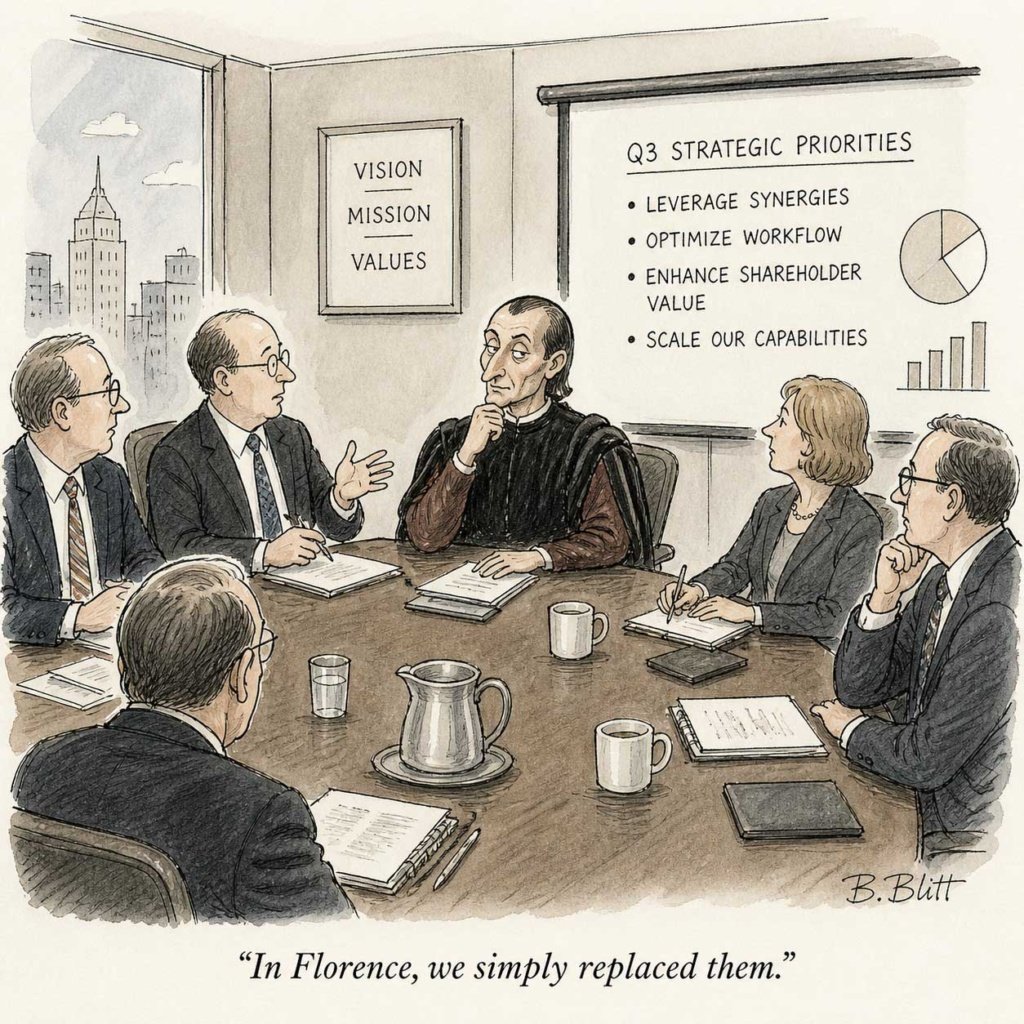
Management, in this view, was a transferable skill. Learn the principles, earn the degree, and you could be dropped into any enterprise like a well-dressed paratrooper and take command. The assumption—never quite stated but widely believed—was that the particulars didn’t matter. Soup was soup.
For a while, it worked. The postwar economy expanded, conglomerates multiplied, and the country produced a generation fluent in phrases like “leveraging synergies,” which had the useful quality of sounding precise while meaning almost nothing at all.
Then the ground shifted.
Enter Marc Andreessen, who has spent three decades watching founders build companies and managers explain them. His conclusion is less revolutionary than it is awkward: managers are excellent at running stable systems, but when the system itself changes, they tend to stall.
It is not a character flaw. It is a job description.
If you are managing a business where the rules hold steady, you can optimize it into submission. But if the rules change—if, say, rockets that used to fall into the ocean begin landing upright—then optimization is not much help. The playbook assumes yesterday.
Founders, by contrast, are inclined to ignore the playbook entirely.
You can see the distinction without leaving Beaver County.
The Michael Baker Corporation began with a founder’s conviction that a local firm could take on national—and eventually global—projects. From a modest start in Rochester, it went on to help shape the Parkway East, contribute to the Trans-Alaska Pipeline System, and play a quiet but consequential role in building the modern oil-producing Saudi Arabia.
That kind of reach does not come from a committee. It comes from someone willing to assume that the future can be larger than the present.
But not every founder story requires a pipeline stretching across Alaska. Some of them can be found, quite reliably, at a counter with a paper tray and a chili dog.
The Brighton Hot Dog Shoppe began in 1959 with the Trevelline brothers and a bit of roadside improvisation—run out of gas on the way to one town, open in another, and let history take it from there. It might have remained a single beloved stop had it not been for Frank G. Papa, an accountant hired in 1975 who ended up running the whole enterprise.
There are no case studies at Harvard on how to turn a hot dog stand into a regional institution. What Papa brought was not a portable management toolkit but a founder’s instinct: protect the product, expand carefully, and make the place feel like it belongs to the people who walk through the door.
He built a commissary to ensure consistency. He borrowed ideas where they worked—souvenir cups, for instance—and ignored them where they didn’t. He treated employees like family, which in Beaver County is either a compliment or a warning. And he grew the business without ever losing sight of the fact that nobody drives across county lines for a strategic plan.
They come for the chili dogs.
Burnham’s broader point was that organizations drift toward management the way water drifts downhill. Management brings order, process, and the comforting sense that everything important can be measured. It also brings caution. Risk is itemized, debated, and, if possible, postponed.
Greatness rarely survives that process intact.
The old historians used to call this the “Great Man Theory,” which has since been retired in polite conversation but remains stubbornly alive in practice. Companies, like countries, are still shaped by individuals—people willing to make decisions before consensus has been achieved and to accept the consequences afterward.
That does not make management obsolete. Even the most inspired founder eventually discovers that payroll must be met and regulations obeyed. The trick, as Andreessen suggests, is not to replace the founder with a manager but to teach the founder enough management to keep the enterprise from dissolving into improvisation.
Too little structure invites chaos. Too much invites a meeting about chaos.
Here in Beaver County, where industries rise, fall, and occasionally reappear wearing different clothes, the distinction matters. Steel returns, but not quite here. Energy expands, but not always in familiar forms. Data centers arrive where racetracks once stood, and somewhere in the middle of it, a manager is revising a forecast to reflect developments no forecast predicted.
The question is whether anyone is doing more than revising the forecast.
If history offers any guidance, the next great enterprise will not come from a committee. It will come from someone who hasn’t yet learned why it can’t be done.
That person may lack polish. They may speak in sentences rather than bullet points. They may even make decisions without first consulting a task force.
But they will have the one qualification that resists standardization: the belief that the future does not have to resemble the present.
And in business, as Machiavelli might have observed—perhaps while waiting in line at the Hot Dog Shoppe—that belief is where both the trouble and the success usually begin.