Listen to a podcast discussion about this article.
There are, broadly speaking, two ways to celebrate Easter in Beaver County. One involves solemn church services, lilies arranged with architectural precision, and a sermon that reminds you, gently but firmly, that eternity is a long time to get things wrong.
The other involves a hard-boiled egg, a suspiciously well-organized rabbit, and a child sprinting across damp grass at 9:00 in the morning like a linebacker chasing redemption.
It will not surprise you to learn that the second owes a great deal to the Pennsylvania Dutch.
Now, the term “Pennsylvania Dutch” has always been one of those small historical jokes we’ve collectively agreed not to examine too closely. They are not Dutch, of course, but German—Deutsch—which, somewhere along the way, got mistranslated into a nationality better known for windmills and tulips. This is the sort of thing that happens when English speakers are left unsupervised with foreign languages.
But mistranslations aside, the Pennsylvania Dutch brought with them a deep reservoir of customs, folklore, and practical wisdom that have quietly shaped life across western Pennsylvania—including, whether we realize it or not, the way we celebrate Easter.
Take, for example, the humble Easter egg.
In Beaver County, we treat egg dyeing as a domestic ritual of such seriousness that it borders on liturgy. Kitchens are transformed into temporary laboratories. Vinegar is deployed with scientific precision. Paper towels—usually in short supply the rest of the year—suddenly appear in abundance. And children, who cannot be trusted to load a dishwasher, are given full authority over color combinations that would alarm a professional interior designer.
This is not accidental.
The Pennsylvania Dutch had a long tradition of decorating eggs, known as Ostereier, often using natural dyes made from onion skins, beets, and other items that sound less like art supplies and more like the ingredients for a modest soup. These eggs were not merely decorative; they were symbols of new life, which, in the Christian calendar, is Easter’s central claim.
Over time, as these traditions filtered into broader American life, the symbolism remained, but the dyes improved. We now have colors that do not occur anywhere in nature, including a shade of blue that suggests the egg may have been exposed to radiation.
Then there is the matter of the Easter Bunny.
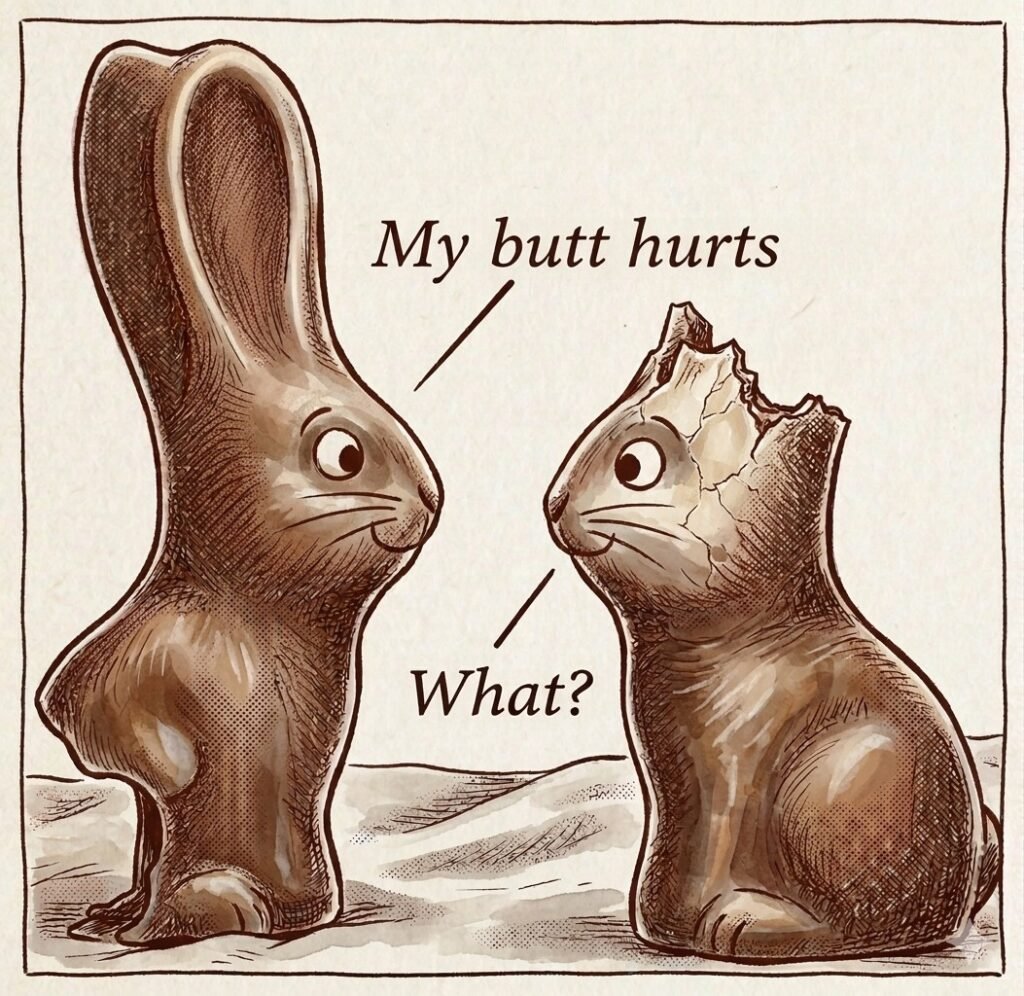
Now, I have long maintained that the Easter Bunny is one of Christianity’s more puzzling subcontractors. A rabbit—an animal not widely known for its logistical discipline—has somehow been entrusted with the overnight distribution of candy across multiple time zones. This raises questions not only of theology but of management.
Yet here again, the Pennsylvania Dutch are to blame.
The Osterhase, or Easter Hare, originated in German folklore as a judge of children’s behavior, not unlike a fur-covered version of Santa Claus with a slightly tighter performance review schedule. Well-behaved children would receive eggs; less exemplary ones presumably received a stern look and a reminder to improve before Christmas.
When German immigrants brought this tradition to Pennsylvania in the 18th century, it began to evolve. The hare became a bunny, the eggs became candy, and the entire operation took on a level of commercial efficiency that would impress a Fortune 500 logistics officer.
By the time it reached Beaver County, the Easter Bunny had fully integrated into our local economy, appearing in shopping malls, church basements, and the occasional slightly unnerving costume at community events.
And then, of course, there is the Easter egg hunt.
If you have ever watched a group of children participate in one of these, you will know that it combines the strategic planning of a military exercise with the emotional intensity of a stock market crash. Parents hover at the perimeter, offering encouragement that quickly escalates into unsolicited tactical advice.
“Check behind the bush!”
“Look near the tree!”
“Don’t let that kid from Chippewa take your eggs—he’s already got six!”
What appears to be a spontaneous burst of childhood joy is, in fact, the descendant of carefully structured traditions. The Pennsylvania Dutch often hid eggs for children to find, reinforcing both the symbolism of discovery and the practical lesson that good things sometimes require a bit of searching.
It is a philosophy that has served Beaver County well, particularly in matters of economic development.
Even our Easter meals bear the imprint of these influences. Ham, for instance, has long been a centerpiece of the Easter table, a tradition rooted in the agricultural rhythms of German-speaking farmers. By spring, the preserved meats of winter were ready to be enjoyed, and what better occasion than a holiday celebrating renewal?
In Beaver County, this has been elevated to an art form. Entire dining rooms are organized around the ham, which is often accompanied by potatoes, vegetables, and a dessert table that suggests we are preparing for a minor siege.
And yet, for all the eggs and bunnies and hams, there remains the underlying reason for the season—the resurrection story that gives Easter its meaning.
What the Pennsylvania Dutch managed to do, perhaps without fully intending it, was to wrap that profound theological claim in a layer of accessible, even joyful customs. They understood that traditions endure not only because they are meaningful, but because they are memorable—and, occasionally, a little bit fun.
So we dye our eggs, and we hide them, and we send our children out into the yard to find them. We set our tables, we gather our families, and we participate in a set of rituals that have traveled centuries and continents to arrive, improbably, in Beaver County.
And somewhere between the vinegar cups and the chocolate rabbits, it begins to dawn on you that these old Pennsylvania Dutch habits were never really about eggs or sweets in the first place. They were about teaching renewal in a way a child could understand—something you could hold in your hand, hunt for in the grass, or pass across a crowded table.
The theology comes later, if it comes at all. But the lesson sticks: life returns, families gather, and hope—like a well-hidden egg—has a habit of turning up when you least expect it, right there in the backyard, just as the church bells start to ring.