Listen to a podcast discussion about this article.
Pittsburgh has always liked to think it could make money in the morning and give it away in the afternoon. It’s a tidy arrangement—entrepreneurship pays the bills, philanthropy polishes the halo. For more than a century, the two have coexisted politely, like old industrialists at a Duquesne Club lunch.
Now they’re about to compete.
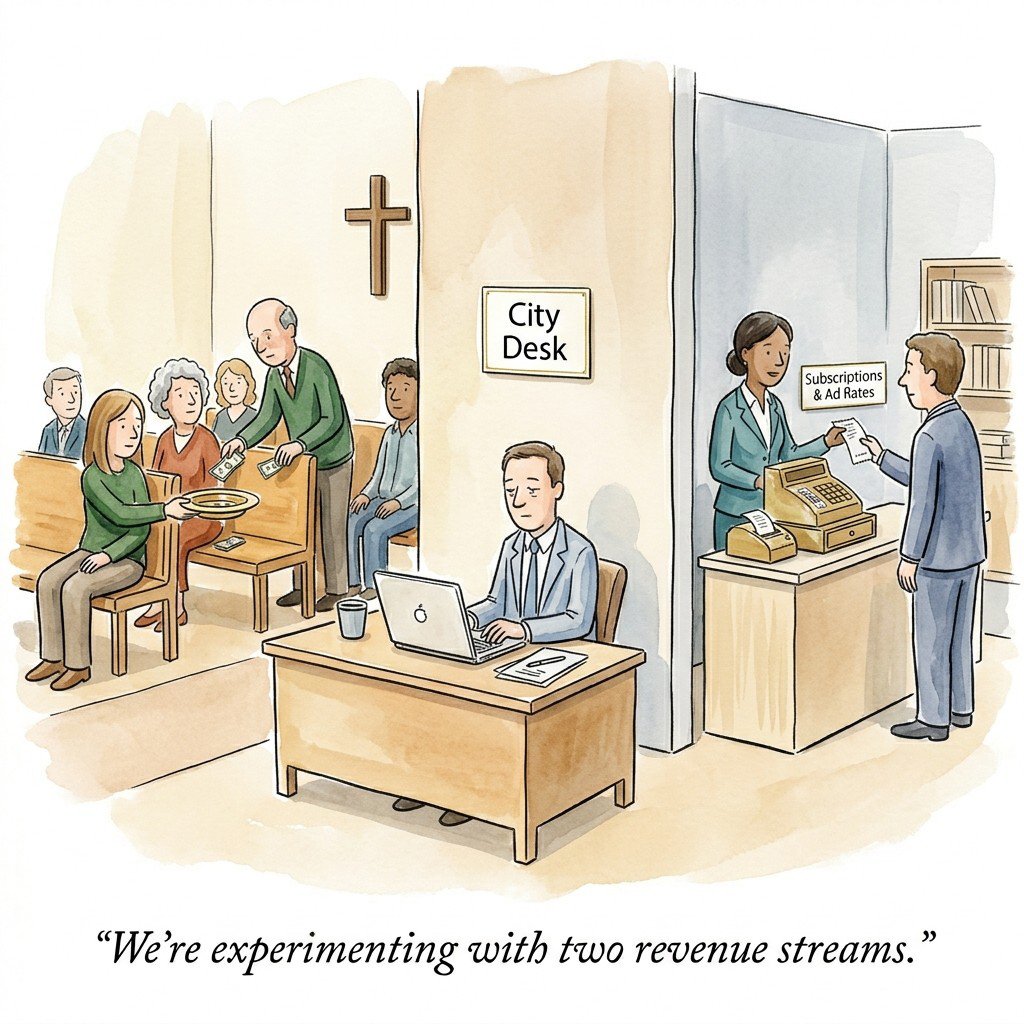
For the first time anyone can recall, Pittsburgh’s two defining instincts—profit and nonprofit—are squaring off in the same arena: the daily news. The outcome may tell us less about journalism than about the city itself.
The immediate cause is the sale of the Pittsburgh Post-Gazette, a paper that’s staged more comebacks lately than a rock band that refuses to retire. Its longtime owner, Block Communications Inc., had announced plans to shut it down after racking up $350 million in losses over 20 years—enough to make even a steel man reach for the smelling salts.
But closure has a way of concentrating the civic mind. Along came a buyer with a checkbook—and a different idea of what a newspaper is for.
Enter the Venetoulis Institute for Local Journalism, a Baltimore-based nonprofit that’s agreed to take over the Post-Gazette and keep it alive—though not quite as we knew it. Founded by Stewart Bainum Jr., the institute already runs The Baltimore Banner, a startup that’s grown fast, hired aggressively, and even picked up a Pulitzer—proof that nonprofit journalism doesn’t have to mean nonprofit ambition.
The theory is straightforward: treat journalism as a public good, not a quarterly earnings report. Find donors. Build trust. Accept that the balance sheet may never look like a tech company’s, but the civic return might justify the expense.
It’s a noble idea. It also arrives with competition.
Because while the Post-Gazette has been reinventing itself as a mission-driven enterprise, Trib Total Media has been doing something more old-fashioned: expanding. The Trib, which wisely ditched daily print years ago, now plans a weekend edition and more hiring. It’s acting like a business that expects to make money—and possibly even a profit.
And just like that, Pittsburgh has a matchup it’s never quite seen: a nonprofit newsroom versus a for-profit one, each trying to prove it’s the more sustainable way to tell the region’s story.
It’s tempting to cast this as a morality play—capitalism versus charity, spreadsheets versus good intentions. But both models are really answers to the same nagging question: who pays for the news now that the old model’s gone?
Once upon a time, newspapers were subsidized by a river of advertising—department stores, car dealers, classifieds for used sofas with complicated histories. That river’s since been diverted to Silicon Valley. What’s left is subscriptions, digital ads, and a lingering hope that readers still think local news is worth paying for.
The nonprofit answer: if the market won’t sustain journalism, the community must. The for-profit answer: the market still works—if you’re disciplined enough to adapt.
Pittsburgh, being Pittsburgh, is trying both.
This is a city that built fortunes and then endowed museums with them. It knows how to make money, and it knows how to give it away. What it hasn’t done—until now—is ask those two instincts to compete for the same audience, the same attention, and, not incidentally, the same dollars.
Will readers support a nonprofit Post-Gazette out of civic duty? Or a for-profit Trib because it delivers value? Will advertisers favor scale and efficiency, or mission and community ties? And will either model hold up when the next downturn comes along?
No one knows. If there’s a clean solution to local journalism’s troubles, it hasn’t shown up in the morning paper.
There are reasons for hope. The Venetoulis Institute has proved a nonprofit newsroom can grow and win. The Trib has proved a leaner, market-driven operation can survive. Between them, they might sketch a hybrid future that borrows from both traditions.
But there’s also the stubborn fact that neither model has yet demonstrated it can fully escape the forces that hollowed out the industry in the first place.
Which brings us back to Pittsburgh, a city that respects ideals but trusts results.
The Post-Gazette will have to prove that mission can sustain momentum. The Trib will have to prove that profit can still fund ambition. And readers—who’ve heard all this before—will decide which argument they believe.
It’s not often a city gets to watch its own character tested in real time. But that’s what this is: Pittsburgh, putting its faith in both enterprise and generosity, and waiting to see which one can carry the news.