Listen to a podcast discussion about this article.
One of the enduring mysteries of American capitalism is how an industry can move millions of people through the skies every day and still conduct itself financially like a raccoon rifling through a campground cooler. Commercial aviation has spent decades consuming astonishing amounts of capital while returning profits so thin they’d embarrass a church bake sale. Passenger traffic climbs. Flights remain packed. Everybody complains. And somehow the airlines still often behave like men trying to pay off a bass boat with lottery tickets.
Consider poor Spirit Airlines, which recently staggered through bankruptcy, flirted with liquidation, blamed soaring jet-fuel prices for pushing it over the edge, and finally shut down operations altogether after 34 years in business. Rising fuel prices are hammering carriers across the industry, especially the bargain outfits whose entire business model depends on selling you a ticket to Orlando for less than dinner at Eat’n Park.
Yet here we are in Western Pennsylvania admiring a gleaming new $1.7 billion terminal at Pittsburgh International Airport.
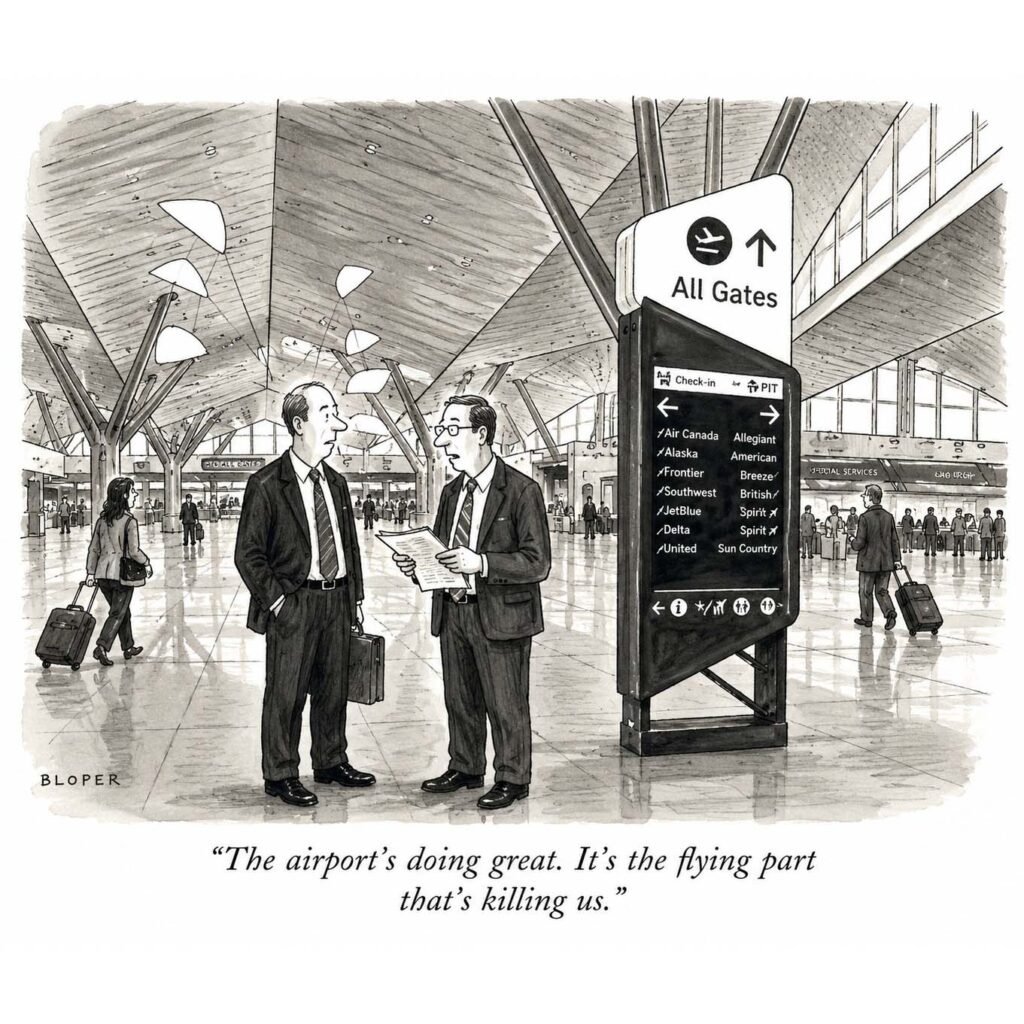
The old tram is gone. Security lanes have multiplied. There’s local art on the walls, outdoor terraces overlooking the airfield, polished wood, natural light, and enough upscale retail to briefly distract you from the fact that in twenty minutes you’ll be wedged into Seat 28B beside a man eating barbecue-flavored almonds with the concentration of a neurosurgeon.
It feels, against all odds, like progress.
Which raises an obvious question: if airlines themselves operate on margins thinner than deli ham at the Beaver Super, why spend all that money building them a fancier barn?
The answer is that airports make sense precisely because airlines struggle.
Flying passengers is mostly a commodity business. A seat from Pittsburgh to Orlando differs only marginally from the seat sold by the fellow parked at the next gate. The planes come from the same two manufacturers. Everybody serves some variation of pretzels, resentment, and Wi-Fi that only functions while you’re trying to close the browser window complaining about the Wi-Fi.
Meanwhile, the airplanes themselves are monstrously expensive depreciating assets. Every minute a jet sits idle on the ground costs money the way teenage sons consume breakfast cereal. Crew costs continue. Gate fees continue. Maintenance schedules continue. Airlines make money only when those giant aluminum cigars are airborne and moving paying customers around the country.
The old Pittsburgh setup, magnificent in its 1992 USAir hub glory, increasingly resembled a tuxedo worn to mow the lawn. It had been designed for a level of traffic and connecting-passenger complexity that no longer existed. Long walks, cumbersome transfers, outdated security arrangements, and operational inefficiencies all added precious minutes to turnaround times. In aviation, minutes are money.
The new terminal fixes much of that.
By consolidating operations and putting landside functions where human beings might logically expect them to be, Pittsburgh dramatically cuts car-to-gate times and streamlines the whole operation. Airlines agreed to the higher fees because faster passenger flow and shorter aircraft turns help keep those expensive jets where they belong: in the air generating revenue instead of parked at the gate while somebody searches Concourse D for a wheelchair attendant.
But here’s where the story gets interesting.
The real economic payoff often has less to do with the airlines than with everybody surrounding them.
Construction firms, steel fabricators, electricians, engineers, suppliers, and contractors have spent years feeding at the trough of this project. Then come the passengers themselves — what one economist cheerfully called “wallets with legs.”
Every arriving flight disgorges business travelers, tourists, conventioneers, Steelers fans, visiting grandparents, and bewildered Floridians underdressed for February. They rent cars. Stay in hotels. Eat in restaurants. Buy drinks. Attend conferences. Wander into Primanti Bros. and spend the next six hours trying to digest French fries inside a sandwich.
The airport becomes an economic pump.
Pittsburgh gets a more impressive front door for the medical industry, robotics firms, energy companies, universities, and the increasingly fashionable “advanced manufacturing” crowd. Beaver County benefits too, whether through logistics, hospitality spillover, business investment, or the simple fact that executives scouting Shell or regional industrial sites no longer arrive through a terminal that looked vaguely like a suburban mall after the anchor stores closed.
Government authorities understand this perfectly well.
They finance the bonds, collect parking revenue, tack fees onto tickets, and quietly watch property values and tax revenues respond. The airlines assume the high-risk, low-margin burden of actually flying people around while the surrounding ecosystem — airports, contractors, restaurants, rental-car agencies, and regional economies — often does rather nicely.
The price tag climbed, of course. Big infrastructure projects possess an almost supernatural ability to become more expensive once the concrete trucks arrive. Still, there’s something to be said for refusing to build everything in the spirit of a probation office.
In the end, this is how a good chunk of American capitalism actually functions. The parts that lose money over the long haul — operating the airplanes — make possible the parts that generate real returns: building and running the terminals, selling the $9 coffee, driving regional economic multipliers, and moving people where they want to go.
So the next time you’re standing in the bright, airy new PIT terminal sipping that overpriced latte while your flight boards on time, offer a small ironic toast to the paradox. The airlines may forever fly on a wing and a prayer, but the rest of the region is doing just fine.
Safe travels, neighbors. And try not to do the math on what your ticket actually supports.