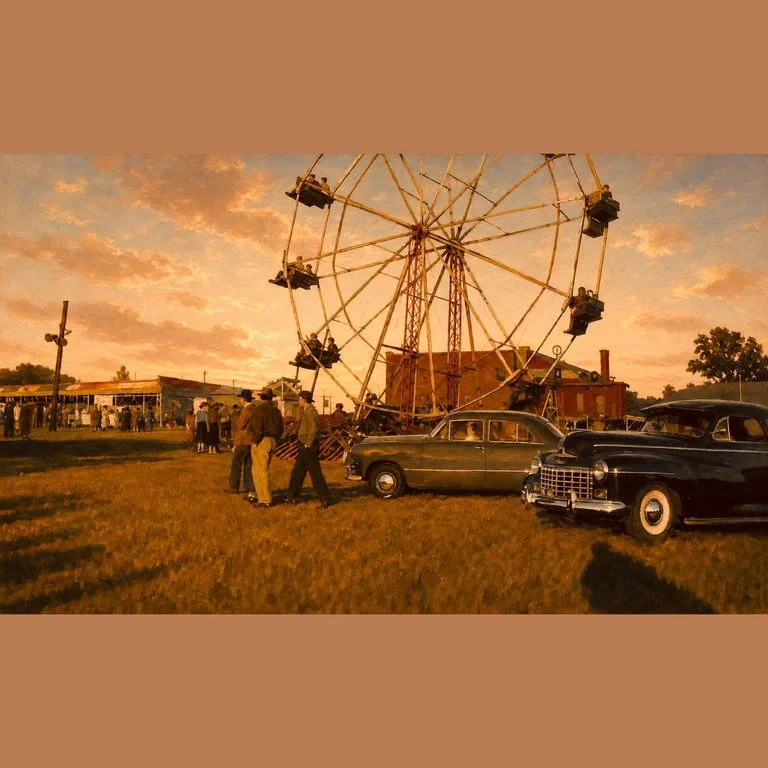
The Fair, the Farm, and the Candidate in Clean Shoes
A look at Beaver County’s fair traditions, from Hookstown and Big Knob to tractor pulls, farm families, fair food and politicians courting rural voters.

Nobody knows precisely what to do with a polo ball found beneath an automobile. The usual choices would be to return it, ignore it or let the dog have it. In Darlington in 1937, several men chose a fourth course: They founded a polo club.
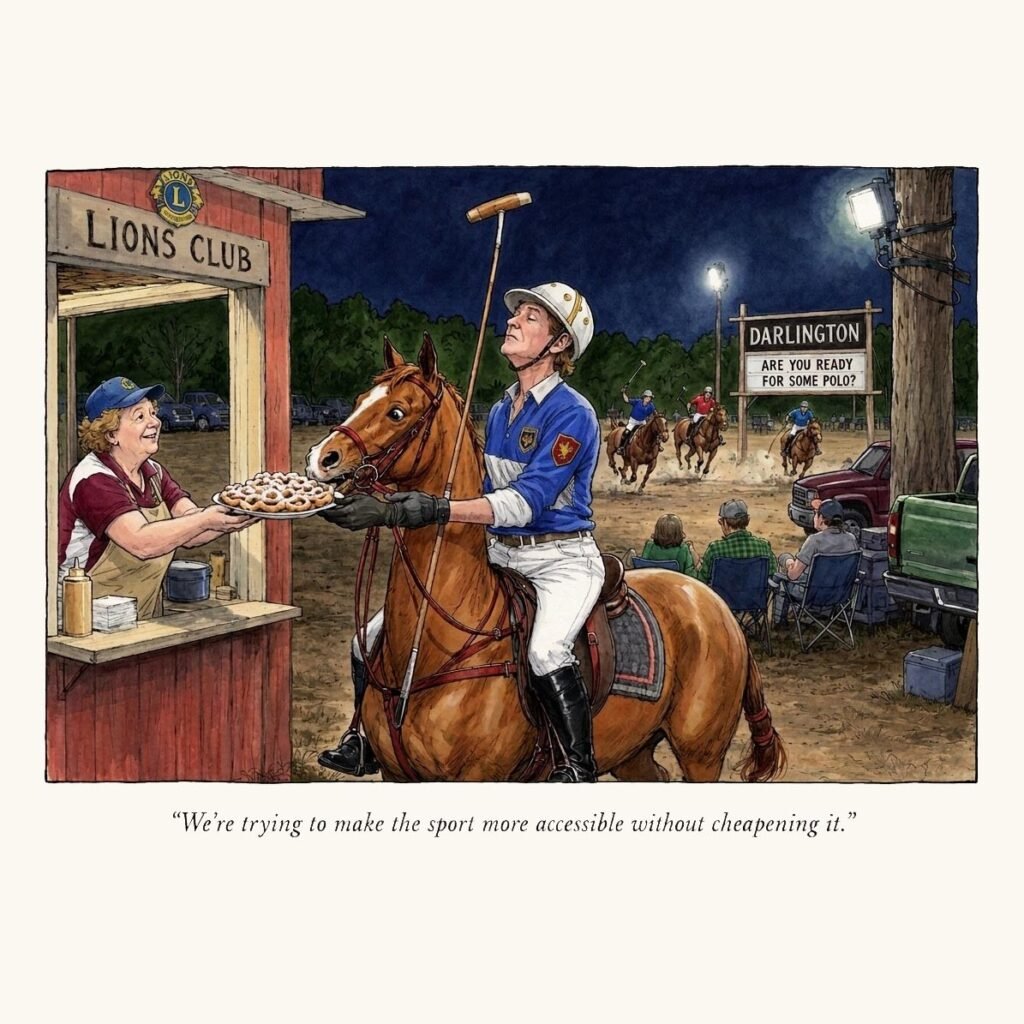
This was an ambitious response, particularly since they had no proper field, little money and only a conversational acquaintance with polo. What they did have were horses, some dirt, a few trees and the American conviction that equipment is mostly a state of mind. Plow horses became polo ponies. Mallets were made by hand. Coal miners’ helmets served as protective headgear. Gasoline cans marked the goals. Floodlights were fastened to trees so the men could work all day and play the sport of kings at night—rather like kings who had to punch the clock at the mill by seven the next morning.
Thus began the Darlington Polo Club, which has now spent nearly ninety years demonstrating that aristocracy is not strictly necessary for aristocratic sport. Its team is called the Night Riders, a name suggesting either galloping romance or an urgent bulletin from the insurance company.
Glenn Robert “Bob” Watterson soon emerged as the club’s guiding hand. Every durable local institution seems to require one person who knows where the keys are, remembers what happened in 1948 and can persuade six other people to show up with shovels. For Darlington polo, that man was Bob. He helped turn an evening’s improbable enthusiasm into an organized club and later arranged charity matches benefiting the D.T. Watson Home. He apparently believed that if you were going to gallop around whacking a ball with a mallet, you might as well do somebody some good while you were at it.
The club plays Friday nights at about eight, an hour when sensible people are settling into their recliners and beginning the serious work of complaining that there is nothing on television. There is no polo on Sunday. This is not a suggestion or a scheduling preference but a commandment, apparently handed down somewhere between “Remember the Sabbath” and “Keep your eye on the ball.”
The field is dirt and roughly one-third the size of a regulation polo field. This saves acreage but produces a game of considerable intimacy. Horses, riders, mallets and the ball are seldom troubled by loneliness. The style of play might charitably be called vigorous. On a grand English estate, polo unfolds across acres of manicured turf. At Darlington, events develop more quickly, like an argument in a small kitchen.
Around the field, pickup trucks gather in a loose semicircle, creating a temporary village of tailgates, lawn chairs and people eating French fries while large animals rush past at speed. The Lions Club runs the concession stand, because no Beaver County institution is entirely legitimate until somebody is selling funnel cake beside it. Spectators need no special wardrobe and are not required to know the rules. If the riders suddenly race in one direction, that is generally where the ball has gone, and a newcomer can build from there.
Night polo on dirt makes its own demands. Under artificial light, the ball becomes a small white fugitive with no respect for prediction. Shadows dart about without explanation. Dust rises and hangs in the beams. Horses, who prefer their surroundings to make sense, must contend with glare, darkness and the occasional existential surprise of discovering another horse where a shadow had been a moment earlier.
Grass encourages elegance. Dirt encourages attention.
The smaller field makes the game quicker in its reactions and less patient with ceremony. There is little room for the sweeping pageantry associated with fashionable polo grounds, where spectators sip champagne and appear to have been born knowing which fork to use. Darlington reduces the sport to its working parts: horse, rider, mallet, ball and the fervent hope that all four continue in approximately the intended direction.
The club survived because certain families refused to let it become one of those things old-timers vaguely remember and young people assume was invented after the third beer. The Watterson family supplied players, leadership and memory through several generations. Later, the Powers family took on much of the same responsibility, seeing that horses were available, newcomers were encouraged and the lights still came on Friday night. This is how traditions actually endure—not through mission statements, strategic plans or commemorative plaques, but because somebody remembers to feed the horses.
Darlington has welcomed teams from Ohio, Canada and other places where visitors may have imagined they were coming to a quaint rural exhibition. They went home with dust in their shoes, perhaps a dent in their dignity and a story that improved with every telling. Newspapers have occasionally discovered the club and marveled that polo exists in Beaver County, as though a clerical error at the Department of Recreation had deposited it here instead of Palm Beach.
But Darlington polo belongs here precisely because it should not.
America has always been at its most interesting when it borrows something grand, removes the expensive upholstery and sees whether it will run on regular gasoline. Darlington took the sport of princes and gave it plow horses, mining helmets, pickup trucks and fries from the Lions Club. Nothing essential was lost. Something better may have been added.
And so, on Friday nights, the lights come on, the dust rises and the Night Riders gallop once more. The sport of kings survives in Beaver County—not through wealth or pedigree, but through families, volunteers and the stubborn local belief that if a thing is worth doing, it is worth doing with whatever happens to be in the barn.
⸻
Where: Darlington Polo Field, 3475 Darlington Road, Darlington, PA 16115
When: Friday nights at 8 p.m. Matches are subject to weather, field conditions and team availability.
Admission: $5 for spectators 16 and older.
What to bring: A lawn chair, unless you prefer to watch from your vehicle. Concessions are available from the Darlington Township Lions Club.
Before you leave: Call or text the polo hotline at 330-692-0062 to confirm that the match is being played.
More information: darlingtonpoloclub.com
Champagne is optional. Funnel cake is not.
A look at Beaver County’s fair traditions, from Hookstown and Big Knob to tractor pulls, farm families, fair food and politicians courting rural voters.
Electric bikes, scooters and other micromobility devices are transforming sidewalks, raising questions about pedestrian safety, rules and infrastructure.