Listen to a podcast discussion about this article.
There are certain annual rituals that define a place. In Beaver County, we have the first sighting of a robin, the reopening of Rita’s, and the seasonal debate over whether Route 18 traffic is an act of God or PennDOT.
This year, however, we are preparing for something larger—considerably larger—than a robin.
Sometime in the next 30 days, Pittsburgh will brace itself for the arrival of between 500,000 and 700,000 football fans descending upon the North Shore for the 2026 NFL Draft, a number that sounds less like a crowd and more like a mid-sized European principality.
And if Pittsburgh is the front porch for this gathering, Beaver County will be the spare bedroom, the couch, and possibly the air mattress in the basement.
A Homecoming in Black and Gold
At VisitPittsburgh’s annual meeting—an event where statistics are usually recited with the solemnity of a tax code—Steelers President Art Rooney II offered a more sentimental forecast.
This, he suggested, would not merely be a football event. It would be a homecoming.
Unlike other cities, Rooney noted, Steelers fans have a habit of leaving town and then, decades later, returning in large numbers—like swallows to Capistrano, only wearing Terrible Towels.
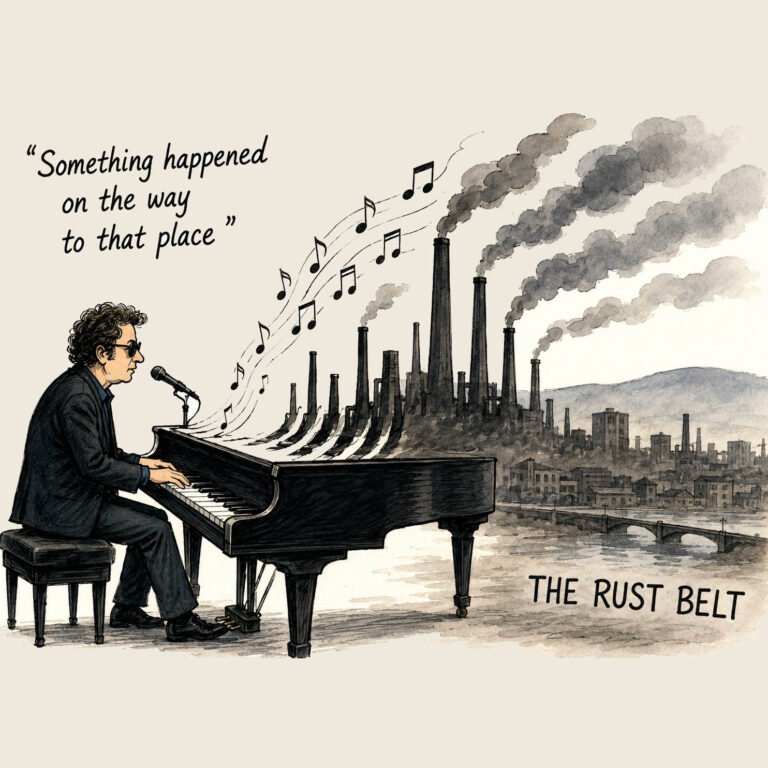
Western Pennsylvania’s great diaspora, set in motion when the steel mills went quiet some 40 years ago, scattered our people to Houston, Phoenix, and points in between. Now, for one long April weekend, many of them are expected to come back—not to reclaim the mills, but to see who the Steelers might draft to protect the quarterback.
It is, in its own way, a touching development.
“Forge On,” With a Side of Primanti’s
VisitPittsburgh, not content to rely solely on nostalgia and defensive line prospects, has rolled out a $2 million marketing campaign called “Forge On.” The goal is to introduce Pittsburgh to those who still imagine it as a place where the sky is permanently the color of an overcooked meatloaf.
Jerad Bachar, the organization’s CEO, described tourism as a “team effort,” which is a polite way of saying that everyone—from hotel clerks to sandwich makers—will soon be drafted into service.
The numbers suggest they are ready. For 2025, VisitPittsburgh booked 291 events generating 375,600 hotel room nights and $433.5 million in visitor spending. The David L. Lawrence Convention Center alone accounted for $121 million of that.
Impressive figures, to be sure. But they now serve as mere warmups for what is coming.
The Great Hotel Migration
Downtown Pittsburgh hotels, we are told, are already sold out. Rates have climbed north of $1,000 per night, which is the sort of pricing that encourages even the most devoted fan to reconsider his relationship with luxury.
This is where Beaver County enters the story.
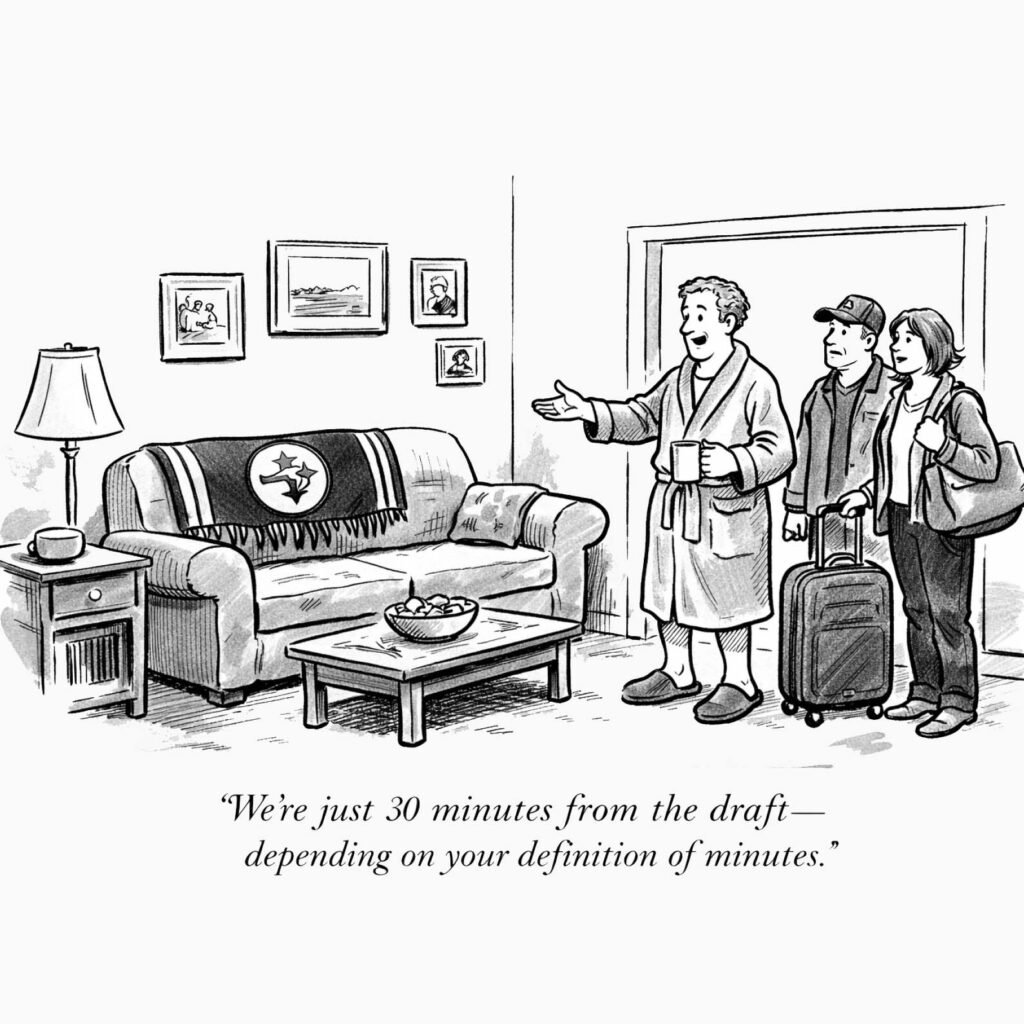
Located a convenient 30 to 45 minutes from Acrisure Stadium—depending, of course, on traffic, weather, and the temperament of the driver in front of you—we have quietly become part of the region’s emergency lodging plan.
Hotels in Monaca, Beaver, and surrounding communities are expected to fill quickly with visitors seeking a more affordable alternative to downtown prices. Short-term rentals are also likely to see brisk demand, as out-of-town guests discover that one can sleep quite comfortably 30 miles from the 50-yard line.
In short, Beaver County is about to experience a hotel boom without having to host the draft itself—a bit like receiving the benefits of a parade without having to sweep up afterward.
Dining Rooms, Checkout Lines, and Other Opportunities
The economic effects will not stop at the hotel door.
Restaurants can expect fuller dining rooms, retail shops more foot traffic, and local attractions a fresh audience of visitors who may have come for football but will stay for a decent meal and a pleasant afternoon along the Ohio River.
The Beaver Valley Mall, long accustomed to a more leisurely pace, may suddenly find itself playing host to shoppers from Baltimore, Cleveland, and beyond—each of them wondering how they ended up buying a pair of shoes in Monaca when they only meant to attend a draft.
Past host cities have reported strong gains in RevPAR—revenue per available room—and a general uplift in regional spending. There is no reason to believe Beaver County will be left out of this particular prosperity.
A Few Minor Inconveniences
No civic windfall arrives without its small inconveniences.
Traffic, for one, will likely resemble a scene from Dante, with slow-moving lines of vehicles inching toward Pittsburgh along I-376 and other familiar routes. E-ZPass has been recommended, which is a helpful suggestion, assuming one remembers where the E-ZPass transponder was last seen.
There may also be the occasional moment of confusion, as visitors attempt to navigate Western Pennsylvania’s uniquely philosophical approach to road signage.
Still, these are minor matters, easily endured in exchange for the broader economic lift.
A Rising Tide, With a Local Current
Local officials have been coordinating with VisitPittsburgh for months, preparing for the influx and positioning Beaver County as a practical extension of the Pittsburgh experience.
There is even a broader opportunity at hand. Some visitors, having secured reasonably priced lodging and discovered that Beaver County is not, in fact, an abstract concept, may choose to explore further—returning later for reasons that have nothing to do with football.
Tourism, like many good things, has a way of lingering.
The Big Weekend
Meanwhile, in Pittsburgh, the finishing touches are being applied. Arts Landing along Penn Avenue and a revamped Market Square—together representing a $45 million investment—are racing toward completion. New businesses are opening downtown at a brisk pace, with hopes of doubling last year’s total of 24 openings in just a few weeks.
State officials report an “energy” in Pittsburgh unlike anything else in Pennsylvania, which is a diplomatic way of saying that, for once, all eyes are on the western side of the state.
And for three days in April, that energy will spill outward—across bridges, highways, and county lines—until it reaches places like Beaver, Monaca, and beyond.
Not Bad for a Spare Bedroom
In the end, Beaver County’s role in the 2026 NFL Draft may not involve a stage, a commissioner, or a televised announcement.
Instead, it will involve something quieter but no less important: a place to stay, a place to eat, and, for many returning expatriates, a familiar landscape that still feels like home.
Not bad, all things considered, for a county that wasn’t even invited to the draft—but will help host it anyway.