Listen to a podcast discussion about this article.
There was a time in Bridgewater when the air itself seemed to be on the payroll. It smelled of yeast, warm flour, sugar, and ambition. If you crossed town at the right hour, you could be forgiven for thinking Providence had decided to make the whole borough smell like breakfast. For much of my lifetime, Bridgewater was known not merely as a town along the Ohio River, but as the home of Keystone Bakery — a factory-sized enterprise that supplied a very large share of Beaver County with its daily bread and did so so steadily that people came to think of it the way they think of weather or gravity. It was simply there.
And then one day, it wasn’t.
Keystone Bakery operated for 126 years, from 1859 to 1985, which is a respectable run for any business and an astonishing one for a bakery. Bread is among the humblest of products, and the making of it rarely inspires the chest-thumping reserved for steel, oil, railroads, or tech startups. Nobody ever said a loaf of white bread conquered the world. Yet Keystone did something almost as impressive: it fed a county, employed generations of families, and gave Bridgewater an identity large enough to be smelled before it was seen.
Its beginnings were modest. In 1859, a German immigrant named Frederick Walters began baking bread in a small building near Bridge Street and Riverside Drive in Bridgewater, though some accounts place the earliest operation briefly in Beaver. This was still the age of the local baker, the delivery wagon, the family enterprise, and the notion—now treated as quaint—that the person making your bread might actually live in your town.
Walters sold to local customers and supplied bread to students at Beaver College for Women. Around 1860 he moved the operation to Beaver, where it remained for about 25 years, before the family returned to Bridgewater in 1885. There they operated out of a house on Bridge Street that served as both home and bakery. You baked downstairs, slept upstairs, and hoped the customers kept coming.
They did.
By about 1890, Frederick’s sons, Charles and Albert, had joined the business, and it became F. Walters & Sons Bakery. Charles handled operations. Albert made deliveries. One imagines the classic family arrangement: one man with flour on his sleeves, another with reins in his hands, and nobody with time for management theory. After Frederick died in 1895, his widow Katherine transferred the business to the sons, and it continued as a sturdy local concern serving the Beaver Valley with fresh bread and dependable service.
The great leap came in 1901, when the company incorporated as Keystone Bakery and built a substantial brick plant along Market Street in Bridgewater. This was no longer a household enterprise with a warm oven and a wagon. This was industry. Older buildings were razed, the new facility went up, and by 1907 the plant had grown into a three-story complex, with further additions in 1911 and 1913. Keystone had discovered the basic law of American business: once people develop a taste for what you make, they want more of it, faster.
By 1921, the bakery had machinery capable of turning out 2,700 loaves an hour. Horse-drawn wagons gave way to trucks. In 1924, Keystone employed 75 people, paid an annual payroll of $47,000, and baked more than 6,000 loaves a day, shipping not just around Beaver County but into Pittsburgh and eastern Ohio. By 1925 it had become the largest independent bakery in Beaver County.
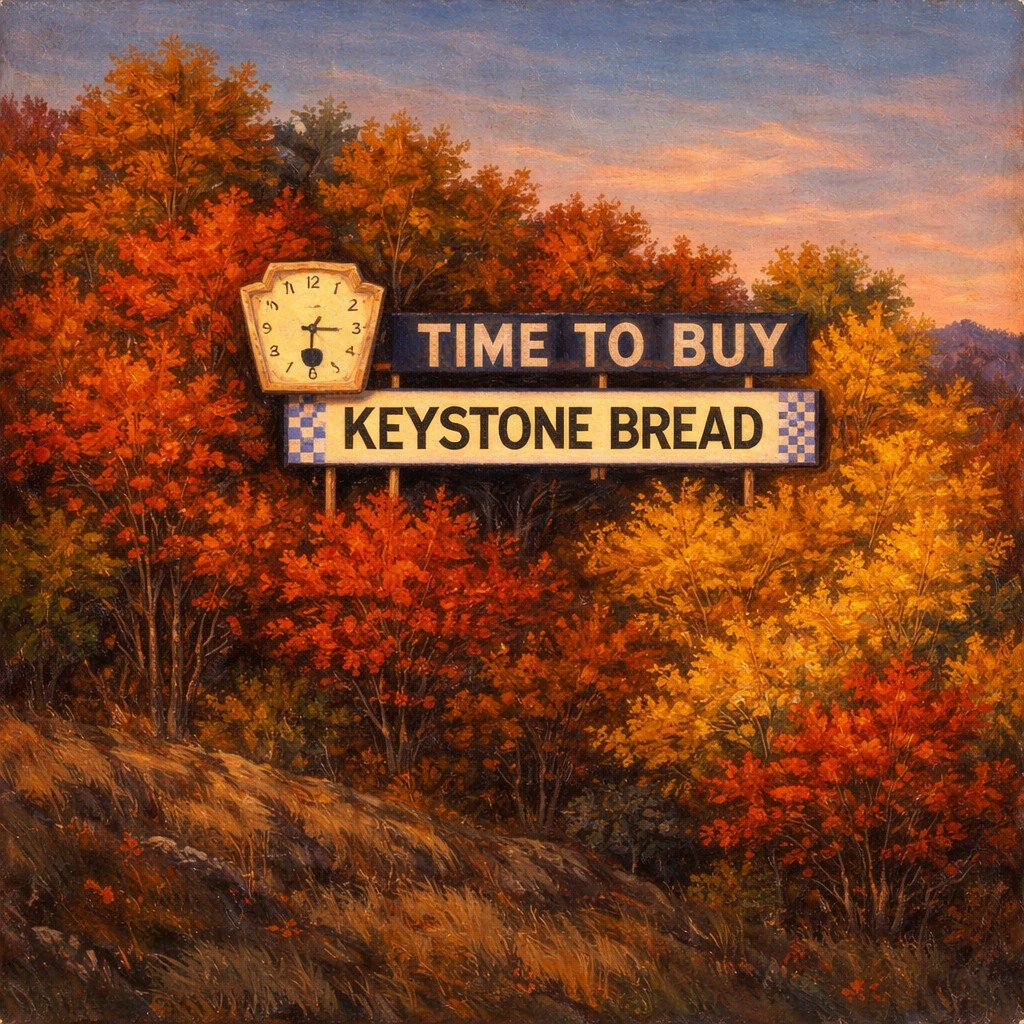
That phrase once meant something. It meant local ownership, local jobs, local decisions, and the comforting knowledge that if management did anything foolish, people would probably run into them at church. Keystone became known for products like its “Old Time Bread,” which sounds less like a marketing slogan than a civic virtue. It also became famous for the Keystone clock sign on the New Brighton–Beaver Falls Bridge reminding motorists it was “Time to Buy Keystone Bread.” There was a time when advertising could be both direct and oddly paternal. Today it would probably ask you to optimize your carb experience.
The Walters family sold the business in 1926 to Braun Baking Co. of Pittsburgh, and the Braun nephews—Gustave, Louis H., and Ernest—took over. By 1929, Keystone had been spun off as an independent operation, largely to avoid competing with the family’s Pittsburgh interests. Under Louis H. Braun, the bakery entered its peak years.
Peak, in Keystone’s case, meant scale on a level that still surprises anyone who remembers Bridgewater as a tidy little river town. The company ran 33 delivery trucks out of Bridgewater and 22 more from a Youngstown facility. Its products moved throughout western Pennsylvania, eastern Ohio, and parts of West Virginia. During and after World War II, Keystone employed roughly 175 to 200 workers. The ovens ran nearly 24 hours a day, five days a week. It made 14 kinds of bread, 10 kinds of rolls and coffee cakes, and 18 varieties of cakes, cookies, and pastries. By the 1970s, it was producing more than 250,000 loaves of bread and 100,000 packages of buns every week.
That wasn’t just a bakery. It was edible infrastructure.
And yet Keystone seems never to have lost the feel of a family business. Braun relatives remained in management. Workers stayed for years. Families built their lives around the plant. In a borough the size of Bridgewater, a place like that does more than produce baked goods. It sets a rhythm. Shift changes affect traffic. Payroll affects shops and restaurants. The smell of bread becomes part of the atmosphere and, in its way, part of the civic soul.
Which is why the ending still stings.
By the late 1970s, Keystone had outgrown its old Market Street plant, and the Braun family sold the company around 1981 or 1982 after more than 50 years of ownership. After several interim owners, Stroehmann Brothers acquired it, backed in part by a $1.3 million Beaver County industrial development loan meant to preserve the plant and its jobs. Stroehmann reportedly invested another $750,000 in upgrades. People naturally assumed the bakery had a future.
It didn’t.
Rumors surfaced in 1984. On January 25, 1985, production of Keystone products in Bridgewater ended. Workers were idled, and the Bakery, Confectionery & Tobacco Workers Union charged that Stroehmann had acquired Keystone less to preserve it than to seize its valuable distribution routes. Call that corporate strategy if you like. Around here, a lot of people called it something else.
The closure fit the broader pattern of the 1980s, when Western Pennsylvania learned that loyalty, competence, and history counted for less on a balance sheet than leverage and routes. Steel disappeared with a clang. Bread disappeared with silence.
The old building, however, didn’t vanish. The Market Street complex was eventually reborn as Stone Point Landing, home now to offices, medical and corporate tenants, and one restaurant, Frank G’s Place. It remains one of Bridgewater’s anchor structures, a reminder that buildings, unlike corporations, occasionally have the decency to stay put.
Still, for many people, the real Keystone Bakery survives not in brick but in memory: the smell of fresh bread drifting through town, the sight of Keystone products on store shelves, and the sense that somewhere nearby a dependable machine was turning flour into supper and paychecks into mortgages.
For 126 years, Keystone Bakery did what the best local businesses do. It made something people needed. It paid people honestly. It helped define a town. It turned Bridgewater into, as one historian put it, the baked-goods capital of Beaver County.
That’s a legacy substantial enough to nourish memory long after the ovens have gone cold.