Listen to a podcast discussion about this article.
There was a time in Beaver Falls when putting on a jacket meant you were headed somewhere that mattered. Not the grocery store, not the bank, and certainly not one of those modern establishments where the highest culinary ambition is a warmed-over appetizer and a television tuned to sports. No, a jacket meant the Brodhead Hotel.
And if you were lucky—and small—you might also walk away with a paper clown mask.
My earliest memories of the Brodhead are not of grandeur, though it had plenty of that, but of ritual. My parents, having finished their day at Morrow Motors a few blocks up Seventh Avenue, would take me there for dinner. The place had a kiddie menu that could be folded into a clown mask, which struck me as a marvel of both engineering and hospitality.
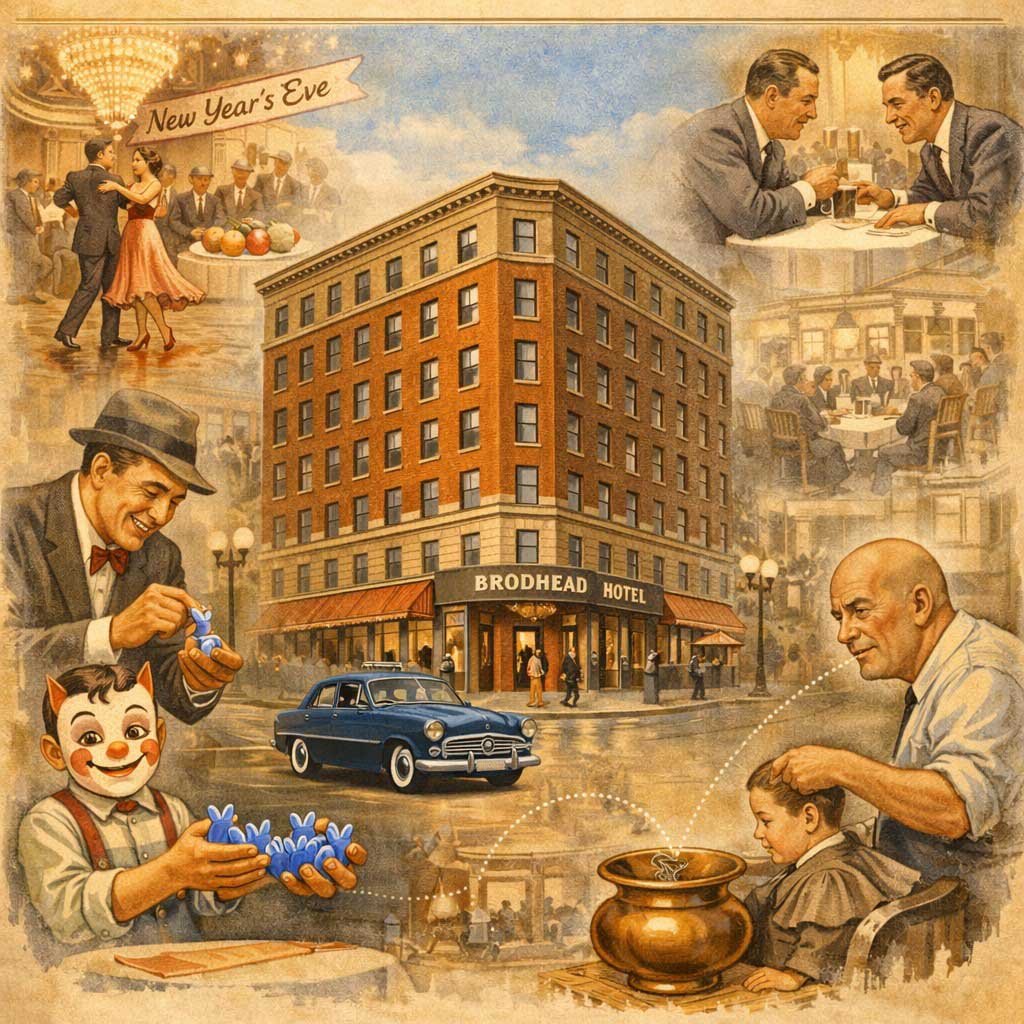
The adults, for their part, were entertained by a man named Brainerd Metheny, a friend of my father’s from Geneva College, who performed small miracles with coins and cards at our table. His masterpiece was the “multiplying rabbits” trick. He would place a small sponge rabbit in my hand, add another, and then—through means that remain suspicious to this day—my closed fist would produce not two rabbits but a small, thriving population.
Years later, still chasing that original astonishment, I sent away to Kanter’s Magic Shop in Philadelphia and bought a set of those same sponge rabbits. I learned the close-hand routine myself, which gave me a newfound respect for Mr. Metheny’s easy manner. What looks like magic at a dinner table turns out to be practice, timing, and a willingness to let people believe, if only briefly, that the world is more surprising than advertised.
Long before I arrived, however, the Brodhead had already made its entrance.
In the mid-1920s, when Beaver Falls was humming with the energy of its mills and railroads, a group of stockholders from the Union Drawn Steel Company decided the city deserved a proper civic living room. They formed the Union Hotel Company and commissioned architect Emmet E. Bailey to design a five-story brick landmark at Seventh Avenue and 12th Street. The project cost about $1.5 million—serious money in a town where fortunes were still measured in tons of steel.
By the time it opened on May 2, 1927, the building had been renamed the Brodhead Hotel, honoring Revolutionary War general Daniel Brodhead IV, who once owned much of the land beneath it. The first guest to sign the register was one of his descendants, which must have seemed like history stopping by to approve the place.
For the next four decades, the Brodhead was where Beaver Falls went to see itself. It was, as people liked to say, the place where “the elite would meet to eat,” though in Beaver Falls that included anyone with a decent suit and an understanding of table manners.
Inside were dining rooms, lounges, and bars enough to satisfy every appetite, along with a grand ballroom where couples danced under chandeliers and a rooftop “Hurricane Deck” that suggested either glamour or mild peril, depending on your disposition.
High school proms were held there. Rotary lunches. Military reunions. Holiday banquets. New Year’s Eve dinners where fresh fruit appeared in the dead of winter, a luxury so extravagant it bordered on legend. If Beaver Falls had a social heartbeat, it pulsed through the Brodhead.
It also served as a kind of civic glue. Deals were discussed, alliances formed, grievances aired, and occasionally resolved over respectable meals. If you wanted to know what was happening in town, you could do worse than sit quietly at the Brodhead and listen.
By the time I was getting my hair cut in the basement barber shop, some of the shine had softened, but the place still carried itself with dignity. The barber, Roy Hilburg, chewed tobacco as he worked and kept a large brass spittoon nearby, which he could hit from distances that would have impressed a marksman. As a child, I found this both horrifying and admirable—a combination that neatly sums up boyhood.
Upstairs, the dining rooms still buzzed. The white tablecloths were still white. The waiters still moved with purpose. And the sense lingered that you were participating in something slightly elevated from everyday life.
But history, like a bad dinner guest, eventually changes the subject.
By the 1960s, Americans had embraced the automobile and the roadside motel, where one could park outside one’s room and avoid the inconveniences of lobbies and conversation. Downtown hotels like the Brodhead began to feel like overdressed relics.
In 1965, industrialist Michael Baker Jr. purchased the hotel and invested more than $400,000 in modernization. It was a valiant effort, the architectural equivalent of putting a new engine in a classic car.
For a time, it worked. But the broader currents were too strong.
On December 30, 1967, the Brodhead closed as a hotel. The guest rooms were converted into apartments, many for senior citizens, while the ballroom hosted occasional events into the early 1970s. In 1985, the building was renovated again, settling into its present identity as the Brodhead Apartments.
Today it still stands at 712 12th Street, its brick façade steady and unpretentious, watching over Seventh Avenue as it always has.
The clatter of dishes has been replaced by quieter sounds. The ballroom no longer hosts proms. The Hurricane Deck no longer tempts dancers. And somewhere along the way, the clown masks disappeared.
But if you stand on that corner long enough, you can almost hear it—the murmur of conversation, the clink of silverware, the laughter rising just above decorum. You can picture a magician at a table, a boy clutching a handful of impossible rabbits, and a barber downstairs lining up an improbable shot.
The Brodhead Hotel was not merely a place to stay or eat. It was where Beaver Falls went to feel like itself—prosperous, connected, and, for a few hours at a time, just a little bit grand.
And for those of us who passed through its dining room as children, it remains something rarer still: a place where memory never quite checks out.