Listen to a podcast discussion about this article.
Let me begin with a frank and slightly embarrassing confession: I have never liked amusement park rides.
This is not a philosophical objection so much as a deeply held personal conviction, formed in childhood and confirmed repeatedly under duress. On one memorable occasion at an amusement park in Florida—when I was all of three years old—I kicked up such a fuss on what was advertised as a “kiddie coaster” that the operator, who had likely seen everything short of a full-scale mutiny, actually stopped the ride.
I have been on a Ferris wheel exactly once, when my son Grant was a little boy, and even then it was less an act of courage than a piece of amateur theater, performed for his benefit. I spent the entire ascent explaining, in a tone of forced calm, that there was absolutely nothing to fear, while privately reviewing my will.
Which brings us, improbably, to Harry Guy Traver—a man who looked at a perfectly respectable piece of steel and asked, quite reasonably, “How might we use this to terrify people for fun?”
Traver was born in 1877 in Gardner, Illinois, the son of a farmer, which is about as far from the amusement business as one can get without actively avoiding it. The family soon moved to Nebraska, where he graduated from high school and, in a plot twist that would alarm any modern school board, spent several years teaching students who were often older than he was.
His life might have continued in this sensible, upright fashion had he not attended the 1898 Omaha Exposition—a kind of late-19th-century World’s Fair where young men went to discover electricity, industry, and occasionally themselves. Traver discovered mechanical engineering.
He apprenticed with General Electric, worked in electric transit systems, and rose through the ranks of early industrial America with the steady competence of a man destined for a respectable career.
Then he got sick.
While recovering from diphtheria aboard a cattle boat returning from Europe—a setting that does not ordinarily lend itself to inspiration—Traver found himself watching seagulls circling the ship’s mast. Where most of us might have admired the scenery and asked for broth, Traver reached for a pencil. The result was the Circle Swing, patented in 1906, and a new career in what he would later describe, with admirable clarity, as a “crackpot business.”
By 1919, he had brought that business to Beaver Falls, Pennsylvania, thereby accomplishing something no one had previously thought necessary: turning Beaver County into a global center for amusement ride manufacturing. He purchased a factory, organized the Traver Engineering Company, and began producing rides by the thousands—devices of steel and timber that would be shipped across the United States and around the world for the express purpose of making people scream voluntarily.
Using steel fabricated in the Beaver Valley, Traver’s company built everything from the relatively polite Circle Swing to the less diplomatic Tumble Bug, Caterpillar, Auto Ride, and Laff-in-the-Dark. These were exported to parks in Europe, India, and New Zealand, carrying with them a bit of Beaver County ingenuity and a great deal of centrifugal force.
At home, Traver lived in a manner consistent with a man who designed roller coasters. He purchased a Victorian house in Patterson Heights and, finding it insufficiently dramatic, remodeled it into what locals still refer to as “Traver’s Castle”—a Moorish-inspired structure with arches, stucco walls, and a tower overlooking the Beaver River. It is the sort of house one builds when ordinary architecture fails to capture one’s inner velocity.
He was, by most accounts, an eccentric genius—generous to a fault, inclined to give away houses, land, and college tuition to employees, which is a wonderful habit unless one is also trying to maintain a balance sheet. He married twice, raised a large family, and left behind a reputation as a man both admired and, in the polite language of local history, “enigmatic.”
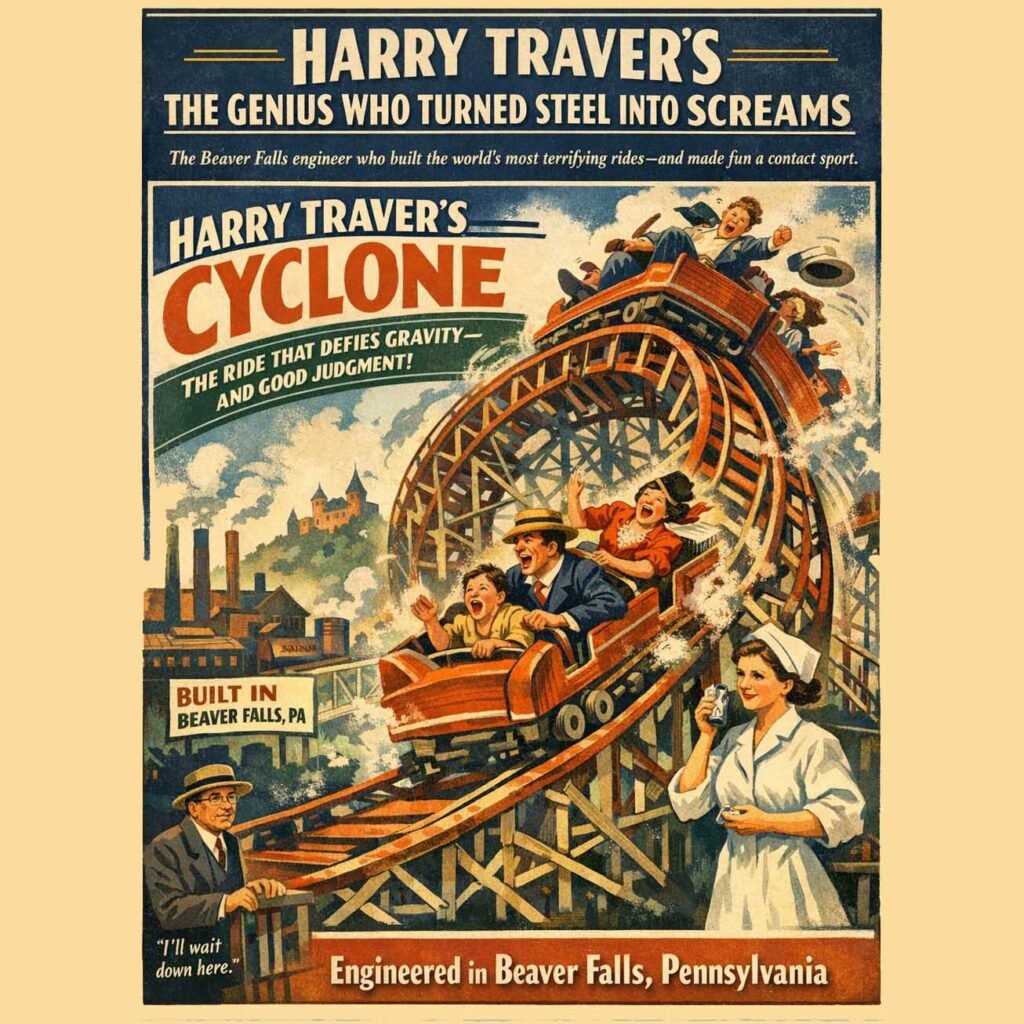
His greatest creations were the Cyclone coasters of the late 1920s—marketed, with a straight face, as “safety” coasters. These rides featured steel frames, laminated wood-and-steel track, spiraling drops, steeply banked turns, and something called “jazz track,” which sounds festive until you experience it at 50 miles per hour while questioning your life choices.
There were no straightaways. There was no rest. Riders were subjected to a continuous sequence of dips, twists, and lateral forces strong enough to rearrange both posture and perspective. The three most famous installations became known as the “Terrifying Triplets,” a nickname that was not bestowed by the marketing department but by survivors.
At Crystal Beach in Ontario, a nurse reportedly stood at the exit with smelling salts, which suggests that the ride experience fell somewhere between recreation and medical event. Riders spoke of bruises, stiff necks, and the occasional loss of dignity. And yet, they kept coming. The 1920s, after all, were not an era that shied away from excess.
Like many enterprises built on speed and optimism, Traver’s company met the Great Depression at precisely the wrong moment. In 1932, he sold the business and left Beaver Falls, bringing to a close one of the more improbable chapters in the county’s industrial history.
He continued to invent—working with Columbia University on wartime technologies and later contributing to rocket launcher design for the U.S. Navy—but the great arc of his career had already been drawn. In his later years, he turned to world travel and amateur anthropology, reportedly circling the globe even after losing his sight, which suggests that once you have built the Cyclone, ordinary risk loses its sting.
When he died in 1961, he had designed or built thousands of rides and helped define the modern amusement industry. He had also, according to contemporary accounts, lost much of his fortune along the way.
Which is, in its own way, entirely fitting.
For Harry Guy Traver spent his life creating machines that rose, plunged, twisted, and occasionally left their passengers a bit shaken but undeniably changed. It seems only fair that his own life followed a similar track—part ascent, part free fall, and, from beginning to end, one unforgettable ride.