Listen to a podcast discussion about this article.
There was a time when the Beaver Valley Mall was where a respectable portion of Beaver County went to practice citizenship. You bought socks there, or school shoes, or a wedding gift for a cousin you barely liked. Teenagers went there to loiter with purpose. Parents went there to spend money they didn’t have on things their children insisted were essential to human dignity. It was, in short, the modern public square, only with better lighting and an Orange Julius.
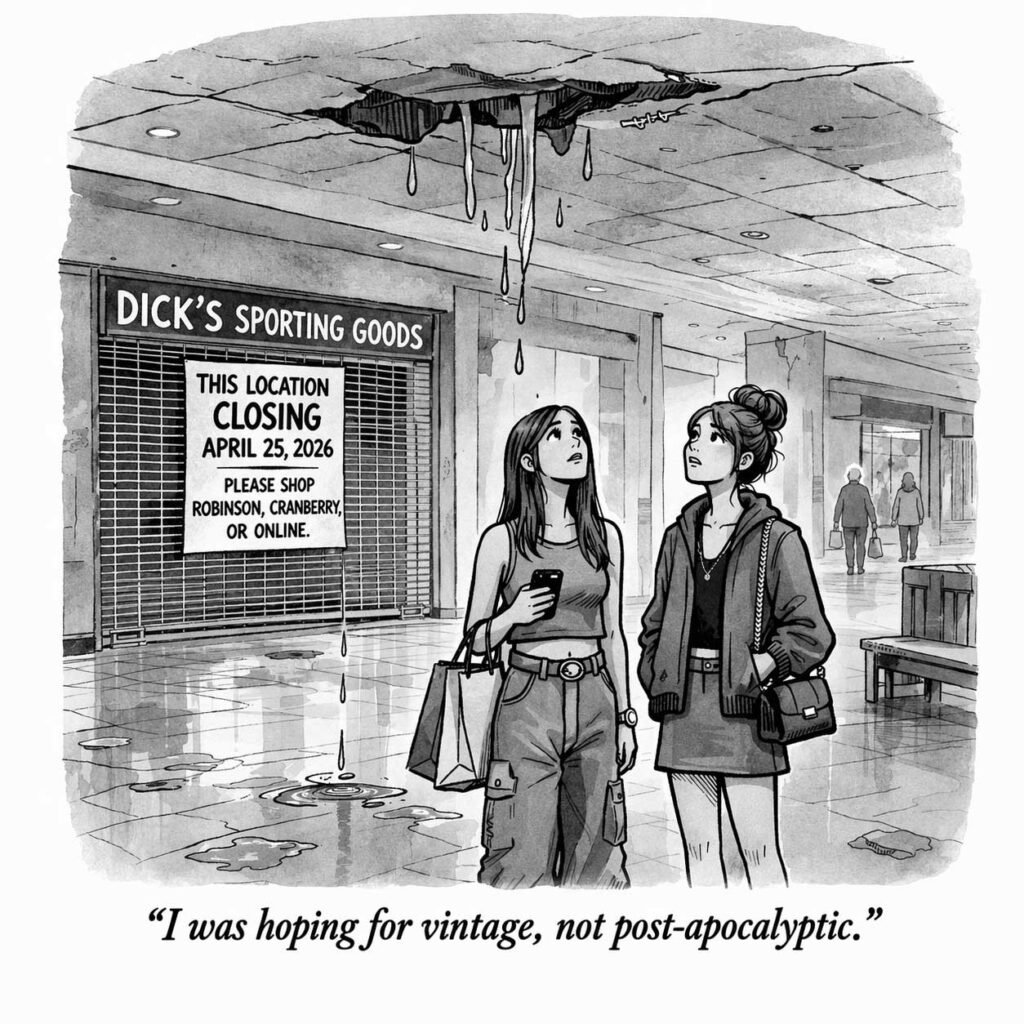
Now Dick’s Sporting Goods is leaving on April 25, after nearly 20 years at the mall, and the sign on the door has all the warmth of a parking ticket: please shop at Robinson, Cranberry, or online. That’s corporate America’s way of saying, “We still love you, but only if you’re willing to drive farther.”
This isn’t just another store closing. It’s another organ failure in a patient who’s been looking unwell for years. JCPenney closed in September 2025. Sears is now Rural King. Macy’s became U-Haul, which may be the most eloquent commentary possible on the American mall: the place where people once bought perfume and cashmere now rents trucks so you can haul away what’s left. Boscov’s, bless it, remains standing like the last aunt at a family reunion who still remembers everybody’s birthday.
What makes the Dick’s departure especially grim is that it comes at a moment when the American mall, in a few favored ZIP codes, has been granted an unlikely second act. The young, who were supposed to live entirely through screens and delivery apps, have in some places rediscovered the ancient thrill of going out in public. They still like stores. They still like seeing one another in the flesh. They still enjoy trying on clothes, bumping into friends, and buying something on impulse.
The kids, in other words, are all right. But for this sort of retail revival to happen, a mall has to offer something more uplifting than the atmosphere of a bus terminal after a power outage.
That’s where Beaver Valley Mall runs into trouble.
The malls making a comeback tend to be in growing, affluent markets, with owners who spend real money to make them appealing. They add restaurants, entertainment, events, apartments, offices, and all the other accessories now required to persuade the public that shopping isn’t a chore but an “experience.” In plain English, they don’t look abandoned.
By contrast, Beaver Valley Mall has spent years acquiring the kind of reputation that’s hard to put on a tourism brochure. Local reporting and shopper accounts have described leaks, unreliable heat, crumbling ceilings in bathrooms, and even a dead rat near the Dick’s entrance. When a mall starts sounding like a chapter from The Grapes of Wrath, younger shoppers don’t rush in to create TikTok content. They go somewhere cleaner.
A large share of the local frustration is aimed at Namdar Realty Group, the Great Neck, New York, firm that bought the mall in 2017. Namdar has built a national portfolio by buying distressed retail properties cheaply and operating them with a reputation—fair or unfair, though many communities insist it’s deserved—for spending as little as possible on upkeep while collecting what cash flow remains. Beaver Valley Mall, to many local eyes, fits the template.
Now, to be fair, Namdar didn’t invent the troubles of the American middle-market mall. E-commerce battered these places. Department-store chains collapsed or shrank. Consumer habits changed. Inflation’s made a casual trip to buy sneakers feel like a review of one’s estate plan. Even a conscientious owner would’ve had a rough go of it.
But there’s a difference between inheriting a difficult property and appearing to let nature take its course.
That distinction matters because Beaver Valley Mall’s problems aren’t purely national. They’re local, too. Beaver County is older than it used to be, smaller than it used to be, and too often forced to watch its young adults head elsewhere for work, excitement, or at least a Target with better lighting. A mall that hopes to become a social magnet for younger shoppers has to compete not only with Amazon but with Robinson, Cranberry, Ross Park, and every other place that looks newer, cleaner, and more alive.
So what happens now?
The honest answer is that without meaningful reinvestment, a bold redevelopment plan, or some entirely new use for the site, the mall will continue its long conversion from shopping center to cautionary tale. That new use might be housing, healthcare, entertainment, logistics, or some hybrid that no longer depends on the ghost of 1994 wandering in to buy khakis.
And that’s the melancholy little lesson here. The death of a mall is never just about retail. It’s about the slow disappearance of a place where ordinary life used to happen in public. Teenagers flirted. Grandparents walked laps. Families bought school clothes. People ran into neighbors and were reminded that they belonged to a community rather than a delivery radius.
The country’s healthier malls may yet thrive because a generation of young shoppers has rediscovered the pleasures of being somewhere together. Beaver Valley Mall, sadly, seems poised to miss that revival. The kids are all right. It’s the grown-ups who owned the building who seem to have misplaced the plot.