
Listen to a podcast discussion about this article.
Yesterday’s ceasefire announcement out of Islamabad produced the usual modern reaction to complicated diplomatic events: millions of people instantly explaining it on the internet after reading three tweets and a headline.
When this happens, I find it helpful to call a friend.
Mine happens to be Persian, a student of statecraft and the long, peculiar habits of the theocracy that runs Iran. Persians have been studying power and survival since before most Western nations had figured out the correct way to construct a saddle, so they often have a calming perspective when the rest of us are flailing about.
“What happened?” I asked him.
He sighed the way a man sighs when he realizes he must now explain three thousand years of politics in less than 20 minutes.
“First,” he said, “this ceasefire is not peace. It is a pause.”
Then he began laying out the situation with the calm precision of someone explaining a chessboard to a man who thought he was watching checkers.
The immediate beneficiary of the agreement, he said, is the United States, under Donald Trump. The ceasefire gives Washington roughly a two-week window—an eternity in geopolitical time—to stabilize the oil and gas markets and reposition itself diplomatically.
More importantly, it removes one of the Islamic Republic’s favorite weapons: the ability to trigger panic in global energy markets.
For years, Tehran could threaten to disrupt supply in the Persian Gulf whenever pressure mounted. That card, my friend explained, has now been played—and lost.
The next factor was blunt force.
Trump’s public threats to destroy power plants and bridges inside Iran elevated the conflict to something far more dangerous for the regime. In Tehran, threats against infrastructure are interpreted not merely as battlefield rhetoric but as threats against the survival of the state itself.
When regimes begin imagining their own collapse, they tend to become suddenly pragmatic.
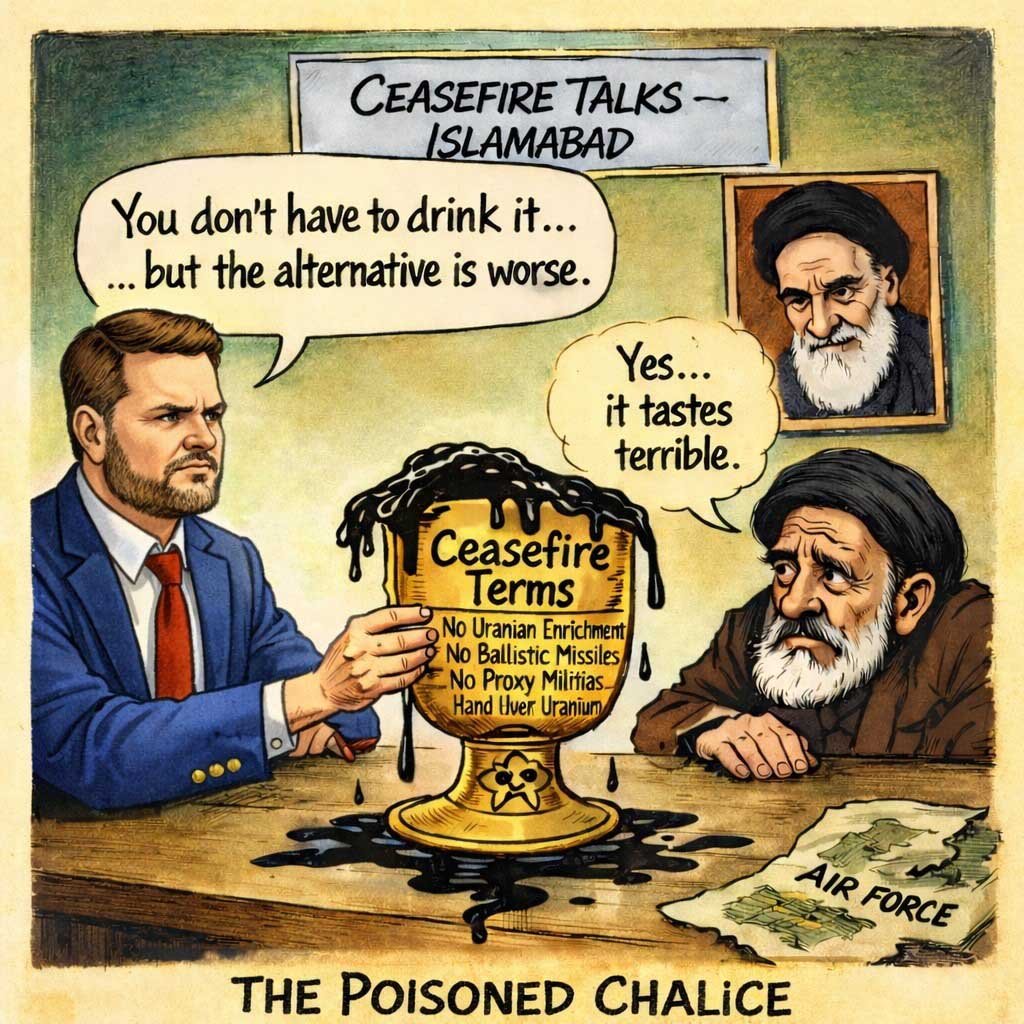
My friend compared the moment to the end of the long war between Iran and Iraq. In 1988, Iran accepted United Nations Security Council Resolution 598 after years of refusing it. At the time, Ayatollah Khomeini famously described the decision as “drinking from a poisoned chalice.”
Yesterday’s ceasefire, he suggested, has a similar flavor.
There is another historical parallel as well. In 2015, Tehran accepted the nuclear agreement known as the Joint Comprehensive Plan of Action largely because the economy was nearing collapse under sanctions.
Pressure, in other words, works.
Which brings us to the next phase.
According to my Persian friend, Washington intends to push four conditions in any final settlement: halt uranium enrichment, halt the ballistic missile program, end support for proxy militias across the region, and surrender existing enriched uranium stockpiles.
“If they accept this,” he said dryly, “it is surrender.”
“If they refuse?” I asked.
“Then the war likely returns.”
The reason the regime accepted a pause at all, he said, lies in the damage already done.
Iran’s leadership structure has been shaken severely. A large number of senior commanders and officials have been killed, including key figures in the intelligence services, the military command structure, and the Revolutionary Guard hierarchy.
The commander-in-chief of the Islamic Revolutionary Guard Corps is dead. The chief of staff of the armed forces is dead. The defense minister is dead. Senior intelligence chiefs across multiple agencies are dead.
In the world of authoritarian governments, where power flows through a narrow and carefully managed pyramid, losing that many senior figures at once produces something approaching institutional vertigo.
The military damage is equally severe.
Iran’s air force, my friend said, has been largely destroyed. Air defense systems are badly degraded. The skies over the country remain effectively controlled by American and Israeli aircraft.
Major petrochemical facilities—the country’s most important source of foreign currency—have been hit. Military production centers have been damaged across the country. Even the paramilitary infrastructure of the Basij has taken heavy losses.
Then there is the diplomatic damage.
The Gulf monarchies, organized under the Gulf Cooperation Council, have moved firmly into the opposing camp. Tehran’s once-valuable financial escape routes through Dubai have largely closed. Even relations with Qatar—formerly one of the regime’s more flexible neighbors—have deteriorated.
Wars rarely end neatly. They usually leave a country surrounded by bills.
Iran now faces enormous financial demands from war damage, delayed payments, and economic disruptions that accumulated during the conflict.
And then there is the domestic front.
My friend spoke quietly when he reached this part.
“The most important opposition to the regime,” he said, “is the Iranian people.”
Inside the country, anger toward the government remains intense, particularly after violent crackdowns earlier this year that left many dead and deepened the already vast divide between rulers and ruled.
The ceasefire, he said, has not improved the regime’s standing. If anything, it has damaged it further. Many Iranians believe the government abandoned civilians during the conflict while protecting its own leadership compounds.
Naturally, the regime is calling the outcome a victory.
In Tehran’s official narrative, survival itself counts as triumph.
“They say they won,” my friend laughed, “because they still exist.”
Which brings us back to the present moment.
The ceasefire announced in Islamabad does not end the war. It merely freezes the board while both sides examine their remaining pieces.
Two weeks from now, diplomacy could produce a settlement—or the guns could start again.
“Politics,” my Persian friend concluded, “is never a straight road. It goes up and down.”
Then he added the most Persian sentence imaginable.
“Patience,” he said, “is required.”
1 thought on “What Just Happened in Islamabad? A Persian Friend Explains”
Makes sense, thanks!