Listen to a podcast discussion about this article.
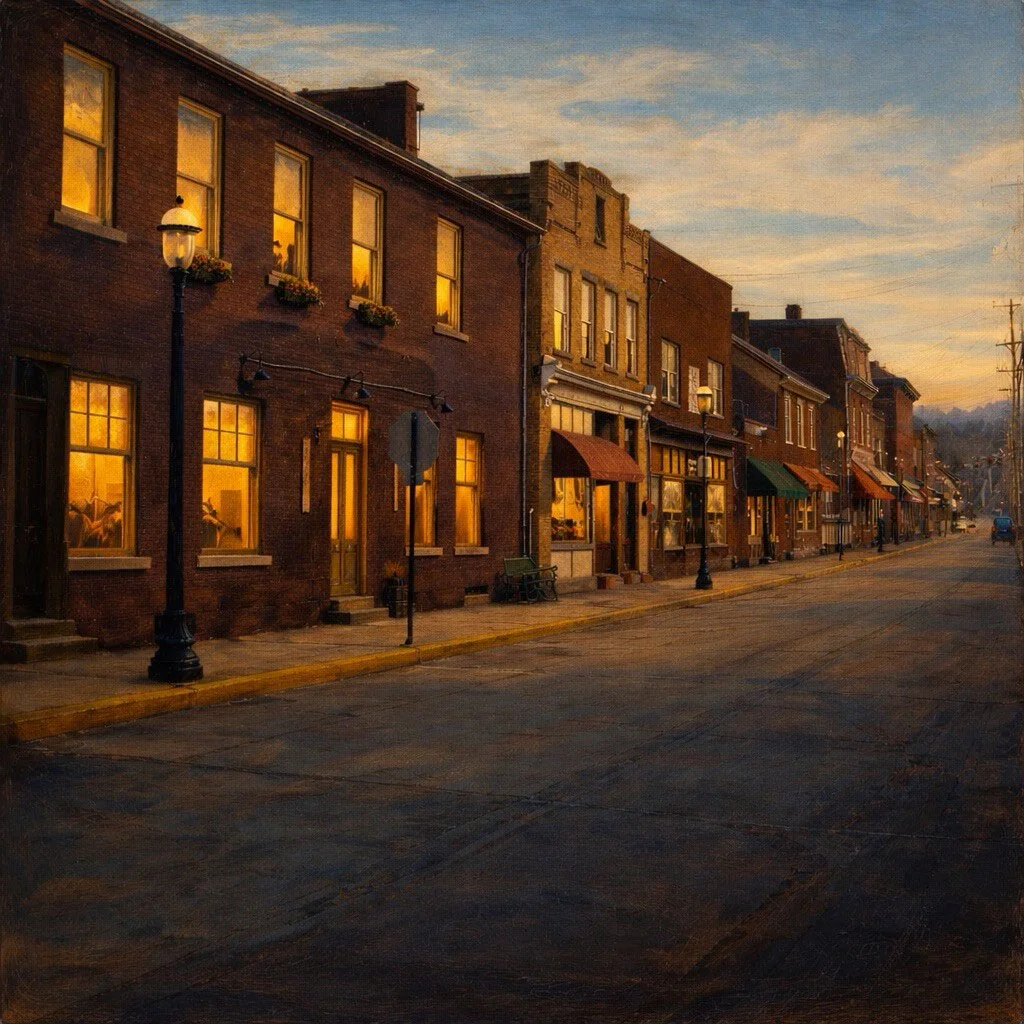
Bridgewater is not an ambitious place, which may explain why it has aged so well. In a county that once believed every riverbank was an invitation to build something enormous, Bridgewater quietly declined the offer. It took the land it had, arranged it sensibly, and went about the business of being useful without becoming complicated.
This is not the sort of strategy that earns headlines. It is, however, the sort that keeps a place intact—most of the time.
Where the Rivers Meet—and Occasionally Misbehave
Bridgewater sits at the confluence of the Beaver and Ohio Rivers, a location that in earlier centuries inspired trade, settlement, and the occasional overconfidence.
It also inspired flooding.
For as long as anyone can remember, the rivers have reminded Bridgewater who’s in charge. High water has come and gone in cycles—sometimes politely, sometimes with the enthusiasm of an uninvited relative who decides to rearrange the furniture. Basements fill. Streets disappear. And then, just as inevitably, the water recedes and life resumes with a kind of practiced shrug.
Hovering over all of this—sometimes serenely, sometimes with a front-row seat to the chaos—is the Beaver Bridge, connecting Beaver to Monaca while passing over Bridgewater like a piece of infrastructure that knows it has better things to do than explain itself.
It carries a different kind of traffic than the streets below—freight, industry, and the steady, unromantic business of moving things from one place to another. If Bridgewater specializes in staying put, the bridge specializes in everything else.
It was also, briefly and somewhat nervously, a place of national intrigue. Just across the river and along these banks, preparations tied to Aaron Burr Conspiracy took shape—an episode that suggests Bridgewater has always been closer to history than its size might imply.
The Business of Being Nearby
If Bridgewater has an economic model, it is proximity.
It sits within arm’s reach of larger, more assertive neighbors: Rochester to the north, Beaver to the west, Monaca just across the river. Each of these places developed its own identity—industrial, governmental, logistical—while Bridgewater adopted a quieter role.
It became the place next to the place.
This is not as passive as it sounds. Proximity creates opportunity. Businesses that didn’t require large footprints found a home here. Residents who wanted access to jobs and services elsewhere discovered they could live in Bridgewater without sacrificing convenience.
The borough became, in effect, a well-positioned participant in other people’s plans.
The Culinary Capital (Quietly)
For a place that never chased size, Bridgewater has developed an appetite—specifically, for feeding the rest of Beaver County.
It is, without much argument, the county’s culinary heart.
Within a few compact blocks and nearby corners, you’ll find a concentration of dining establishments that would make a larger town self-conscious: the Wooden Indian, Wooden Angel, Mario’s 410 Grille, Frank G.’s Place, The Grumpy Beaver, The Grille at Bridgewater Crossings, Jerry’s Curb Service, Bruster’s Real Ice Cream, and the ever-reliable Beaver Bagel Co..
For those inclined to linger rather than simply dine, there is also the Riverside Bed and Breakfast, offering a quieter, more reflective way to experience the borough—preferably after a meal that requires a walk and a moment to consider your life choices.
Taken together, they form something like an accidental food district—one that evolved not through planning documents or branding exercises, but through the simple and persistent act of serving people well.
If you want to understand Bridgewater, it helps to arrive hungry—and, depending on the forecast, possibly in waterproof shoes.
A Town That Stayed Put
While much of Beaver County surged and receded with the tides of industry, Bridgewater remained remarkably steady.
There were no massive mills to close, no sprawling industrial complexes to redevelop. The town avoided both the boom and the bust, which in economic terms can look like a lack of excitement but in human terms often translates to stability.
Buildings went up and, for the most part, stayed up. Streets were laid out and continued to make sense. The scale of the place—small enough to be known, large enough to function—remained consistent.
In an era of constant change, this begins to look less like inertia and more like discipline.
Keystone Bread and Memory
Bridgewater also carries its history in ways both visible and aromatic.
For generations, the Keystone Bakery supplied much of Beaver County with its daily bread—a factory-sized operation that turned flour and routine into something approaching civic infrastructure.
It is difficult to overstate what that meant in a county where industry dominated the conversation. Keystone was not glamorous, but it was essential. It fed people, literally, and in doing so became part of the rhythm of everyday life.
Even now, long after its peak, the memory lingers—proof that not all local legacies are made of steel.
Living With Water—and Everything Else
Flooding, like everything else in Bridgewater, is handled with a certain practicality.
It is neither romanticized nor catastrophized. It is understood. Preparations are made. Stories are told—about the year the water reached this step or that storefront—and then the town carries on.
In a region accustomed to larger disruptions—mill closures, economic shifts, and billion-dollar bets—this quieter form of endurance can be easy to miss.
But it may be the most relevant kind.
The Modest Achievement
It is easy to overlook a place like Bridgewater.
It does not announce itself. It does not demand attention. It lacks the dramatic history of its industrial neighbors and the curated charm of more self-conscious communities.
But it has something else.
It has continuity—and, rather unexpectedly, cuisine—and a working relationship with the river that built it and occasionally inconveniences it.
From river commerce to bakery bread to a lineup of restaurants that quietly outperform their ZIP code, Bridgewater has found ways to matter without making a spectacle of itself.
It did not chase greatness.
It settled for usefulness.
And in the long run, that—and the ability to mop up and reopen the next day—may prove to be the greater achievement.