
Listen to a podcast discussion about this article.
One of the advantages of growing older is that you stop paying much attention to what people say and start paying attention to what they do.
Politicians say the economy is booming. Economists say it’s slowing. Television commentators spend entire afternoons arguing over decimal points in reports nobody reads twice.
Meanwhile, somewhere between Midland and Monaca, a fellow in a hard hat is trying unsuccessfully to find a flatbed truck.
That tells you more than a hundred cable-news panels ever will.
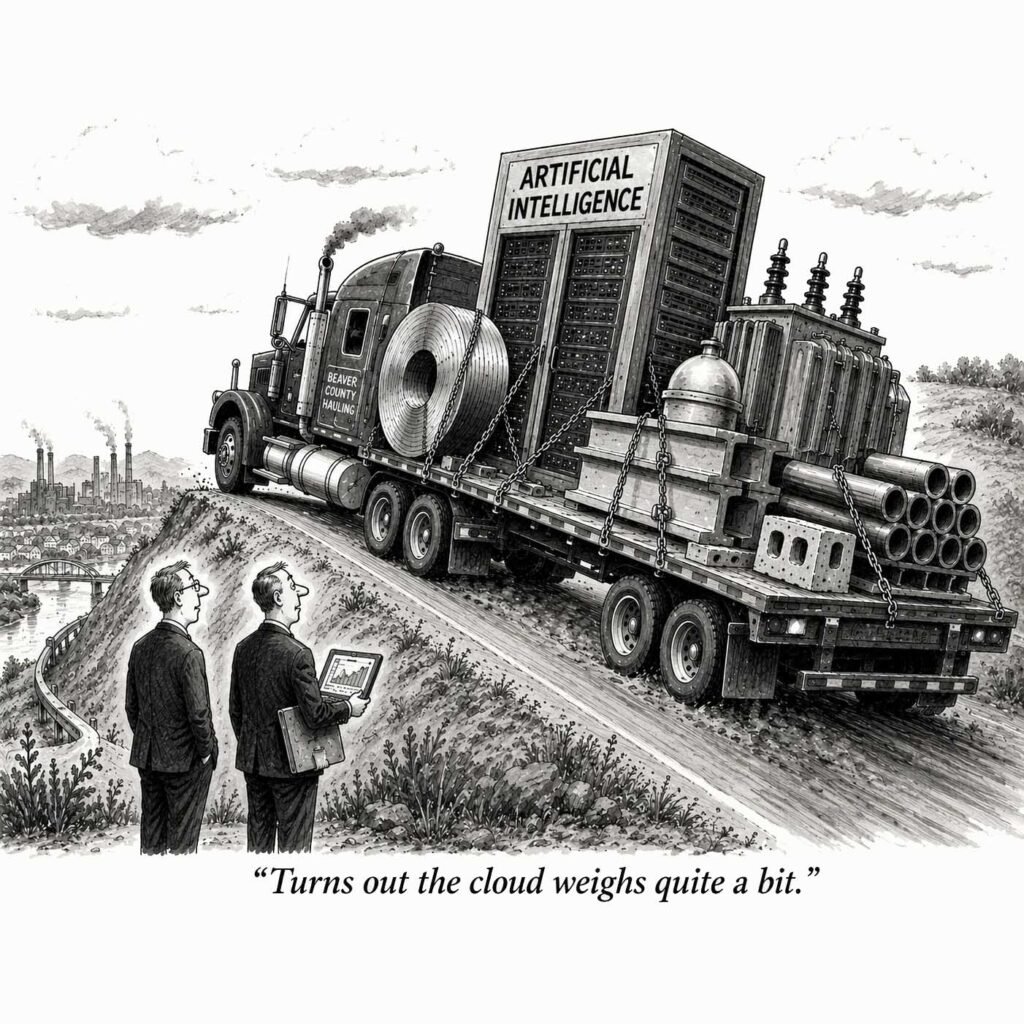
Economists have a fancy term for this. They call it “revealed preference.” The theory is simple: what people do reveals what they actually believe. If a man tells you he’s saving money while financing a bass boat and a side-by-side ATV, trust the bank statement, not the conversation.
The same principle applies to freight.
Freight cannot lie.
A company can issue optimistic press releases. It can hire consultants to produce colorful PowerPoint presentations. It can host investor conferences in expensive hotels.
But when somebody is paying through the nose to move steel coils, structural beams, transformers, machinery, and industrial equipment, something real is happening.
And something very real is happening right now.
For years, America’s freight maps looked exactly as you’d expect. The hot spots were clustered around the coasts. Containers arrived from overseas. Goods moved inland. The economy functioned largely as a giant distribution system for products made somewhere else.
Today the map looks different.
The brightest red stretches through the middle of the country. Texas. Oklahoma. Missouri. Ohio. Pennsylvania. The old industrial heartland.
In other words, the places many experts assured us were permanently finished.
The most interesting signal comes from flatbed trucking.
Most people never think about flatbed trucks unless they’re stuck behind one carrying a bulldozer on Interstate 376.
But flatbeds occupy a special niche in the economy. They don’t haul groceries. They don’t haul televisions. They don’t haul packages from online retailers.
They haul the things used to build things.
Steel. Lumber. Pipe. Industrial machinery. Structural components. Heavy equipment.
When flatbeds get busy, factories get busy.
And right now they’re beyond busy.
Industry data shows rejection rates on flatbed loads approaching 50 percent in some markets. In plain English, half the available loads are struggling to find trucks because demand is outrunning supply.
The situation has become so tight that manufacturers are reportedly offering truckers rates that would have sounded like typographical errors six months ago. Some are paying nearly twice as much just to persuade a flatbed driver to show up.
That doesn’t happen because Americans suddenly decided to buy more patio furniture.
Which brings us to Beaver County.
For decades we’ve listened to experts explain why our future belonged somewhere else.
Manufacturing was dead.
Heavy industry was obsolete.
The knowledge economy would replace blast furnaces with coffee shops and software developers.
Oddly enough, nobody ever explained how software developers were supposed to manufacture transformers, gas turbines, switchgear, pipelines, electrical substations, steel beams, or data centers.
Now reality has arrived with a forklift.
The biggest force behind this resurgence may be the least expected: Silicon Valley.
The same technology companies that spent years convincing us everything would become virtual are now spending astonishing sums building physical infrastructure.
The artificial-intelligence arms race has become the largest industrial construction program many of us have witnessed in our lifetimes.
Hyperscale technology companies are collectively spending well over $100 billion annually constructing data centers, power systems, transmission infrastructure, cooling systems, and computing campuses.
Every one of those facilities requires steel.
Concrete.
Electrical equipment.
Natural gas.
Construction crews.
And, yes, flatbed trucks.
A great deal of that activity is flowing directly into places that still know how to make things.
Places like Western Pennsylvania.
Places like Beaver County.
Consider what sits within a short drive of the Beaver County Courthouse.
• The Beaver Valley Nuclear Power Station.
• The Shell Pennsylvania Petrochemicals Complex.
• The Westinghouse Electric Company nuclear operations.
• The Mitsubishi Electric Power Products facility in New Galilee.
• The Tenaris in Koppel.
• The McCarl’s LLC on Bet-Tech Drive.
The growing energy and manufacturing corridor stretching along the Ohio River.
Add the proposed AI data-center developments emerging around Shippingport and elsewhere, and suddenly our geography begins looking less like yesterday’s economy and more like tomorrow’s.
The funny thing about economic revolutions is that they rarely announce themselves.
The internet revolution arrived disguised as a toy for academics and hobbyists.
The shale revolution began with drillers many experts dismissed as dreamers.
The AI revolution may prove similar.
Some economists describe these moments as positive Black Swans—unexpected events that dramatically expand human capability.
Nobody predicted penicillin.
Nobody predicted the internet.
Very few predicted that artificial intelligence would arrive and immediately begin boosting productivity across industries ranging from engineering to software development to scientific research.
Yet here we are.
And unlike previous technology booms, this one requires enormous amounts of physical infrastructure.
Servers need buildings.
Buildings need steel.
Steel needs energy.
Energy needs pipelines, substations, turbines, reactors, and transmission lines.
In other words, the digital economy turns out to require a surprisingly large amount of old-fashioned industrial muscle.
Fortunately, America possesses another advantage.
Energy.
Natural gas remains dramatically cheaper here than in Europe, Japan, or China. For energy-intensive manufacturers, that difference matters enormously. Energy can represent up to 40 percent of production costs.
Cheap, abundant energy attracts factories.
Factories create freight.
Freight fills flatbeds.
And flatbeds tell us where the economy is heading.
So the next time somebody asks whether America’s industrial revival is real, don’t bother reading a stack of economic forecasts.
Find a truck stop.
If every flatbed driver in Western Pennsylvania is booked solid and smiling, you’ll have your answer.
The future may be powered by artificial intelligence.
But it’s still arriving on a flatbed truck.