Listen to a podcast discussion about this article.
There comes a certain point in life when a man realizes he is no longer trying to lose weight.
He is trying to negotiate a peace treaty with gravity.
At 25, you want abs.
At 72, you want to get out of a chair without sounding like a screen door that hasn’t seen a drop of oil since the Carter administration.
That is why SUPER Body, the latest book by physician and bestselling author William Davis, struck me as more interesting than the average diet book. It is not really a book about losing weight. It is a book about staying functional. It is a book about preserving the strength, mobility, and independence that become increasingly precious with age.
Davis begins with a simple but provocative argument: most modern weight-loss programs are solving the wrong problem.
The objective, he says, should not be to make the bathroom scale display a smaller number. The objective should be to improve body composition—to reduce harmful visceral fat while preserving or increasing muscle mass. After all, losing twenty pounds sounds impressive until you discover that a substantial portion of what disappeared was muscle.
The distinction matters.
Muscle is not merely decorative. It is what allows people to carry groceries, climb stairs, lift grandchildren, mow lawns, and continue living independently. Davis argues that many popular weight-loss approaches—from calorie restriction to bariatric surgery to the latest generation of weight-loss drugs—often produce a troubling side effect: loss of muscle along with fat.
When the weight returns, as it frequently does, much of what comes back is fat rather than muscle. The result is a body that may end up metabolically worse off than before.
Whether one agrees with all of Davis’s conclusions or not, he raises an important question.
If your weight-loss strategy leaves you weaker, was it really a success?
His answer is an emphatic no.
Readers familiar with Davis’s earlier books, including Wheat Belly and Super Gut, will recognize much of the territory. The villains remain modern processed foods, refined carbohydrates, excessive sugar, and the industrialized diet that dominates American life. The heroes are nutrient-dense foods, strategic supplementation, fermentation, and restoration of a healthy microbiome.
The most intriguing concept in SUPER Body is what Davis calls the “gut-muscle axis.”
Most people think of gut bacteria primarily in terms of digestion. Davis argues that these microbes influence far more than that. According to his theory, the microbiome affects metabolism, inflammation, insulin sensitivity, appetite, mood, sleep quality, and even the body’s ability to preserve muscle tissue as we age.
If that sounds like a lot of responsibility for a collection of microscopic organisms, Davis would simply smile and say that modern medicine has dramatically underestimated their importance.
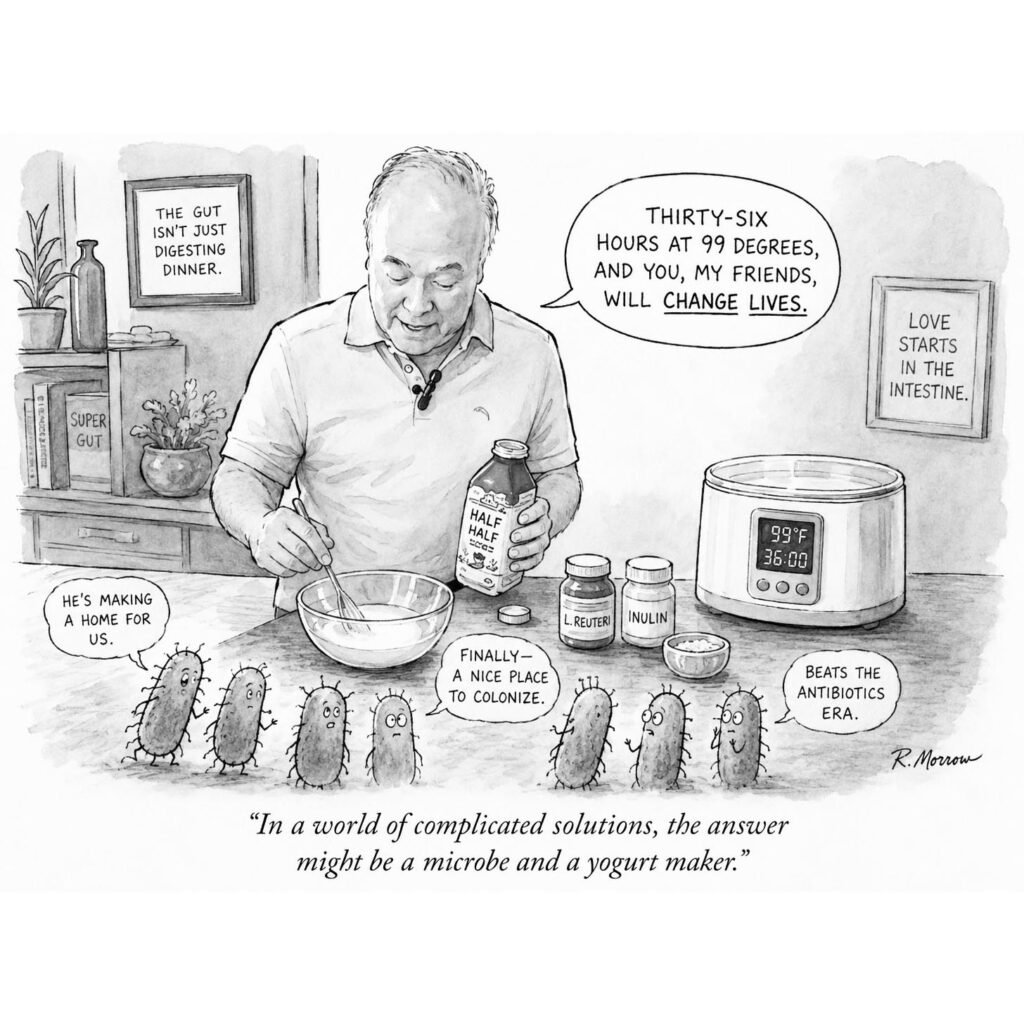
One bacterium in particular receives star treatment throughout the book: Lactobacillus reuteri.
Davis contends that this once-common organism has largely disappeared from modern populations because of antibiotics, pesticides, processed foods, and other features of contemporary life. He links its absence to a surprising list of modern ailments and its restoration to improvements in mood, sleep, body composition, social bonding, and overall health.
Much of the book is devoted to practical methods for restoring beneficial microbes, including fermented foods and homemade yogurts designed to cultivate specific bacterial strains.
Now, before readers begin converting their kitchens into microbiology laboratories, a note of caution is in order.
Davis has never been accused of lacking confidence.
He writes with the certainty of a man who looked at conventional medicine, found it wanting, and decided to construct an entirely different model from the ground up. Admirers see him as an innovative thinker willing to challenge stale assumptions. Critics argue that some of his claims move beyond what has been conclusively established by current scientific evidence.
Both observations can be true simultaneously.
What makes SUPER Body worthwhile is not that it provides the final answer to every health question. It is that it asks better questions than many books in the health-and-fitness aisle.
Most notably, it asks readers to think about strength rather than thinness.
That distinction should resonate in Beaver County.
For generations, this was a place where people worked with their hands. Steelworkers, pipefitters, machinists, electricians, truck drivers, welders, and construction workers understood something modern health culture occasionally forgets: strength matters.
The ability to do useful work matters.
The ability to remain independent matters.
The ability to move confidently through life matters.
The ability to restrain a 140-pound Newfoundland who has suddenly decided that a flock of Canada geese requires immediate supervision matters.
Those capabilities depend far less on the number displayed by a scale than on the amount of functional muscle attached to one’s skeleton.
In that respect, Davis may be pointing toward something genuinely important.
His larger message is that health should be measured not by appearance but by capability. He is not promising readers a swimsuit model’s physique. He is promising the possibility of remaining active, mobile, and self-sufficient well into later life.
That is an appealing proposition.
Especially in Beaver County, where many residents would rather split firewood, tend a garden, fish the Ohio River, or walk a very large dog than spend their retirement posing for fitness influencers on social media.
SUPER Body is provocative, occasionally controversial, and certain to irritate portions of the medical establishment. But it is also thoughtful, readable, and filled with ideas that challenge conventional wisdom in useful ways.
Even readers who reject half of Davis’s conclusions will likely find enough insight in the remaining half to justify the journey.
And if Davis is right, the most important piece of exercise equipment in America may not be a treadmill.
It may be a yogurt maker sitting quietly on a kitchen counter.
Rating: 4 out of 5 stars. A thought-provoking and often persuasive argument that the real goal of health is not simply losing weight, but preserving the strength to enjoy the years ahead.