Listen to a podcast discussion about this article.
Every few weeks I find myself having the same conversation with a local business owner.
It doesn’t matter whether the business is a restaurant, a machine shop, a trucking company, a contractor, a retailer, or a manufacturer. Sooner or later the discussion arrives at the same destination.
“The business is there,” the owner says.
“The customers are there.”
Then comes the sigh.
“What I can’t find are people willing to show up and work.”
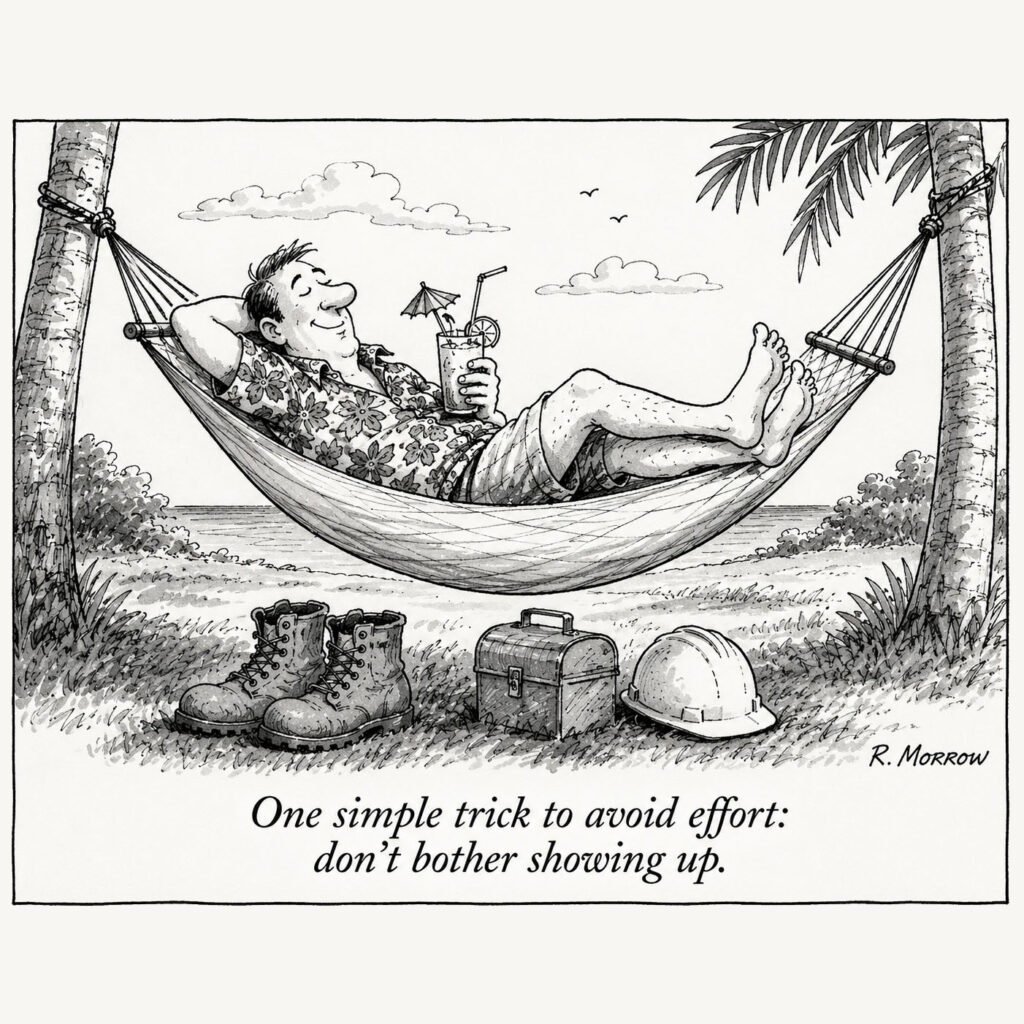
Notice the complaint is not that workers are unavailable. America has plenty of people. We have nearly 350 million of them. What seems increasingly scarce are people who reliably show up on time, stay the entire shift, learn new skills, solve problems, and understand that getting good at anything requires doing a great deal of it when you’d rather be doing something else.
Of course, every generation complains about the next one. The ancient Greeks thought young people were lazy. The Romans thought civilization was collapsing because nobody respected authority anymore. My grandfather thought my father’s generation was soft. My father thought mine was hopeless.
And now I have reached that alarming age where I occasionally find myself thinking my father may have had a point.
Still, something does feel different.
We have spent decades creating a culture devoted to eliminating effort.
If you’re overweight, somebody promises a pill. If you’re unhappy, somebody promises a pill. If you’re anxious, distracted, lonely, or restless, somebody else has another pill.
Every challenge seems to come packaged with a shortcut. The message is hard to miss: discomfort is abnormal, effort is optional, and every problem ought to have a quick fix.
The internet transformed that tendency into an entire industry. Every day brings fresh advertisements promising success through “one simple trick.”
Lose weight with one simple trick.
Get rich with one simple trick.
Retire early with one simple trick.
Find true love with one simple trick.
The only thing nobody has discovered is one simple trick that actually works.
The same impulse has infected the way we consume information. A headline replaces an article. A summary replaces a book. A sound bite replaces an argument. Before long we’ll probably need summaries of the summaries because even the summaries demand too much concentration.
Now artificial intelligence has arrived to join the festivities.
I happen to think AI is a remarkable tool. Beaver County’s future may depend in part on how effectively we learn to use it. But a calculator is only useful if you understand arithmetic. Likewise, AI can help us think, organize, and communicate. It cannot replace judgment, experience, or wisdom.
Yet many people seem delighted by the possibility that they may never again have to wrestle with a difficult idea. Why think deeply about a problem when a machine can generate an answer that sounds authoritative whether it happens to be right or not?
The desire to eliminate effort now extends into nearly every corner of life. Food arrives without requiring us to visit a restaurant. Groceries arrive without requiring us to enter a store. Movies arrive without requiring us to leave the couch. Dating apps allow us to evaluate prospective life partners with roughly the same care we once devoted to selecting a breakfast cereal.
The modern economy increasingly resembles a giant machine designed to eliminate inconvenience.
The trouble is that inconvenience turns out to be where character comes from.
Which brings me back to Beaver County.
There was a time when this county’s defining characteristic was not its steel mills, railroads, or riverfront. Its defining characteristic was that people showed up.
They showed up for shifts at J&L, Crucible, and Babcock & Wilcox. They showed up for church suppers, volunteer fire departments, Little League games, PTA meetings, fish fries, and neighborhood projects. They showed up because that was what adults did.
Nobody expected life to be easy. Nobody expected fulfillment to arrive by Amazon Prime.
Beaver County wasn’t prosperous simply because it sat atop rivers, rail lines, and industrial infrastructure. Half the country had access to natural resources. Beaver County prospered because generation after generation developed a culture that respected work.
People understood that if you wanted a better life, you got out of bed, put on your boots, and went to work whether you felt inspired or not.
Somewhere along the line, a bit of that culture seems to have leaked out of the pipes.
Not all of it. Thank goodness.
There are still thousands of people throughout this county who get up before dawn every day and keep the machinery of civilization running. Electricians. Nurses. Teachers. Truck drivers. Pipefitters. Restaurant owners. Entrepreneurs. People who solve real problems for real customers.
Nobody makes inspirational TikTok videos about wastewater treatment facilities. There are few reality television shows devoted to preventive maintenance. Yet these people remain the foundation upon which every functioning society rests.
The irony is that Beaver County may be standing on the threshold of one of its greatest economic opportunities in generations. Data centers, energy projects, advanced manufacturing, healthcare, logistics, hospitality, and construction are creating opportunities our grandparents would immediately recognize.
But none of it matters if nobody shows up.
A community cannot outsource its work ethic. It cannot import character in shipping containers. It cannot download discipline from the cloud.
The future will belong to the places that still understand a simple truth our grandparents took for granted: showing up is a skill. Working hard is a habit. Prosperity is usually what happens after enough people decide to practice both for a very long time.
As for making America great again, I have no objection to the goal.
But before we make America great, perhaps we should try making America show up.
The rest might take care of itself.