Listen to a podcast discussion about this article.
One of my family’s prized possessions isn’t a rare coin or an antique clock. It’s my mother’s Beaver Falls High School yearbook.
Near the back, among the usual collection of “Best of luck,” “Don’t ever change,” and signatures that now require the services of a forensic handwriting expert to decipher, appears a message from one of her classmates.
“I love you truly,
DeWitt.”
The DeWitt in question was William DeWitt Snodgrass.
Yes, that W. D. Snodgrass—the Pulitzer Prize-winning poet whose Heart’s Needle changed the direction of American poetry.
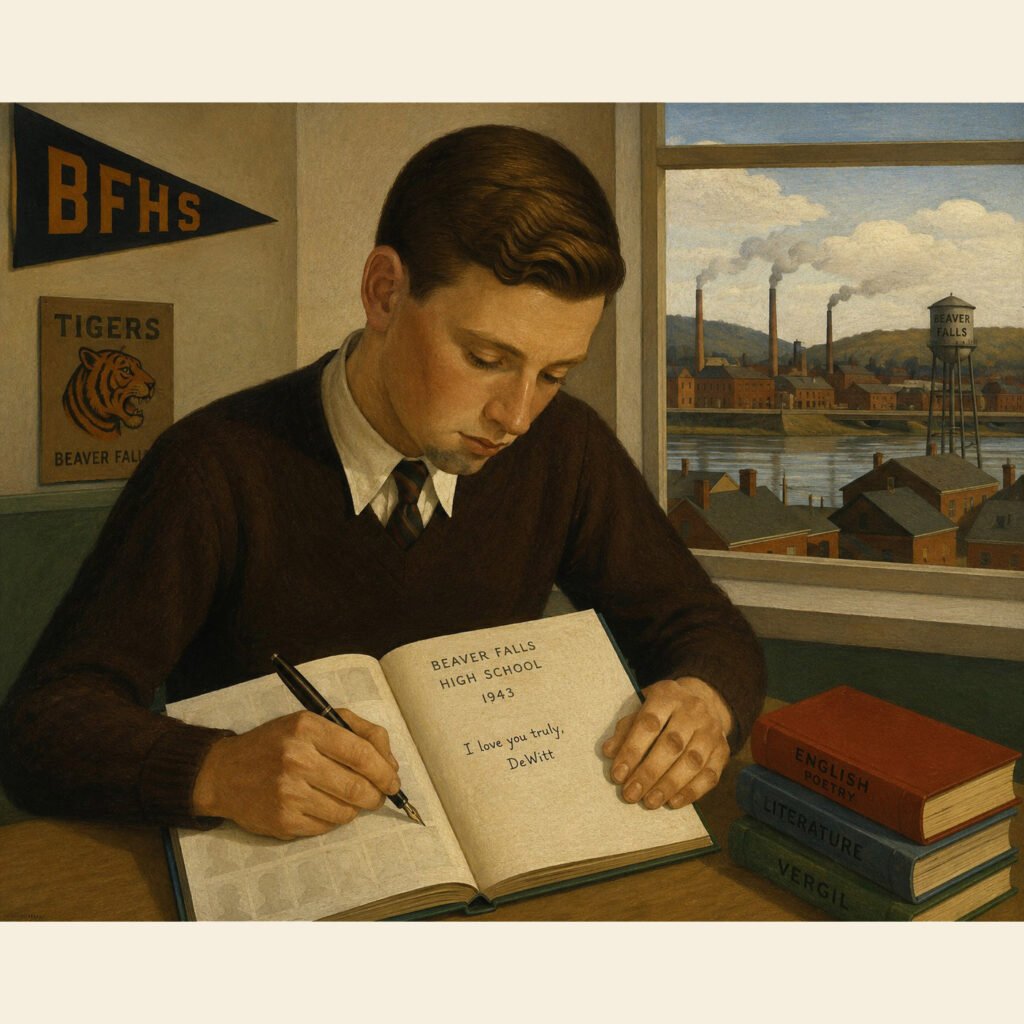
But when he signed that yearbook in the spring of 1943, he wasn’t a literary giant. He was a seventeen-year-old boy from Beaver Falls.
Seventeen-year-old boys are not generally celebrated for emotional courage. Their genius usually runs toward pretending not to have any emotions at all. Yet there, in my mother’s Beaver Falls High School yearbook, is the unmistakable evidence that young DeWitt Snodgrass briefly overcame this masculine affliction and wrote four words that must have left him wondering for weeks whether he’d made the biggest mistake of his life.
It must have taken an astonishing amount of courage.
People who have forgotten what it was like to be seventeen imagine adolescence was all football games, soda fountains, and the occasional victory dance after passing algebra. They have conveniently erased the terror of speaking to someone you admired. Asking a girl to the movies required weeks of planning, three rehearsals in front of the bathroom mirror, and enough resolve to survive the possibility that she might say no while two of her friends stood within earshot.
Writing “I love you” in her yearbook was the emotional equivalent of crossing Niagara Falls on a tightrope.
My mother and DeWitt were classmates and friends. She always described him as quiet, thoughtful, and exceptionally bright. He wasn’t the fellow who walked into a room expecting everyone to notice him. He was more likely to slip into the corner and notice everyone else.
That, as it turns out, is excellent preparation for becoming a poet.
After graduation, Snodgrass attended Geneva College before serving in the Navy during World War II. He eventually found his way to the Iowa Writers’ Workshop, where he studied among a generation of young writers who would transform American literature.
If you’ve never heard of the Iowa Writers’ Workshop, don’t feel badly. Neither had most of America. But among writers, mentioning it is a little like telling baseball fans you once played shortstop for the Yankees.
Then came Heart’s Needle.
Published in 1959, the collection chronicled the anguish of losing custody of his young daughter after divorce. Today that may sound like the premise of an afternoon podcast. In 1959 it was something altogether different.
Poets, at least respectable ones, weren’t supposed to admit they had made a mess of their personal lives. They wrote about mythology, noble ideals, or landscapes that somehow never seemed to contain overdue bills or broken marriages. Snodgrass wrote about pain.
Real pain.
The kind that sits across the breakfast table after everyone else has left the room.
The literary world was stunned. Heart’s Needle won the Pulitzer Prize for Poetry in 1960 and helped usher in what critics came to call “confessional poetry.” Snodgrass never cared much for the label, and I can’t say I blame him. “Confessional poet” sounds less like a literary achievement than something requiring a twelve-step program.
What distinguished Snodgrass wasn’t that he confessed things. Plenty of people confess things. Spend five minutes on social media and you’ll learn more about complete strangers than you ever wanted to know.
Snodgrass did something much rarer.
He told the truth beautifully.
I’ve often wondered what my mother thought when she first opened that yearbook.
Did she smile?
Did she blush?
Did she show it to her girlfriends, who undoubtedly conducted the sort of forensic analysis teenage girls have performed since the invention of ink? “What do you suppose he meant by ‘truly’?”
Did she have the faintest notion that the quiet young man signing her yearbook would someday win the Pulitzer Prize?
Almost certainly not.
The future has a habit of disguising itself as the boy sitting two rows over in English class.
Snodgrass went on to publish more than thirty books, teach at major universities, and influence generations of American poets. His work helped convince writers that ordinary family life—love, divorce, guilt, children, regret—could be the subject of serious literature.
Literary critics have spent decades explaining why W. D. Snodgrass mattered. They have analyzed his imagery, his meter, his symbolism, and his influence on modern poetry.
All worthwhile pursuits.
But I suspect my mother’s yearbook tells us something just as important.
Long before William DeWitt Snodgrass found the courage to write poems that would move readers around the world, he first found the courage to write four honest words to a girl he admired.
Sometimes the first draft of greatness appears in a high school yearbook.