Listen to a podcast discussion about this article.
It was Labor Day 1954, and President Dwight D. Eisenhower—laid up in Denver recovering from a heart attack—didn’t even bother traveling to Shippingport, Pennsylvania, for the groundbreaking of America’s first full-scale commercial nuclear power plant. Instead, in a bit of Atomic Age showmanship that must have delighted every Boy’s Life subscriber in America, Ike waved what newspapers called a “neutron wand” over a detector in Colorado. The signal flashed 1,200 miles east to the Ohio River Valley, where a bulldozer obediently scooped the first shovelful of dirt.
You have to admire a civilization that once treated nuclear engineering with the breezy confidence of a Kiwanis Club pancake breakfast.
Westinghouse Electric Corporation designed the pressurized-water reactor. Duquesne Light Company would operate it. The whole enterprise marched beneath Eisenhower’s hopeful “Atoms for Peace” banner, back when Americans still believed technology might improve life instead of merely spying on it and suggesting products we forgot to buy.
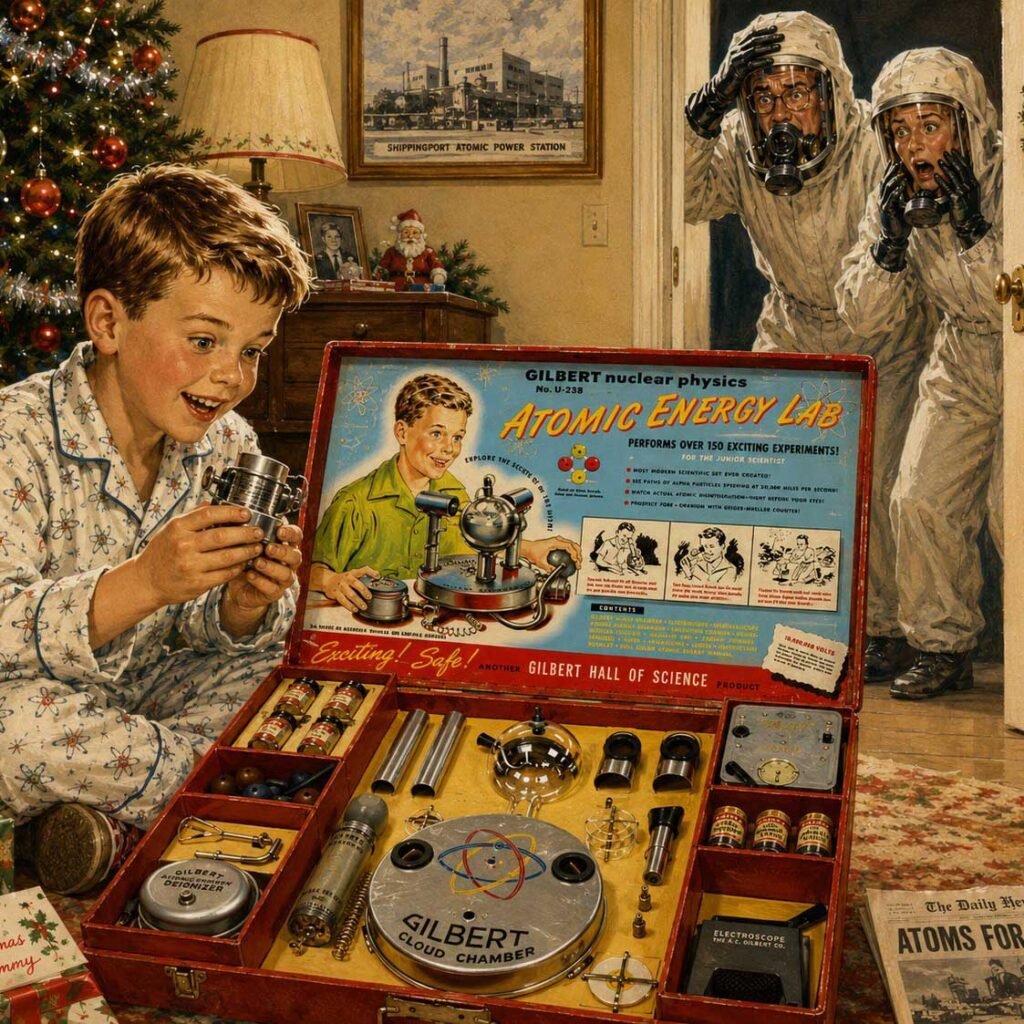
Nobody in Beaver County was fretting over mutant catfish or glow-in-the-dark deer wandering around Midland. People imagined electricity so plentiful and cheap your toaster might eventually develop self-esteem. Construction moved with the brisk competence of an era before environmental impact statements became longer than Russian novels. By December 1957—barely three years later—Shippingport was feeding power into the grid. Today it takes longer than that to get approval for a Sheetz parking-lot redesign.
By the late 1960s and early ’70s, nuclear energy looked less like science fiction than common sense. Plants routinely took five years to build. The public, still flushed with postwar optimism and color television, regarded atomic power as the logical next chapter after rural electrification. Scientists handled radioactive materials with a casualness that would today cause three federal agencies to faint dead away. Many of them lived perfectly long lives, apparently unaware they were supposed to expire dramatically for the benefit of cable documentaries.
Then America discovered fear as a governing philosophy.
In 1975 regulators adopted the ALARA principle—“As Low As Reasonably Achievable”—alongside the wonderfully reassuringly named Linear No Threshold model, which essentially declared that any radiation exposure whatsoever, no matter how microscopic, might someday turn you into a medical cautionary tale. Suddenly your dental X-ray was discussed in tones previously reserved for Soviet missiles.
This was awkward, because radiation is about as exotic as dirt. We live bathed in it. Cosmic rays fall from the heavens. Radon seeps from rocks. Potassium in bananas emits radiation. Folks in Denver absorb substantially more radiation than people at sea level, yet somehow continue skiing, jogging, and purchasing artisanal coffee without collapsing into luminous puddles. Sherpas on Everest receive radiation doses that would make a suburban zoning board clutch its pearls, yet stubbornly refuse to develop supervillain origin stories.
Facts, unfortunately, make terrible television.
Regulations multiplied like rabbits on government grants. Industry standards ballooned from 400 pages in 1970 to roughly 1,800 by 1978. New rules arrived so rapidly that crews often ripped out completed work simply because somebody in Washington had experienced a fresh revelation between lunch and supper. According to the Congressional Budget Office, delays on major projects could bleed roughly $44 million per month in interest and another $20 million in lost revenue. Nuclear plants that once took five years stretched into ten, twelve, even fourteen-year ordeals. Utilities hemorrhaged money. Investors fled like Baptists at a whiskey tasting.
The industry that promised abundant electricity became trapped in a perpetual séance conducted by lawyers.
Then came Three Mile Island accident in 1979—Pennsylvania’s great contribution to the national nervous breakdown. A stuck valve and operator errors caused a partial meltdown near Harrisburg. Television stations responded as though Godzilla had surfaced in the Susquehanna. Americans stocked basements with iodine tablets and behaved as though central Pennsylvania were moments from resembling the surface of Mars.
Yet detailed studies by the NRC, EPA, and other agencies found the radiation release remarkably small. Average exposure within ten miles measured about eight millirem—roughly equivalent to a chest X-ray. No deaths. No injuries. No detectable long-term cancer spike. The principal casualty was the American nervous system.
But fear, once institutionalized, never willingly retires.
And so we spent the next four decades treating nuclear power like an unstable uncle at Thanksgiving while embracing supposedly “safe” alternatives requiring landscapes the size of Rhode Island. Matching a modern nuclear plant’s output requires staggering amounts of land for solar and wind. Wind turbines kill protected birds and wear out in a couple decades before their blades head off to giant landfills where future archaeologists will presumably mistake them for the ribs of some extinct fiberglass dinosaur. Nuclear plants, meanwhile, can operate for 80 years or more on compact sites with fuel stored safely in concrete casks sturdy enough to survive just about everything short of a Michael Bay movie.
But fear has never been especially fond of arithmetic.
Now comes the delicious irony. The same technology companies that spent years lecturing the rest of us about solar virtue have discovered that artificial intelligence consumes electricity the way teenage boys consume frozen pizza. AI data centers require enormous amounts of uninterrupted, carbon-free power around the clock. Suddenly nuclear energy—the wallflower everybody mocked at the dance—looks like the only adult left in the room.
Westinghouse Electric Corporation is once again at the center of it all, developing Small Modular Reactors derived partly from technology perfected in the U.S. Navy’s nuclear fleet. For seventy years the Navy has operated more than 200 nuclear-powered vessels without a reactor meltdown, which is a better safety record than most kitchen appliances. These SMRs are designed to be factory-built, standardized, and assembled far faster than the lumbering custom megaprojects of old.
Now companies like Amazon, Google, and Microsoft are suddenly enthusiastic because windmills, for all their moral superiority, have an unfortunate habit of stopping when the wind does.
Sitting here in western Pennsylvania, watching electric bills rise while politicians explain why modern civilization requires us to dim the lights and feel virtuous about it, one begins to suspect the real danger was never the atom itself. The danger was our peculiar national talent for transforming engineering problems into apocalyptic morality plays.
Radiation is part of life on Earth. We evolved in it. The atom was never skulking around plotting humanity’s destruction like a Bond villain with a glowing briefcase. What crippled nuclear power was regulatory paralysis, lawsuit culture, and a civilization increasingly convinced that absolute safety is achievable if only enough consultants are hired.
If the coming SMR renaissance succeeds, historians may eventually place the Great Nuclear Panic alongside Y2K and 1960s fears that jet travel would scramble the human brain—another chapter in America’s long tradition of terrifying itself silly.
And somewhere along the Ohio River, in the shadow of old Shippingport, the punchline may finally arrive. The Pittsburgh engineers are dusting off their tools again. The atom is back. And after fifty years of frightening ourselves half to death over phantom dangers, we may discover the lights stay on just fine after all.