Listen to a podcast discussion about this article.
There was a time when every mayor, borough manager, economic development consultant, and chamber of commerce president in America woke up each morning asking the same question:
“How do we get more people?”
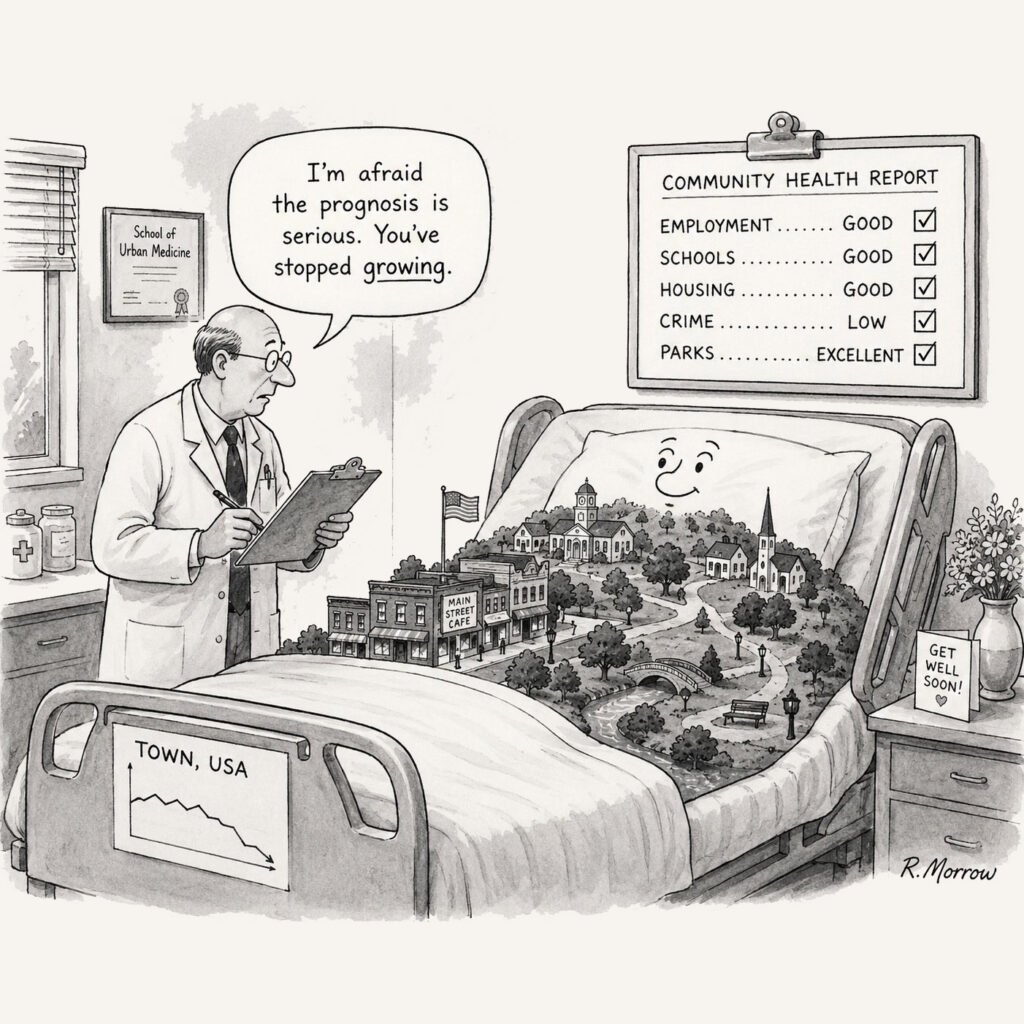
The assumption behind the question was simple enough. More people meant more houses, more taxpayers, more stores, more jobs, more restaurants, more Little League teams, more church picnics, and more opportunities to complain about traffic.
Growth was good.
Decline was bad.
And anybody who suggested otherwise was generally escorted from the room before they could contaminate the coffee.
The trouble is that reality has developed an annoying habit of refusing to cooperate.
A recent analysis of census data shows that while the City of Pittsburgh added roughly 4,500 residents between 2020 and 2025—the first sustained growth the city has enjoyed in about seventy years—the broader eight-county region lost nearly 35,000 people during the same period.
In other words, Pittsburgh gained a few passengers while the bus itself was getting lighter.
That raises an uncomfortable question: What if population growth is no longer the most useful measure of success?
For generations, we have treated population numbers the way baseball fans treat batting averages. Bigger is always better. A growing community is presumed healthy. A shrinking community is presumed sick.
Yet some of the most desirable places in the world are growing slowly or hardly growing at all.
People don’t move to Zurich because it’s adding residents at a breathtaking rate. They move there because it’s clean, prosperous, safe, and pleasant.
Likewise, Vienna doesn’t spend its days obsessing over population charts. It focuses on quality of life.
The same principle applies closer to home.
A town isn’t successful because more people live there.
More people live there because the town is successful.
Those are not the same thing.
The distinction matters because many communities across Western Pennsylvania continue to chase population targets that may never return.
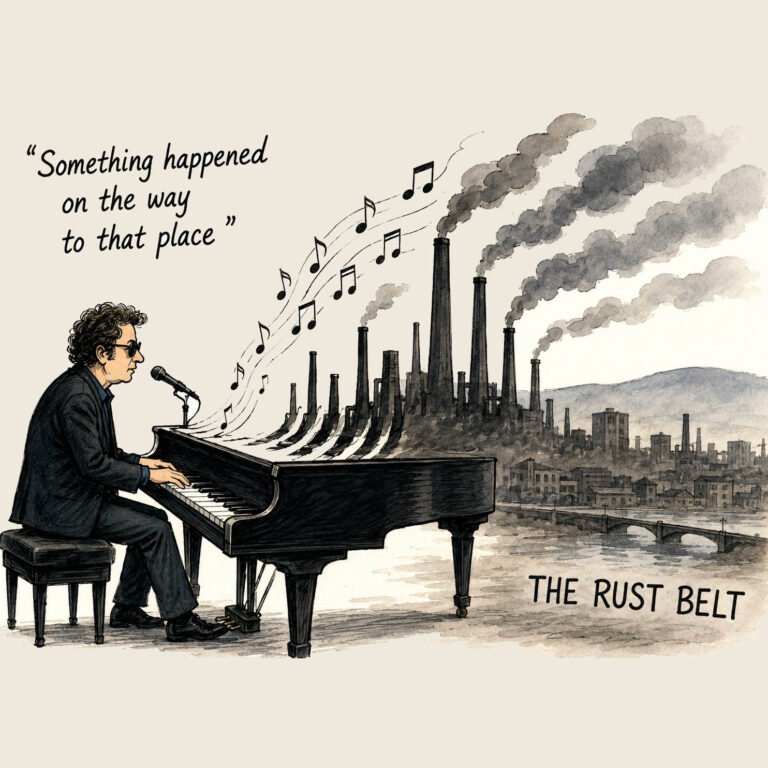
Consider Braddock. Andrew Carnegie built his first steel mill there in the nineteenth century. At its peak, the borough had more than 20,000 residents.
Today it has fewer than 2,000.
No amount of wishful thinking is likely to bring back the other 18,000.
Youngstown, Ohio, faced the same reality after the collapse of the steel industry. Former Mayor Jay Williams made headlines years ago when he proposed something that sounded almost heretical: planning for the city Youngstown actually was instead of the city everyone wished it still might become.
The idea became known as “managed decline.”
That phrase sounds about as appealing as “scheduled root canal,” but the concept contains a certain hardheaded wisdom.
If your town has 5,000 residents, it may make more sense to plan for 5,000 residents than for an imaginary future population of 15,000.
That doesn’t mean giving up.
It means giving up illusions.
Here in Beaver County, we occasionally suffer from the same growth addiction.
For decades, local leaders measured success by comparing today’s population to what existed when J&L Steel, Crucible, Babcock & Wilcox, and other industrial giants employed thousands of workers.
By that standard, every year looks disappointing.
Aliquippa once had more than 27,000 residents. Today it has roughly a third of that number.
Ambridge has experienced similar declines.
The population isn’t coming back simply because somebody produces a glossy brochure promising that it will.
Yet both communities possess assets their larger predecessors never imagined: walkable neighborhoods, historic architecture, lower housing costs, riverfront access, and proximity to Pittsburgh International Airport and the emerging energy and AI economy.
The question is not whether Aliquippa becomes 1955 again.
The question is whether Aliquippa becomes the best version of 2026.
Those are entirely different goals.
The same might be said of Beaver County as a whole.
Our future prosperity may not be measured by whether we add 50,000 residents. It may be measured by whether the people already here can find good jobs, affordable housing, safe neighborhoods, quality schools, reliable infrastructure, and reasons to stay.
A county that loses a few residents while becoming wealthier, safer, cleaner, and more economically resilient may be doing better than a county that gains population while struggling with congestion, rising costs, and declining quality of life.
That’s not surrender.
That’s arithmetic.
The reality is that much of America is entering a period where growth will be slower, aging populations will be common, and competition for residents will become increasingly intense.
In such an environment, honesty becomes more valuable than optimism.
Communities that acknowledge demographic realities can adapt.
Communities that spend their time waiting for the return of a vanished past may find themselves endlessly chasing ghosts.
The goal should not be growth for growth’s sake.
After all, cancer grows.
The goal should be prosperity.
If population growth follows, wonderful.
If it doesn’t, but the community remains a place where people want to live, work, raise families, and spend their Saturday afternoons, that sounds like success to me.
Even if the census bureau refuses to give us a trophy for it.