Listen to a podcast discussion about this article.
I grew up in that vanished American era — the 1950s and 1960s — when the Western was not merely a form of entertainment but a kind of national weather. It was always on. Gunsmoke. Have Gun—Will Travel. Death Valley Days. Bonanza. The Rifleman. Wagon Train. If you sat still long enough in front of a television set, sooner or later a man in a hat would ride into town, squint at a stranger, and settle a moral question with a revolver.
This was true even in places like Beaver County, where the real economy rested not on horses and cattle but on mills, rail sidings, machine shops, and men coming home with soot on their collars. Never mind. Boys still walked around imagining they lived in a world where men rode the range, drank in saloons, and dueled in dusty streets at high noon. Every boy wanted a Red Ryder BB gun for Christmas, or a Fort Apache play set, or one of those Mattel six-shooters slung low on his hips.
And then there were the old-timers.
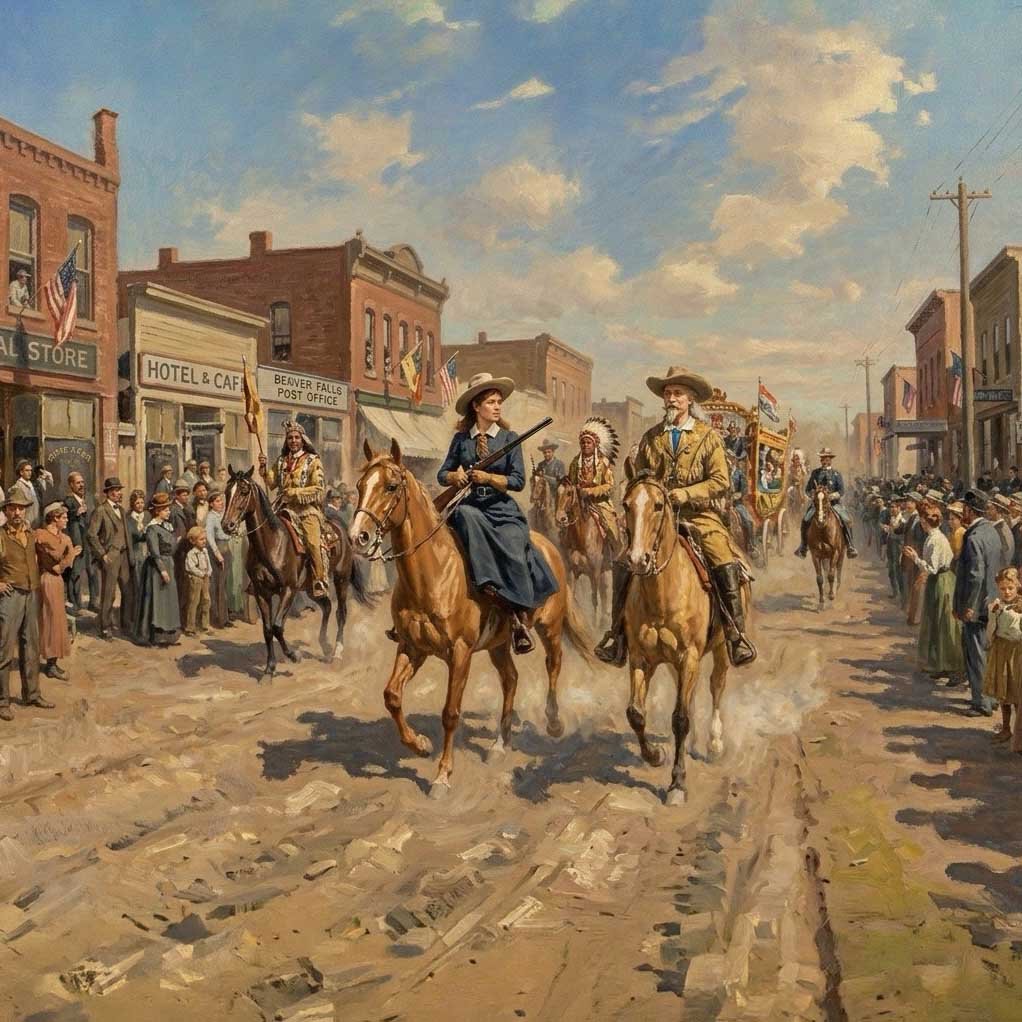
When I was young, old men in Beaver County would sometimes speak of Buffalo Bill and Annie Oakley as though they might stroll back up Seventh Avenue at any moment. It was a glorious time to be young in America, especially in Beaver County, where even a child surrounded by steel and smoke could still half-believe he lived in the West.
The odd thing is that, in a sense, Beaver County really did.
Buffalo Bill’s Wild West Show came here not once, but four times in its officially remembered form, with Beaver Falls serving as the railroad stop. The confirmed dates were December 17, 1885; July 28, 1899; June 18, 1908; and July 4, 1911. Local memory also preserves a 1910 appearance featuring Buffalo Bill and Annie Oakley in upper Beaver Falls, on a field later used as a swimming pool site. So for a stretch of years, the most famous showman in America and the most famous woman with a rifle were not just names in dime novels. They were physically here, unloading from trains, parading through town, and stirring Beaver County into one of its recurring fits of public excitement.
The arrangement had a fine old-fashioned grandeur. The troupe would arrive by rail in Beaver Falls, because railroads, after all, were the internet of that age. Out came riders, horses, equipment, buffalo, and the assorted machinery required to recreate the frontier for people who had never been west of East Palestine. From there, the company would parade or march toward Junction Park, in the Beaver Falls–New Brighton area, where the actual performance took place. Before a ticket had even been collected, the show had already turned itself into a civic occasion.
And what an occasion it must have been.
Imagine Beaver County, still industrializing, proud, practical, and suddenly interrupted by a pageant of cowboys, Native American performers, crack shots, international riders, and Buffalo Bill himself, with his flowing hair and theatrical dignity. In an era before movies and long before television, the world had to come to you. Buffalo Bill obliged by bringing not just the world, but an embroidered, brass-buttoned, heavily advertised version of it, complete with dust, music, horses, and gunfire.
The appeal in a place like Beaver County is not hard to figure out. Working people, then as now, were not opposed to spectacle. A man who had spent six days around molten steel or machine grease was not likely to turn down an afternoon of trick riding, sharpshooting, stagecoach attacks, buffalo hunts, and patriotic commotion. The show promised condensed magnificence: a year’s visit to the West in three hours. It offered a romantic frontier to people whose own frontier had already been replaced by pay envelopes, trolley lines, and the noon whistle.
It also offered authenticity, or something near enough for show-business purposes. Buffalo Bill was no invented hero. William F. Cody was already a legend, polished by scouting, stagecraft, newspaper mythology, and the American habit of turning a living man into a monument. Annie Oakley, meanwhile, was not merely a performer but an astonishment — a woman who could outshoot nearly anybody and do it with such poise that whole grandstands must have stared in disbelief.
Her 1910 appearance in upper Beaver Falls seems to have lodged especially firmly in local memory. This was apparently a more intimate, star-centered event than the full Wild West extravaganza. Cody and Oakley led the parade. Hundreds arrived by trolley to the field, and hundreds more lined Seventh Avenue. One can picture the scene without much effort: boys standing on tiptoe, women shading their eyes, men pretending not to be impressed while trying hard not to miss anything. Long before celebrity culture became a national affliction, Beaver County already understood the pleasure of seeing famous people in the flesh.
And Annie Oakley was worth the wait. She split playing cards edgewise. She hit targets behind her by aiming with a hand mirror. She could shoot tossed coins and snuff ashes from a cigarette with the kind of accuracy that ought to have made spectators review their own ambitions. She turned marksmanship into choreography. There was danger in it, yes, but also elegance and theater.
Then came July 4, 1911, perhaps the most notable Buffalo Bill occasion of them all. By then the production had become the combined Buffalo Bill’s Wild West and Pawnee Bill’s Great Far East show — the so-called “Two Bills Show.” If the original Wild West had not been extravagant enough, America had decided to add elephants, international acts, and a broader carnival of empire. The company arrived by train at Beaver Falls, paraded through New Brighton, and performed at Junction Park on Independence Day. That was timing worthy of a born showman. If you were going to wrap the fading frontier in patriotism, you might as well do it on the Fourth of July.
By 1911, the real West had already been packed away into history, memory, and merchandise. Modernity was moving in, and financial trouble was beginning to nip at Buffalo Bill’s enterprise. Yet that only deepened the appeal. The show offered audiences not the West as it had been, but the West as Americans preferred to remember it: bold, colorful, dangerous, moral, and permanently available for matinee performances.
That version of the West lasted a long time. It survived into my own boyhood in reruns, toy guns, comic books, and the solemn conviction that a pair of cap pistols could improve a young man’s character. Long after Buffalo Bill was gone, Beaver County boys still lived partly in his world.
And perhaps those old-timers who spoke of Buffalo Bill and Annie Oakley as though they were regular callers on Seventh Avenue were not confused at all. They understood something children understand too: once a grand spectacle enters a town, it never entirely leaves.
The tents come down. The train pulls out. The horses disappear. The mills keep running.
But the story stays.