Listen to a podcast discussion about this article.
There was a time when the moral risk at the local gas station ran to cigarettes, lottery tickets, and a glazed pastry that had clearly lost the will to live sometime during the Clinton administration. Today the modern convenience store has grown more ambitious. Alongside the energy drinks and beef jerky, you may now find a retail chemistry set of intoxicants, quasi-intoxicants, “supplements,” mystery gummies, and novelty glassware sold with the sort of straight face usually reserved for campaign season.
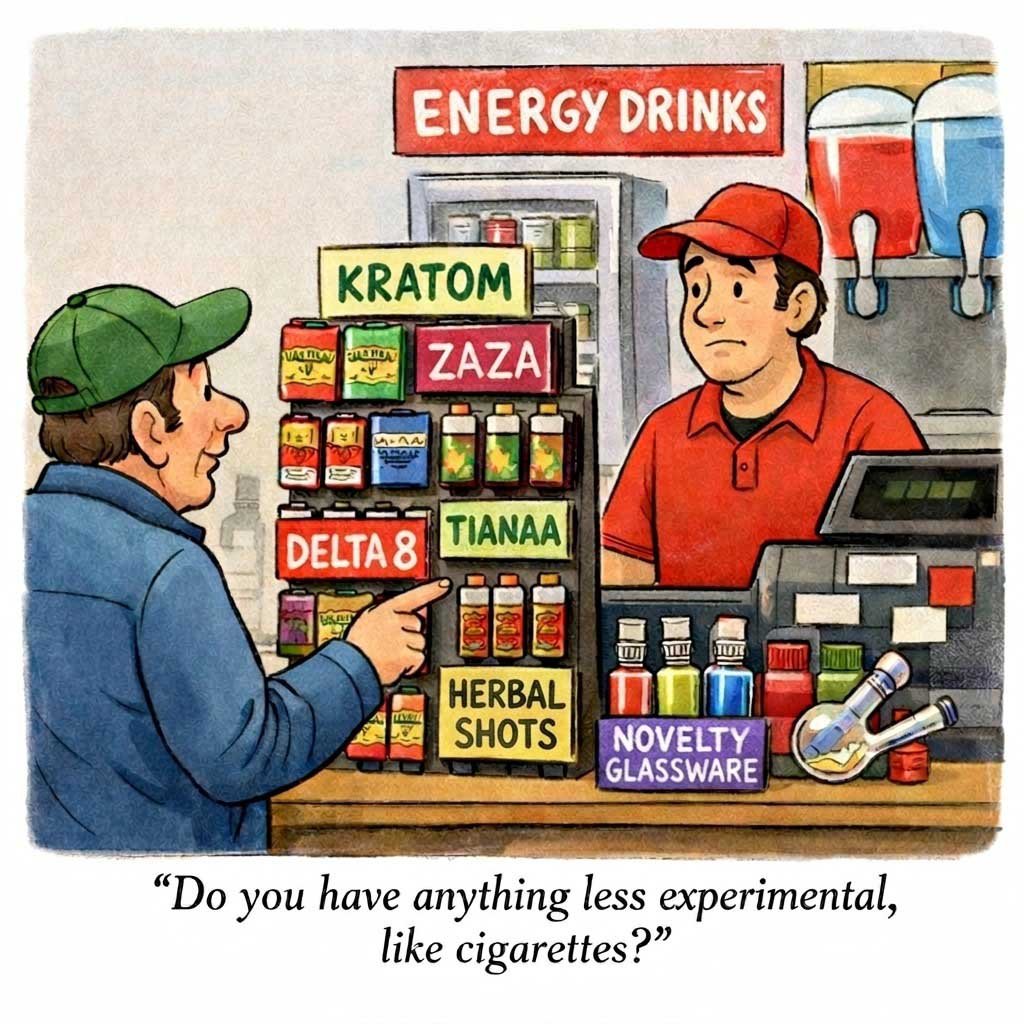
This isn’t chiefly a vice story. It’s a business story. These products are on the shelf for the same reason anything else is on the shelf: somebody makes money on them. They’re compact, shelf-stable, highly marked up, and often pitched as legal, herbal, or wellness-adjacent. That’s a marvelous arrangement for the seller, right up to the moment the county coroner, the poison center, the FDA, or the legislature begins taking a sharper interest in your merchandise mix.
Take kratom and 7-hydroxymitragynine, or 7-OH, the latest entrant in the great American tradition of selling trouble in cheerful packaging. Pennsylvania’s Department of Health warned in 2025 that products marketed as kratom and 7-OH are increasingly sold online, in smoke shops, and at gas stations. The same advisory reported 167 poison-center exposure cases in Pennsylvania from January 2022 through June 2025, including 81 cases of significant illness. Naloxone was used in 25 of them, and 14 people needed mechanical ventilation. That’s a long way from the harmless image suggested by words like “plant-based” and “herbal.”
The FDA got interested too, which is seldom a sign that a retail category is entering its golden age. In July 2025, the agency said 7-OH products pose opioid risks and announced steps to restrict them, noting that companies had been distributing tablets, gummies, shots, and drink mixes containing the substance. By December, the FDA had escalated further, seizing concentrated 7-OH products and calling them potent opioids. In other words, this isn’t a dispute over chamomile tea. It’s a fight over products the government now sees as a genuine threat to consumers.
For Beaver County, the local angle doesn’t require much imagination. We don’t live under a bell jar. If these products are showing up in Allegheny County poison data, in statewide health advisories, and in the sort of stores found all over western Pennsylvania, then they’re part of the same retail ecosystem that serves Monaca, Center, Economy, Beaver Falls, and the rest of the county. The question for local business owners isn’t whether the trend exists. It’s whether they want to be associated with it when the backlash arrives.
Then there’s tianeptine, charmingly nicknamed “gas station heroin,” which is not the sort of branding exercise most chambers of commerce would encourage. The FDA says tianeptine isn’t approved for any medical use in the United States, yet products containing it have been sold to consumers while making claims about anxiety, depression, pain, and brain function. The agency has linked these products to serious harm, overdoses, and death, and it warns that easy availability, including at gas stations, can fool consumers into thinking they’re safe. That’s one of the oldest tricks in retail: if it’s sold beside the counter display of phone chargers, it must be respectable.
Delta-8 THC and the broader family of intoxicating hemp products occupy a similar commercial gray zone. The FDA says delta-8 products haven’t been evaluated or approved for safe use and may be marketed in ways that put public health at risk. Last fall, Pennsylvania Attorney General Dave Sunday joined a bipartisan push urging Congress to close loopholes that have allowed hemp-derived intoxicants to spread without uniform age limits, labeling rules, or testing standards. Retailers who’ve convinced themselves this whole category will remain forever murky may want to keep an eye on Harrisburg and Washington. Murk rarely stays profitable forever.
Even the old retail standbys deserve mention: glass tubes sold as “love roses,” “oil burners,” or aromatherapy accessories, though everyone in America over the age of twelve has a fairly good idea what many of them are really for. Pennsylvania law prohibits drug paraphernalia, but enforcement tends to arrive with less regularity than the delivery truck. So the stuff lingers in plain sight, sustained by that ancient retail custom of calling a thing by any name except the right one.
And that, finally, is the business problem. Short-term profit is easy. Reputation is harder. In a county like Beaver, store owners live among the people they sell to. Parents notice what’s near the register. Police notice patterns. ER doctors notice trends. So do school officials, pastors, and neighbors. A retailer may think he’s just moving product with a fat margin. The community may decide he’s doing something shabbier: monetizing addiction, confusion, and loopholes. Once that impression sets in, it doesn’t come off with a new coat of paint and a two-for-one coffee special.
The smart merchants in Beaver County have a choice. They can make a few extra dollars selling little packets of risk dressed up as convenience, or they can decide that not every legal gray area deserves shelf space. Sooner or later the laws will tighten, the regulators will circle, and the excuses will get less persuasive. As Mencken put it in the fuller version of the line so often attributed to him, “No one in this world … has ever lost money by underestimating the intelligence of the great masses of the plain people.” On this subject, too many retailers seem determined to test the proposition.