Listen to a podcast discussion about this article.
If you’ve ever tried to explain the Beaver County road system to an out-of-towner—why Route 51 seems to go everywhere and nowhere at once—you already possess the essential intellectual equipment required to understand quantum computing.
The only difference is that quantum computing makes Route 51 look orderly.
Let’s begin simply. A normal computer—the kind sitting on your desk or quietly judging you from your pocket—thinks in bits. A bit is like a light switch in your Bridgewater apartment: it is either on or off. Zero or one. No ambiguity. No philosophical crisis.
A quantum computer, however, prefers to keep its options open. Instead of bits, it uses something called “qubits,” which can be both zero and one at the same time. This condition is known as superposition, which sounds like a zoning dispute but is actually closer to being in two places at once—like claiming you’re in Beaver Falls and Aliquippa simultaneously, depending on who’s asking.
Now, if you have one qubit, that’s mildly interesting. If you have two, things get complicated. If you have 300, you are now dealing with more possible combinations than there are atoms in the known universe, which is roughly equivalent to trying to count all the opinions expressed at a Beaver County commissioners meeting.
This is where quantum computing begins to show off.
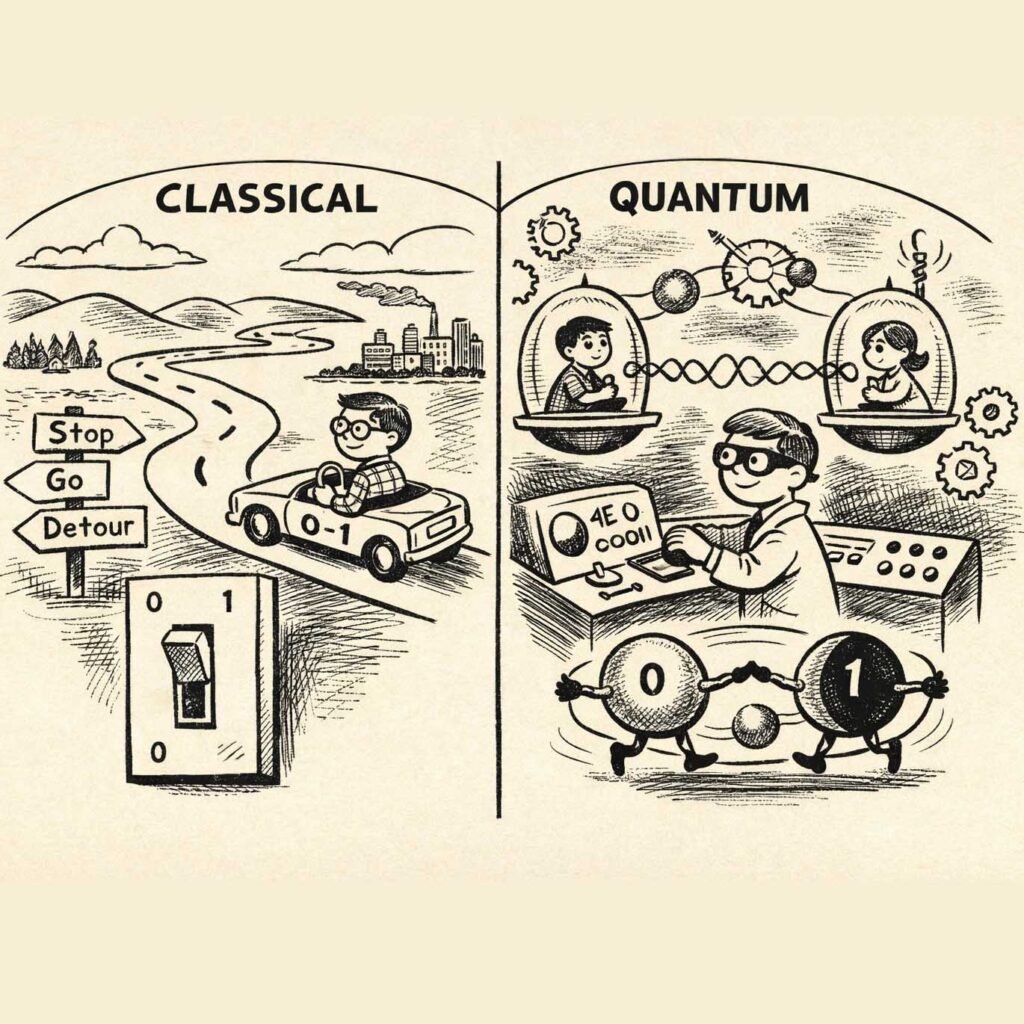
A classical computer solves problems step by step, like a methodical clerk at the courthouse flipping through files one at a time. A quantum computer, by contrast, looks at all the files at once—past, present, and possibly mislabeled—and somehow nudges the correct answer to the top of the pile.
It does this with another charmingly mysterious concept called entanglement. Entanglement means that two qubits become linked in such a way that whatever happens to one instantly affects the other, no matter how far apart they are.
In Beaver County terms, it’s like two cousins—one in Midland and one in Monaca—who somehow know exactly what the other is thinking at all times, without the benefit of a phone call, text message, or gossip chain at Sunday dinner. Einstein, who was not from Beaver County but would have appreciated the analogy, called this “spooky action at a distance.”
Now, once you’ve got your qubits happily existing in multiple states and gossiping across the universe, you need to do something with them. This is where quantum gates come in.
If classical computing is like following a recipe—add flour, stir, bake—quantum computing is more like improvising at a church potluck where everyone brings a casserole and nobody admits what’s in it. Quantum gates manipulate qubits in ways that amplify the right answers and quietly cancel out the wrong ones, a process known as interference.
Think of it as a crowd at a high school football game. The correct answer is the home team’s touchdown, which gets louder and louder as the crowd cheers. The wrong answers are the opposing team’s plays, which are politely booed into oblivion. By the time the game ends, there’s no doubt which outcome mattered.
Eventually, however, reality intrudes. You have to measure the result. And measurement in quantum computing is a bit like asking a room full of people in Beaver County where they want to go for dinner: all the possibilities collapse into one actual decision, usually after some debate and mild disappointment.
When you measure a qubit, its multiple possibilities collapse into a single answer—zero or one. Because of this, quantum computers often run the same calculation thousands or millions of times to make sure they’re not just guessing after a long day.
Now you might reasonably ask: what’s all this good for?
Quite a lot, as it turns out.
Quantum computers are especially good at problems that involve enormous complexity—things like breaking encryption, designing new materials, or simulating chemical reactions. Tasks that would take a classical computer longer than the lifespan of the universe could, in theory, be handled much more quickly by a quantum machine.
Which is excellent news for medicine and materials science, and slightly less comforting if your bank is still using yesterday’s encryption.
Before you panic, however, it’s worth noting that quantum computers are still in their awkward adolescence. Today’s machines are what experts call “noisy,” meaning they are extremely sensitive to their surroundings. A stray vibration, a bit of heat, or the quantum equivalent of someone slamming a door can cause the whole system to lose its delicate state—a problem known as decoherence.
To keep qubits stable, they must be cooled to temperatures colder than outer space, which makes your refrigerator look like a tropical resort. Even then, errors creep in, and fixing those errors requires more qubits, which introduces new challenges. It’s a bit like trying to fix potholes on Route 65 by adding more lanes—admirable in theory, complicated in practice.
Still, progress is being made. In early 2026, researchers demonstrated a breakthrough in error correction, suggesting that building larger, more reliable quantum systems is no longer just a theoretical exercise but an engineering problem—one that companies like Google and IBM are racing to solve.
The timeline? Optimists say the 2030s. Pessimists say later. Beaver County residents, seasoned by decades of industrial reinvention, will recognize this as the familiar rhythm of technological promise.
And here’s the final point, which may come as a relief: quantum computers are not going to replace your laptop. They are not especially good at checking email, writing columns, or ordering fish sandwiches during Lent. For everyday tasks, the old-fashioned binary world of zeros and ones works just fine.
Quantum computers are specialists. They are the brain surgeons of the computing world—extraordinary at certain tasks, unnecessary for others, and best handled by people who know exactly what they’re doing.
So if you take nothing else from this explanation, remember this: a classical computer is like driving from Beaver to Pittsburgh one road at a time. A quantum computer is like taking every possible route at once, then somehow arriving first.
And if that sounds impossible, don’t worry.
So does getting through Route 51 at rush hour